What Examiners Notice That Supervisors Sometimes Don't
Introduction
Many students assume that if their dissertation supervisor is happy with their work, their examiner will be too.
Unfortunately, that isn't always the case.
While supervisors provide guidance throughout your research journey, examiners assess your dissertation independently using the university's marking criteria. They often notice issues that supervisors may not focus on during regular meetings.
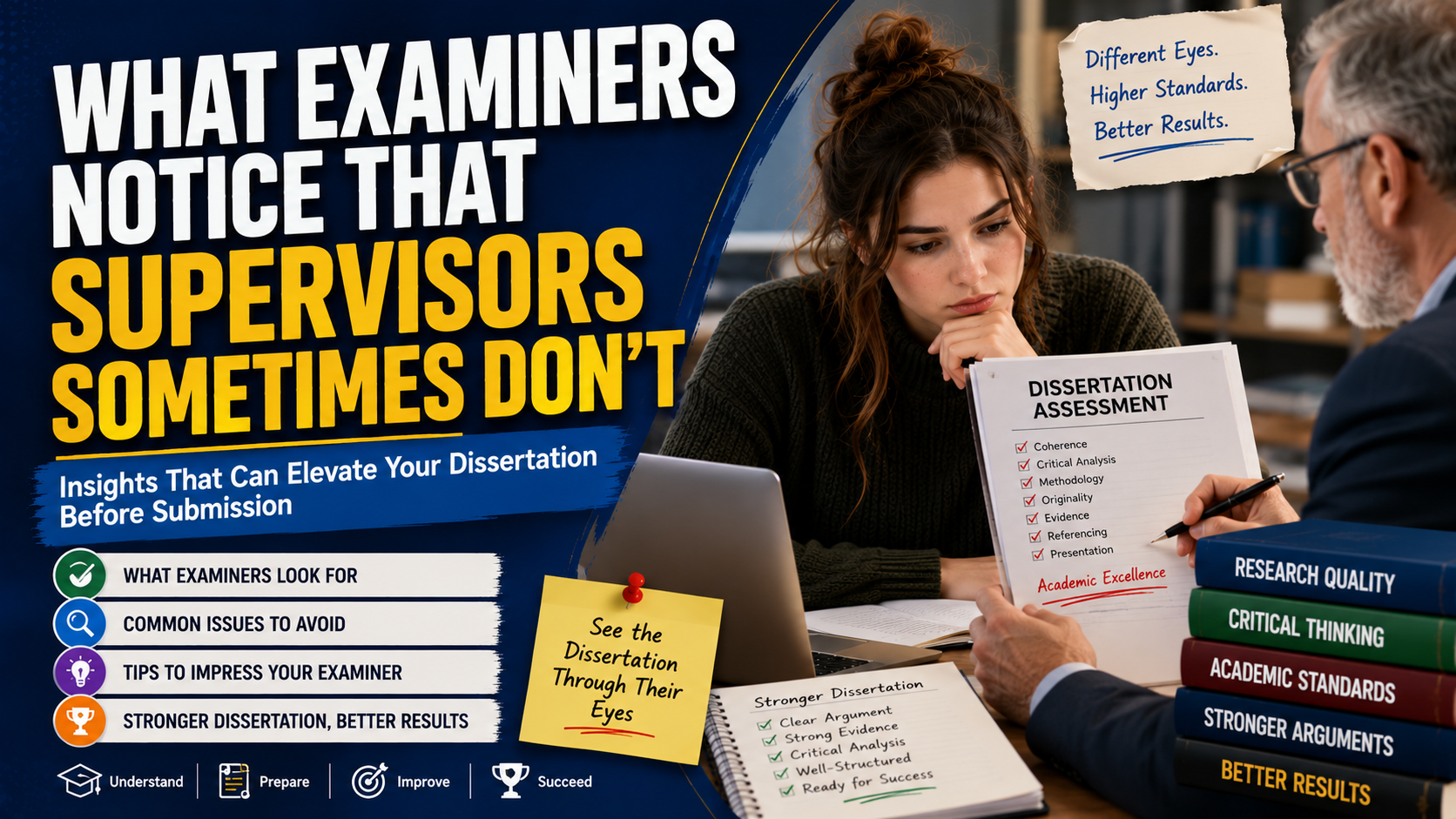
This doesn't mean your supervisor has missed mistakes. Instead, supervisors and examiners have different roles. Supervisors help you develop your research, whereas examiners evaluate the final dissertation against academic standards.
Understanding what examiners typically look for can help you strengthen your dissertation before submission and improve your chances of achieving a higher grade.
Supervisor vs Examiner: Different Responsibilities
Understanding the distinction is important.
Your Supervisor
A supervisor generally helps you:
Refine your research question.
Develop your methodology.
Improve your writing.
Provide constructive feedback.
Guide your research process.
Their role is supportive rather than evaluative.
Your Examiner
An examiner's responsibility is to determine whether your dissertation meets the university's assessment criteria.
They assess:
Academic quality.
Originality.
Critical thinking.
Research design.
Evidence.
Structure.
Referencing.
Overall coherence.
Because they approach the dissertation with fresh eyes, they often notice issues that developed gradually during the writing process.
1. Overall Coherence
Students often focus on individual chapters.
Examiners focus on the dissertation as one complete document.
They ask:
Does every chapter support the research question?
Is there a consistent argument?
Do conclusions match the findings?
Does the discussion answer the objectives?
A dissertation can contain excellent individual chapters while lacking overall coherence.
2. Consistency
Small inconsistencies quickly stand out.
Examples include:
Different terminology.
Changing chapter titles.
Inconsistent tense.
Mixed referencing styles.
Contradictory statements.
Different definitions of key concepts.
These issues reduce professionalism.
3. Alignment Between Research Question and Conclusions
One common weakness occurs when students gradually change direction.
Examiners check whether:
Research questions,
Objectives,
Methods,
Results,
Discussion,
Conclusions
all align with one another.
Misalignment can weaken the overall dissertation.
4. Critical Thinking
Supervisors often encourage students to "be more critical."
Examiners assess whether this has actually been achieved.
Strong critical analysis includes:
Comparing viewpoints.
Evaluating evidence.
Discussing limitations.
Explaining disagreements.
Justifying interpretations.
Simply summarising literature is rarely sufficient.
5. Justification of Research Decisions
Every methodological choice should be explained.
Examiners look for justification such as:
Why this research design?
Why this sample?
Why these participants?
Why these analytical techniques?
Well-justified decisions demonstrate research maturity.
6. Academic Writing Quality
Because supervisors read multiple drafts, they may become familiar with your writing.
Examiners read the dissertation as a new reader.
They quickly notice:
Awkward sentences.
Repetition.
Grammar issues.
Unclear transitions.
Wordiness.
Clear writing improves readability and strengthens academic arguments.
7. Referencing Accuracy
Minor referencing mistakes accumulate.
Common examples include:
Missing citations.
Incomplete references.
Incorrect formatting.
Different referencing styles.
Missing page numbers where required.
Accurate referencing demonstrates academic professionalism.
8. Original Contribution
Even undergraduate dissertations should demonstrate some originality.
Examiners ask:
What does this research contribute?
Does it offer a new perspective?
Does it apply existing theory differently?
Does it solve a practical problem?
Originality doesn't always mean discovering something entirely new.
9. Discussion of Limitations
Strong dissertations openly acknowledge limitations.
Examples include:
Small sample sizes.
Limited data access.
Time constraints.
Methodological weaknesses.
Discussing limitations demonstrates honesty and critical evaluation.
10. Presentation Quality
Presentation influences first impressions.
Examiners notice:
Formatting consistency.
Table numbering.
Figure captions.
Page numbering.
Appendix organisation.
Professional layout.
Presentation reflects attention to detail.
Final Proofreading Matters
Before submission, review your dissertation as though you were the examiner.
Ask yourself:
Does every chapter support my research question?
Are all arguments connected logically?
Is referencing completely consistent?
Have I explained every research decision?
Are grammar and formatting polished?
A fresh review often reveals issues that were previously overlooked.
Examiner Checklist
Area | Examiner Focus |
|---|---|
Research question | Clearly answered |
Structure | Logical progression |
Critical analysis | Strong evaluation |
Methodology | Fully justified |
Evidence | Supports conclusions |
Referencing | Accurate and consistent |
Originality | Demonstrated appropriately |
Presentation | Professional throughout |
Academic Integrity Remains Essential
Regardless of supervisor feedback, your dissertation must reflect your own independent work.
Ensure that you:
Cite all sources accurately.
Follow university referencing requirements.
Use AI tools only where permitted by institutional policies.
Produce original analysis and conclusions.
Academic integrity remains one of the most important assessment criteria.
Final Thoughts
A supervisor's guidance is invaluable throughout your dissertation journey, but the final assessment belongs to the examiner. Examiners approach your work with fresh eyes, focusing on how well every chapter works together, whether your arguments are supported by evidence, and whether your dissertation meets the university's academic standards.
Before submitting, take time to review your dissertation from an examiner's perspective. Check for consistency, strengthen critical analysis, justify your research decisions, and polish the presentation. By understanding what examiners typically notice—and addressing these areas in advance—you can submit a dissertation that is coherent, well-structured, and ready for independent assessment.
Frequently Asked Questions
Everything you need to know about our services


