Why Dissertation Feedback Feels So Confusing
Introduction
You've spent weeks researching, writing, editing, and finally submitting a dissertation chapter. A few days later, your supervisor returns it with dozens of comments.
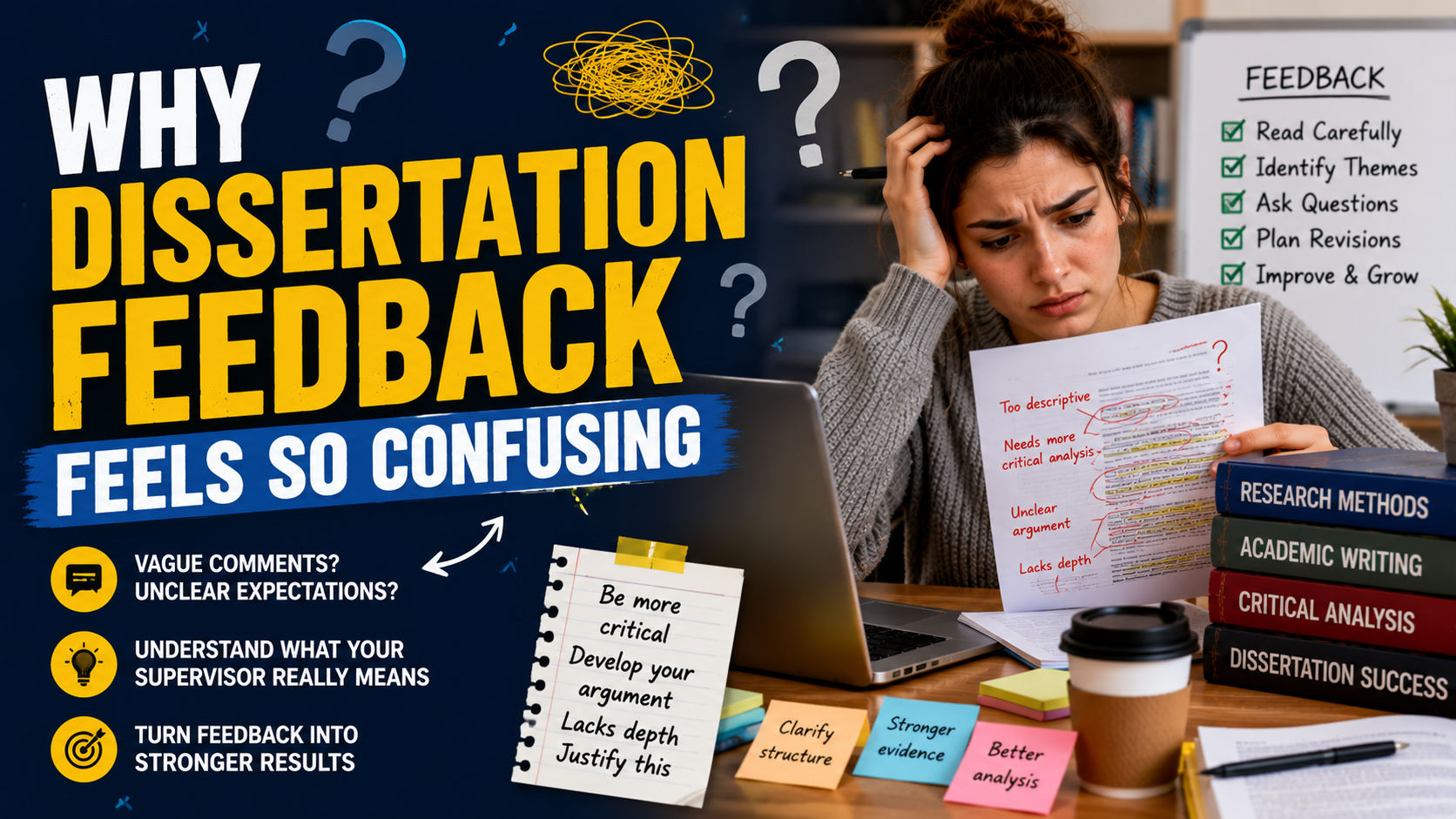
Some comments are straightforward:
"Correct the referencing."
"Expand this paragraph."
Others are far less clear:
Develop your argument.
Needs stronger critical analysis.
This lacks depth.
Clarify your position.
Strengthen your justification.
Many students stare at these comments wondering:
"What exactly am I supposed to change?"
If you've experienced this, you're far from alone. Confusing dissertation feedback is one of the most common challenges faced by university students. Fortunately, there are clear reasons why feedback often feels vague—and practical ways to interpret it effectively.
This guide explains why dissertation feedback can be difficult to understand and how to use it to produce a stronger final dissertation.
Why Supervisors Don't Always Give Detailed Instructions
Many students expect dissertation feedback to resemble corrections in school assignments.
University supervision works differently.
A supervisor's role is to:
Guide your academic thinking.
Encourage independent research.
Develop analytical skills.
Help you meet assessment criteria.
Prepare you for professional research.
Rather than rewriting your dissertation, supervisors often provide prompts that encourage you to improve your own work.
Academic Language Can Be Difficult
Many supervisor comments contain terminology that students are still learning.
Examples include:
Critical analysis
Synthesis
Conceptual framework
Theoretical perspective
Justification
Methodological rigour
Without experience, these terms may feel abstract.
Over time, you'll become more familiar with what they mean in practice.
One Comment Can Mean Several Things
A short comment often represents multiple improvements.
For example:
"Develop your argument"
Could involve:
Adding stronger evidence.
Explaining your reasoning.
Comparing opposing viewpoints.
Linking findings to your research question.
Improving paragraph structure.
A single sentence of feedback may require several revisions.
Every Supervisor Has a Different Style
No two supervisors communicate in exactly the same way.
Some provide:
Detailed explanations.
Examples.
Suggested readings.
Others write:
Brief notes.
Keywords.
Short questions.
Different styles don't necessarily indicate better or worse supervision—they simply reflect different approaches to academic mentoring.
Supervisors Expect Independent Thinking
One purpose of a dissertation is demonstrating independent research skills.
Because of this, supervisors often avoid telling students exactly what to write.
Instead, they encourage students to:
Evaluate evidence.
Question assumptions.
Make justified decisions.
Build original arguments.
Learning to interpret feedback independently is part of becoming a stronger researcher.
Common Dissertation Comments Explained
"Be More Critical"
This usually means:
Compare different studies.
Discuss strengths and weaknesses.
Evaluate evidence.
Explain why one viewpoint is more convincing.
Critical analysis goes beyond summarising research.
"Needs Justification"
This often means:
Explain why you:
Chose your methodology.
Selected participants.
Used particular theories.
Interpreted results in a certain way.
Academic decisions should always have evidence-based reasoning.
"Lacks Depth"
Your supervisor may want you to:
Expand explanations.
Include additional evidence.
Explore alternative viewpoints.
Connect ideas more effectively.
Depth comes from analysis—not simply adding more words.
"Clarify"
Readers may be struggling to understand your point.
Possible improvements include:
Shorter sentences.
Better organisation.
Stronger topic sentences.
Clearer transitions.
Read Feedback as a Whole
Rather than focusing on individual comments immediately, review every comment first.
Look for patterns.
You may notice repeated themes such as:
Structure
Analysis
Referencing
Methodology
Writing style
Repeated comments usually indicate the highest priorities.
Compare Feedback With Your Marking Criteria
Many comments directly reflect assessment requirements.
Review your dissertation rubric.
Typical marking categories include:
Knowledge.
Critical thinking.
Research quality.
Originality.
Organisation.
Academic writing.
Understanding the assessment criteria often makes supervisor feedback much clearer.
Ask Better Questions
If comments remain confusing, ask focused questions.
Instead of asking:
"I don't understand the feedback."
Try:
"Could you explain what you mean by 'develop the discussion' in Chapter Four?"
Specific questions usually produce specific answers.
Create an Action Plan
Transform comments into practical tasks.
Example:
Supervisor Comment | Action |
|---|---|
Develop argument | Add three supporting journal sources |
Improve analysis | Compare opposing viewpoints |
Clarify methodology | Explain participant selection |
Expand discussion | Interpret findings in greater depth |
Fix referencing | Review citations and bibliography |
This approach turns abstract feedback into achievable revisions.
Don't Let Feedback Affect Your Confidence
Receiving pages of comments can feel discouraging.
Remember:
Every dissertation improves through revision.
Feedback focuses on the document—not your ability.
Academic writing is an iterative process.
Even experienced researchers receive extensive reviewer comments before publication.
Constructive feedback is evidence that your work can be strengthened.
Academic Integrity During Revision
While revising your dissertation:
Cite every source accurately.
Follow your university's referencing style.
Use AI tools only where permitted by institutional policies.
Ensure your arguments and conclusions remain your own original academic work.
Feedback should guide your learning, not replace your independent thinking.
Confusing Feedback vs Clear Meaning
Supervisor Comment | What It Usually Means |
|---|---|
Develop your argument | Add evidence and explain your reasoning |
Be more critical | Evaluate and compare research |
Needs justification | Explain why you made decisions |
Lacks depth | Analyse ideas more thoroughly |
Clarify | Improve organisation and readability |
Expand discussion | Interpret findings in greater detail |
Final Thoughts
Dissertation feedback often feels confusing because it is designed to encourage independent learning rather than provide complete solutions. Supervisors use concise academic language to help students think critically, justify their decisions, and refine their research. Although comments may initially seem vague, they usually point toward meaningful improvements in analysis, structure, and academic writing.
By understanding common feedback phrases, reviewing comments alongside your assessment criteria, asking focused questions, and creating a structured revision plan, you can transform confusing feedback into a practical roadmap for success. Every thoughtful revision strengthens your dissertation and helps you develop the research and writing skills expected at university level.
Frequently Asked Questions
Everything you need to know about our services


