I Don't Understand My Supervisor's Feedback
Introduction
Receiving supervisor feedback is an important part of the dissertation process, but understanding that feedback is not always straightforward. Many students open a returned draft expecting simple corrections, only to find comments such as "Develop your argument," "Be more critical," or "Needs stronger justification." These remarks can feel vague, leaving students unsure about what to change.
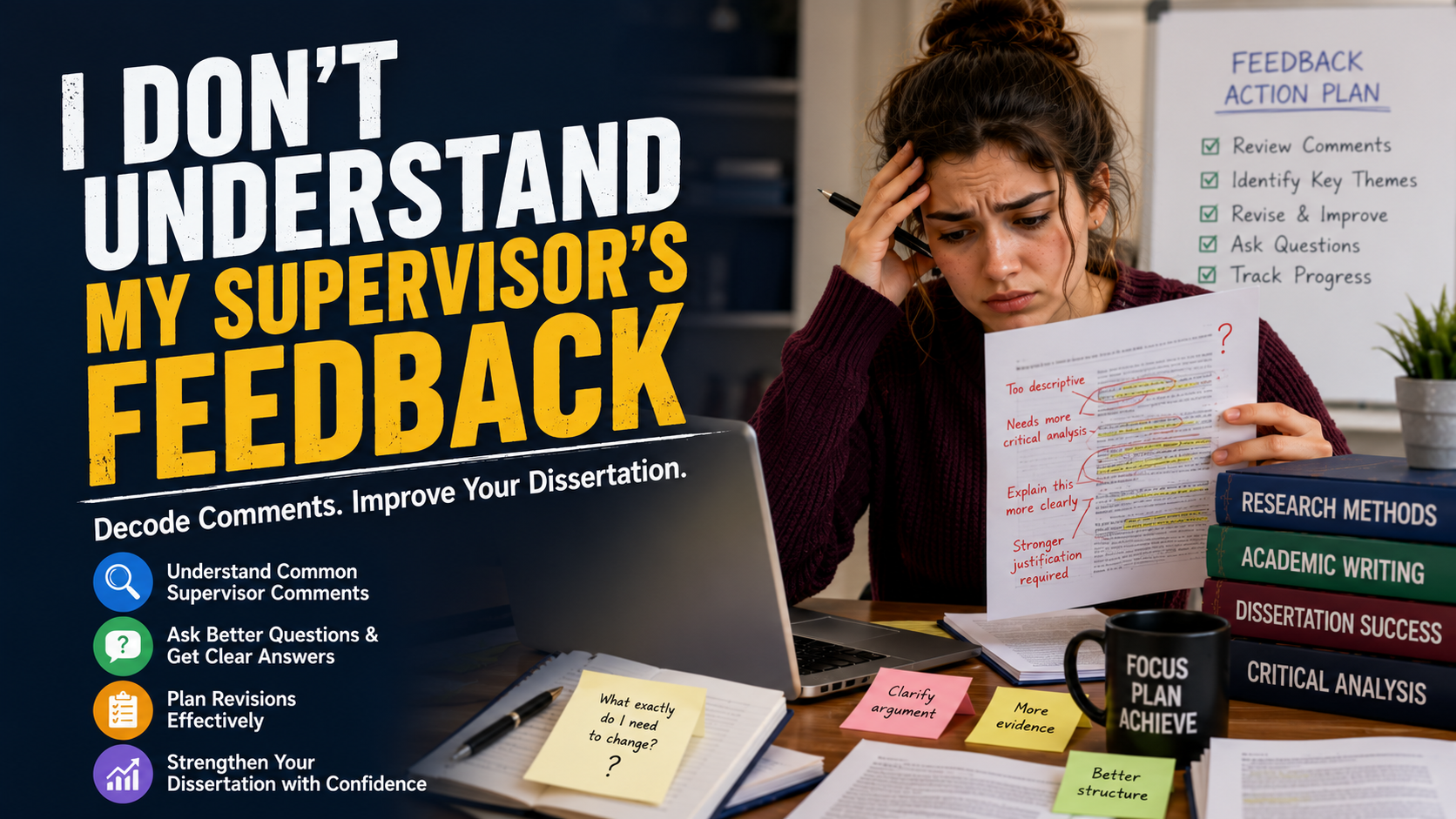
The good news is that this experience is extremely common. Supervisors often use academic terminology because they expect students to engage with ideas independently rather than follow step-by-step instructions. Learning how to interpret these comments is a valuable academic skill that can significantly improve the quality of your dissertation.
This guide explains how to understand supervisor feedback, respond professionally, and use it to produce a stronger final submission.
Why Supervisor Feedback Can Feel Confusing
Supervisor comments are intended to guide your thinking rather than rewrite your dissertation.
Feedback may seem unclear because:
Academic terminology is unfamiliar.
Comments are intentionally brief.
Supervisors expect independent interpretation.
Multiple issues are summarised in one sentence.
Different supervisors have different feedback styles.
Confusing feedback does not mean your dissertation is poor—it usually means there is room for refinement.
Common Supervisor Comments Explained
Many students repeatedly encounter similar phrases.
"Develop your argument"
This usually means:
Explain why your point is important.
Support claims with stronger evidence.
Link ideas more logically.
Show deeper analysis rather than simple description.
"Be more critical"
Critical writing does not mean being negative.
Instead, compare evidence by asking:
Which study is stronger?
What are the limitations?
Why do researchers disagree?
Which findings best support your research?
"Needs justification"
Supervisors want to understand why you made specific decisions.
Examples include:
Why you selected a research method.
Why particular participants were chosen.
Why certain theories were applied.
Why specific literature was prioritised.
Every important decision should have an academic reason.
"Clarify this section"
This often means readers cannot easily follow your explanation.
Consider:
Shorter sentences.
Clear topic sentences.
Better transitions.
More precise wording.
Clarity strengthens academic writing.
Read All Feedback Before Editing
A common mistake is immediately revising the first comment you see.
Instead:
Read every comment.
Look for repeated themes.
Group similar suggestions together.
Identify major priorities.
Understanding the overall pattern prevents unnecessary rewriting.
Categorise Your Feedback
Organising comments makes revision more manageable.
For example:
Structure
Improve chapter flow.
Add clearer headings.
Strengthen introductions.
Research
Include more recent studies.
Explain methodology.
Analysis
Compare evidence.
Strengthen interpretation.
Referencing
Correct citation style.
Complete bibliography.
Working category by category reduces overwhelm.
Ask Specific Questions
If feedback remains unclear, arrange a meeting or send a professional email.
Instead of asking:
"I don't understand your comments."
Try asking:
"Could you explain what you mean by 'develop the critical analysis' in Section 3.2?"
Specific questions usually receive clearer answers.
Compare Feedback With the Assessment Criteria
Many supervisor comments relate directly to the marking rubric.
Review your university's dissertation assessment criteria.
Look for categories such as:
Critical analysis.
Originality.
Research design.
Literature review.
Academic writing.
Presentation.
Understanding these expectations helps explain why particular improvements were suggested.
Keep a Feedback Action List
Rather than relying on memory, create a revision checklist.
Example:
Feedback | Action |
|---|---|
Expand discussion | Add two comparative studies |
Improve methodology | Explain sampling decisions |
Clarify argument | Rewrite introduction |
Update references | Add recent journal articles |
Tracking progress ensures every comment is addressed.
Don't Take Feedback Personally
Receiving extensive comments can feel discouraging.
Remember:
Feedback targets the document—not you.
Every dissertation draft improves through revision.
Even outstanding dissertations receive detailed feedback.
Professional researchers revise their work repeatedly before publication.
Revision is part of academic success.
Continue Improving Between Meetings
While waiting for further guidance, you can still:
Read additional literature.
Improve transitions.
Strengthen evidence.
Review references.
Correct formatting.
Proofread chapters.
Steady improvement builds confidence.
Academic Integrity During Revision
While revising your dissertation, maintain responsible academic practice.
Always:
Cite sources accurately.
Follow your university's referencing style.
Use AI tools only if permitted by institutional policy.
Ensure your arguments, analysis, and conclusions remain your own original academic work.
Feedback should help improve your thinking—not replace it.
Confusing Feedback vs Clear Action
Supervisor Comment | Practical Action |
|---|---|
Develop your argument | Add evidence and explain why it matters |
Be more critical | Compare studies and discuss limitations |
Needs justification | Explain your academic decisions |
Clarify | Rewrite for simplicity and flow |
Expand discussion | Analyse findings in greater depth |
Improve referencing | Correct citations and bibliography |
Final Thoughts
Not understanding your supervisor's feedback can be frustrating, but it is also a normal part of the dissertation process. Academic feedback is designed to encourage independent thinking, stronger analysis, and more effective research rather than provide ready-made answers.
By reading comments carefully, identifying common themes, asking specific questions, organising revisions systematically, and aligning your work with your university's assessment criteria, you can turn confusing feedback into practical improvements. Every revision brings you closer to producing a clearer, stronger, and more academically persuasive dissertation.
Frequently Asked Questions
Everything you need to know about our services


