Turnitin AI Detection Explained for UK Students (2026 Guide)
Introduction
Artificial intelligence tools like ChatGPT have transformed the way students research, study, and write assignments. As AI becomes more common in higher education, many UK students have one important question:
Can Turnitin detect AI-generated writing?
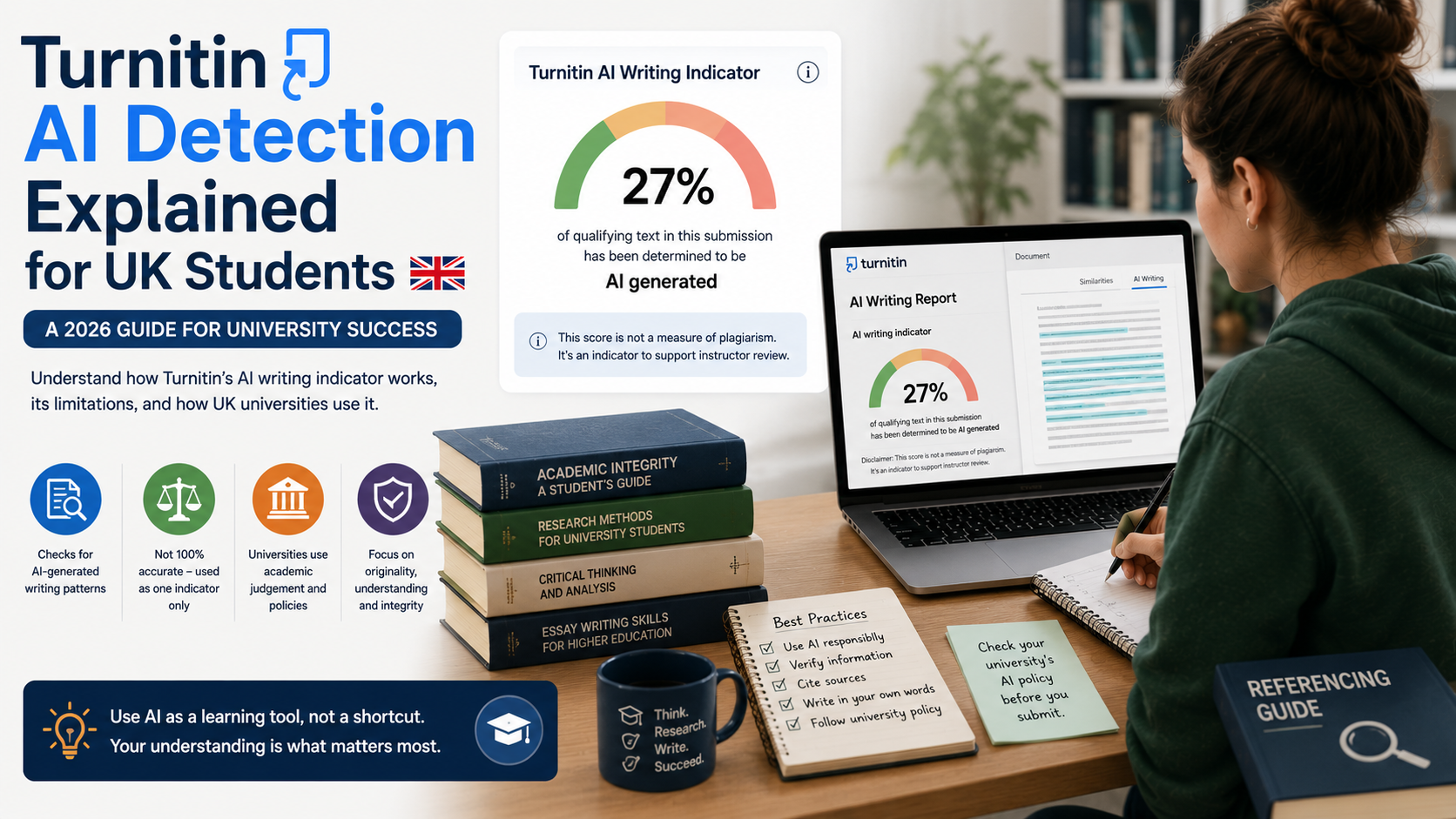
The short answer is:
Turnitin provides an AI writing indicator, but it is not designed to conclusively prove that ChatGPT or another AI tool wrote an assignment. Universities generally use Turnitin alongside academic judgement, assignment review, and institutional academic integrity procedures.
This guide explains how Turnitin's AI writing detection works, its limitations, what UK universities consider during academic integrity investigations, and how students can use AI responsibly.
What Is Turnitin AI Detection?
Turnitin is widely used by universities to check assignments for originality and similarity. In addition to plagiarism checking, Turnitin has introduced an AI writing indicator designed to estimate whether parts of a document may have been generated by AI.
The indicator is intended to support educators rather than replace academic judgement. Universities generally treat it as one piece of information rather than definitive proof of AI use.
Does Turnitin Detect ChatGPT?
Turnitin may identify text that appears similar to AI-generated writing, but it cannot reliably prove that ChatGPT wrote a document.
Several factors influence detection, including:
The amount of AI-generated content.
Whether the text has been substantially edited.
Writing style and sentence structure.
The version of AI used.
The quality and originality of the final submission.
Universities recognise that AI indicators can produce inaccurate results and therefore avoid relying on them alone.
How Accurate Is Turnitin's AI Detection?
No AI detector is 100% accurate.
AI writing indicators may:
Flag human-written content incorrectly (false positives).
Miss AI-generated content (false negatives).
Produce different results after revisions.
Perform differently across writing styles and subjects.
Because of these limitations, UK universities generally use AI detection results as part of a broader academic integrity review rather than as conclusive evidence.
How Do UK Universities Review Suspected AI Use?
If concerns arise about an assignment, lecturers may consider several factors alongside any Turnitin report.
These may include:
Comparing the assignment with previous submissions.
Reviewing writing style and language consistency.
Checking whether references and quotations are genuine.
Assessing the depth of critical analysis.
Asking the student to explain arguments or research methods.
Reviewing drafts, notes, or version history where available.
The focus is usually on whether the work reflects the student's own understanding and learning.
Does a High AI Score Automatically Mean Misconduct?
No.
A high AI writing indicator does not automatically mean that academic misconduct has occurred.
Universities generally investigate the context of the assignment before making decisions. They may consider:
Assignment requirements.
Institutional AI policies.
Student explanations.
Supporting evidence.
Lecturer observations.
Each university follows its own academic integrity procedures.
Common Reasons Students Are Flagged
Assignments may attract additional attention when they include:
Fabricated references.
Generic or repetitive writing.
Weak critical analysis.
Inconsistent writing style.
Unsupported factual claims.
Incorrect quotations.
Poor integration of academic evidence.
These issues are not unique to AI-generated work but can raise questions during assessment.
Can Students Use ChatGPT Without Problems?
Many UK universities now allow some forms of AI use, provided students follow institutional guidance.
Acceptable uses may include:
Understanding difficult concepts.
Brainstorming assignment ideas.
Creating study notes.
Planning essay structures.
Improving grammar and clarity.
Generating revision questions.
Always check your module guidance and university policy before using AI in assessed work.
Best Practices for Responsible AI Use
If you choose to use ChatGPT or other AI tools, follow these principles.
1. Read Your University's AI Policy
Every institution has different expectations regarding AI use.
2. Conduct Independent Research
Support your work with:
Peer-reviewed journal articles
Academic books
Government publications
Professional reports
3. Verify Every Reference
Never include citations generated by AI without checking that they exist and are accurate.
4. Write in Your Own Words
Use AI to understand concepts, then explain ideas using your own analysis and academic voice.
5. Be Prepared to Explain Your Work
You should understand every argument, source, and conclusion included in your assignment.
Common Mistakes Students Make
Avoid these common errors:
Copying AI-generated text directly.
Using fabricated references.
Depending entirely on ChatGPT.
Ignoring university AI policies.
Submitting work you cannot explain.
Failing to verify facts and citations.
Assuming Turnitin is the only factor universities consider.
Final Thoughts
Turnitin's AI writing indicator is only one part of the academic integrity process. It is designed to help educators review assignments, not to definitively identify AI-generated work. UK universities generally combine Turnitin reports with academic judgement, institutional policies, and evidence from the student's work.
The safest approach is to use AI responsibly. Treat ChatGPT as a study assistant, conduct independent research, verify all sources, and write assignments that demonstrate your own critical thinking and understanding. By following your university's guidance, you can benefit from AI while maintaining academic integrity and producing high-quality academic work.
Frequently Asked Questions
Everything you need to know about our services
Related Posts

Can You Cite ChatGPT in UK Universities? (2026 Guide)

Can UK Universities Detect ChatGPT? What Every Student Should Know (2026 Guide)
