Can You Cite ChatGPT in UK Universities? (2026 Guide)
Introduction
Artificial intelligence tools like ChatGPT have become common study companions for university students. They can explain difficult concepts, generate ideas, improve writing, and help with revision. As AI becomes more widely used, many students ask an important question:
Can you cite ChatGPT in UK universities?
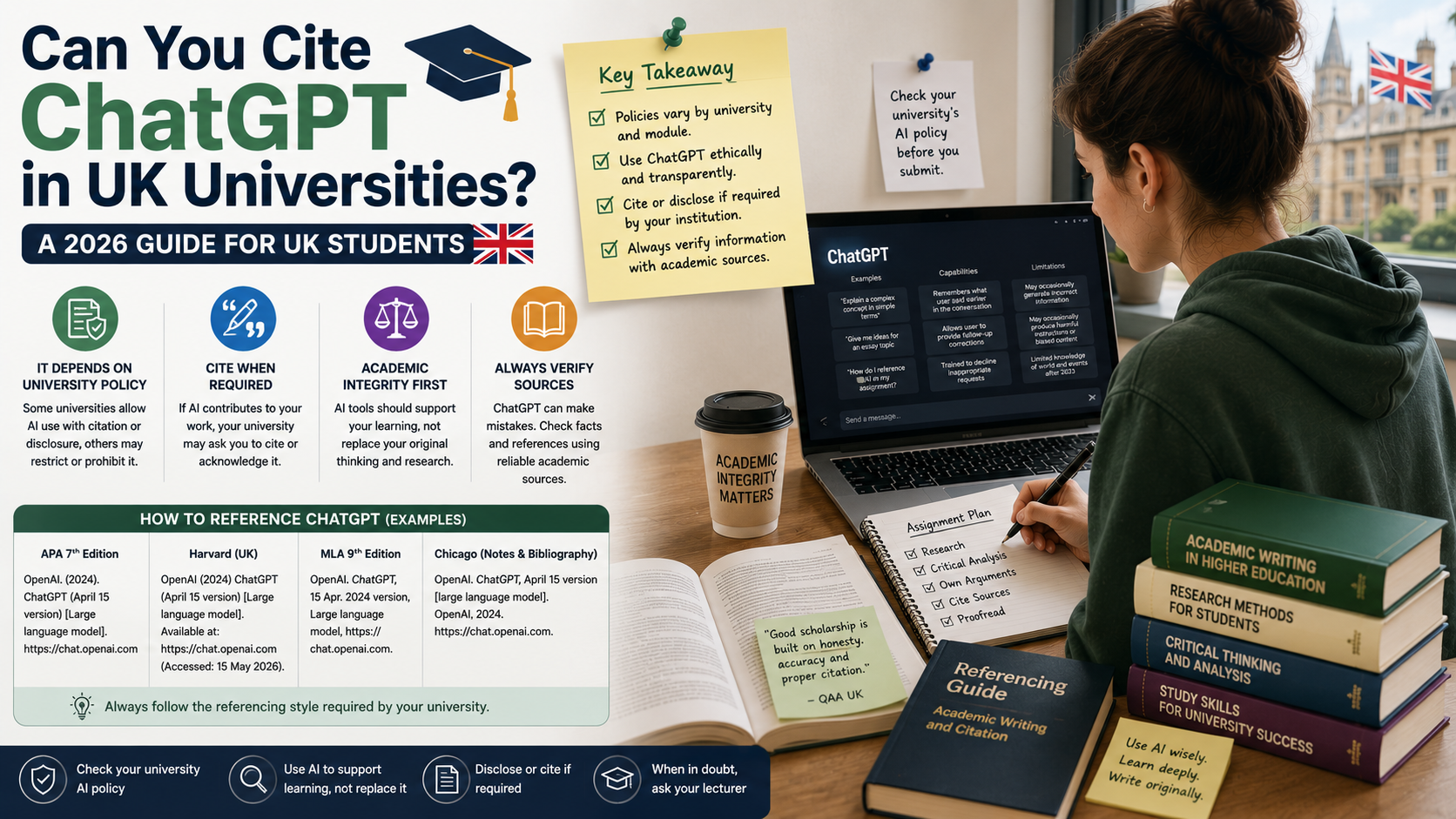
The answer is sometimes—but it depends on your university's policy, your lecturer's instructions, and the referencing style you are required to use.
Some universities allow students to acknowledge or reference AI-generated content in specific situations, while others restrict or prohibit its use in assessed work. This guide explains when ChatGPT can be cited, when it should not be used, and how to follow good academic practice.
Can You Cite ChatGPT in UK Universities?
There is no single rule that applies to every UK university.
Many institutions now publish guidance on the use of generative AI in coursework. Depending on the university or module, you may be:
Allowed to use ChatGPT for brainstorming or planning
Required to disclose any AI assistance
Allowed to cite ChatGPT using a recognised referencing style
Restricted from using AI in certain assessments
Prohibited from using AI in specific assignments or examinations
Always read:
Your assignment brief
Module handbook
Faculty guidance
Academic integrity policy
Instructions provided by your lecturer
If the guidance is unclear, ask your lecturer before submitting your work.
Why Would You Cite ChatGPT?
Academic writing values transparency.
If your university permits AI-assisted work, citing or acknowledging ChatGPT helps explain how it contributed to your learning or writing process.
For example, you may use ChatGPT to:
Explain difficult concepts
Generate research questions
Create an essay outline
Improve grammar
Summarise your own notes
Suggest keywords for literature searches
In these cases, your university may expect you to disclose the use of AI if required by institutional policy.
When Should You NOT Cite ChatGPT?
Even where AI is allowed, ChatGPT should not replace academic sources.
Do not use ChatGPT as the primary evidence for:
Research findings
Academic theories
Statistics
Scientific claims
Legal authority
Medical advice
Historical facts
Instead, support your assignments using:
Peer-reviewed journal articles
Academic books
Government publications
Professional guidelines
Official reports
ChatGPT should complement your research—not replace it.
Does Every UK University Have the Same AI Policy?
No.
Universities have different approaches to generative AI.
Some institutions encourage responsible AI use, while others apply stricter rules depending on:
The subject area
Assessment type
Learning outcomes
Professional accreditation requirements
For example, policies for nursing, law, medicine, engineering, and teacher education may differ from those used in other disciplines.
Always follow the guidance provided for your specific module.
Which Referencing Styles Mention ChatGPT?
Several referencing styles have published guidance on citing generative AI.
Depending on your university, you may be required to use:
APA 7th Edition
Harvard Referencing
MLA
Chicago
OSCOLA (where applicable)
Each style has different recommendations for acknowledging AI-generated content.
Always use the latest guidance from your university or the official referencing manual.
How Should You Use ChatGPT Responsibly?
Using ChatGPT ethically is more important than simply citing it.
Good practice includes:
Use AI to Learn
Ask ChatGPT to explain concepts, define terminology, or clarify theories.
Conduct Independent Research
Always verify information using:
Peer-reviewed journals
Academic books
Government publications
University library databases
Write in Your Own Words
After using ChatGPT to understand a topic, close the conversation and write your assignment independently.
Verify Every Citation
AI tools can occasionally generate incorrect or fabricated references.
Always check every source before including it in your assignment.
Follow University Policies
If your university requires disclosure of AI use, include the required acknowledgement or citation exactly as instructed.
Common Mistakes Students Make
Avoid these common errors:
Assuming every university allows ChatGPT.
Using ChatGPT instead of academic literature.
Copying AI-generated text directly.
Including references that have not been verified.
Ignoring module-specific AI guidance.
Believing AI-generated content is always accurate.
Forgetting to disclose AI use when required.
These mistakes may lead to academic integrity concerns or lower marks.
Best Practices for UK Students
To use ChatGPT responsibly:
Read your university's AI policy before using ChatGPT.
Follow your lecturer's instructions.
Use AI to support learning rather than generate assignments.
Verify every fact with credible academic sources.
Write original content in your own words.
Keep drafts and research notes.
Disclose AI use if your institution requires it.
Proofread your work before submission.
Final Thoughts
ChatGPT is becoming an increasingly common learning tool in higher education, but responsible use is essential. Whether you can cite ChatGPT depends on your university's policy, your module requirements, and the referencing style you are expected to use.
The safest approach is to treat ChatGPT as a learning assistant rather than an academic source. Support your work with peer-reviewed research, verify all information, write in your own words, and follow your university's guidance on AI use and disclosure.
By combining ethical AI use with independent research and critical thinking, you can benefit from modern technology while maintaining academic integrity and producing high-quality university assignments.
Frequently Asked Questions
Everything you need to know about our services
Related Posts

How to Use ChatGPT Ethically in University Assignments (2026 Guide)

AI Tools That Help You Study Without Breaking University Rules (2026 Guide)
