Can UK Universities Detect ChatGPT? What Every Student Should Know (2026 Guide)
Introduction
Artificial intelligence tools like ChatGPT have changed how students research, write, and study. While AI can be a valuable learning assistant, many UK students wonder:
Can my university detect if I use ChatGPT?
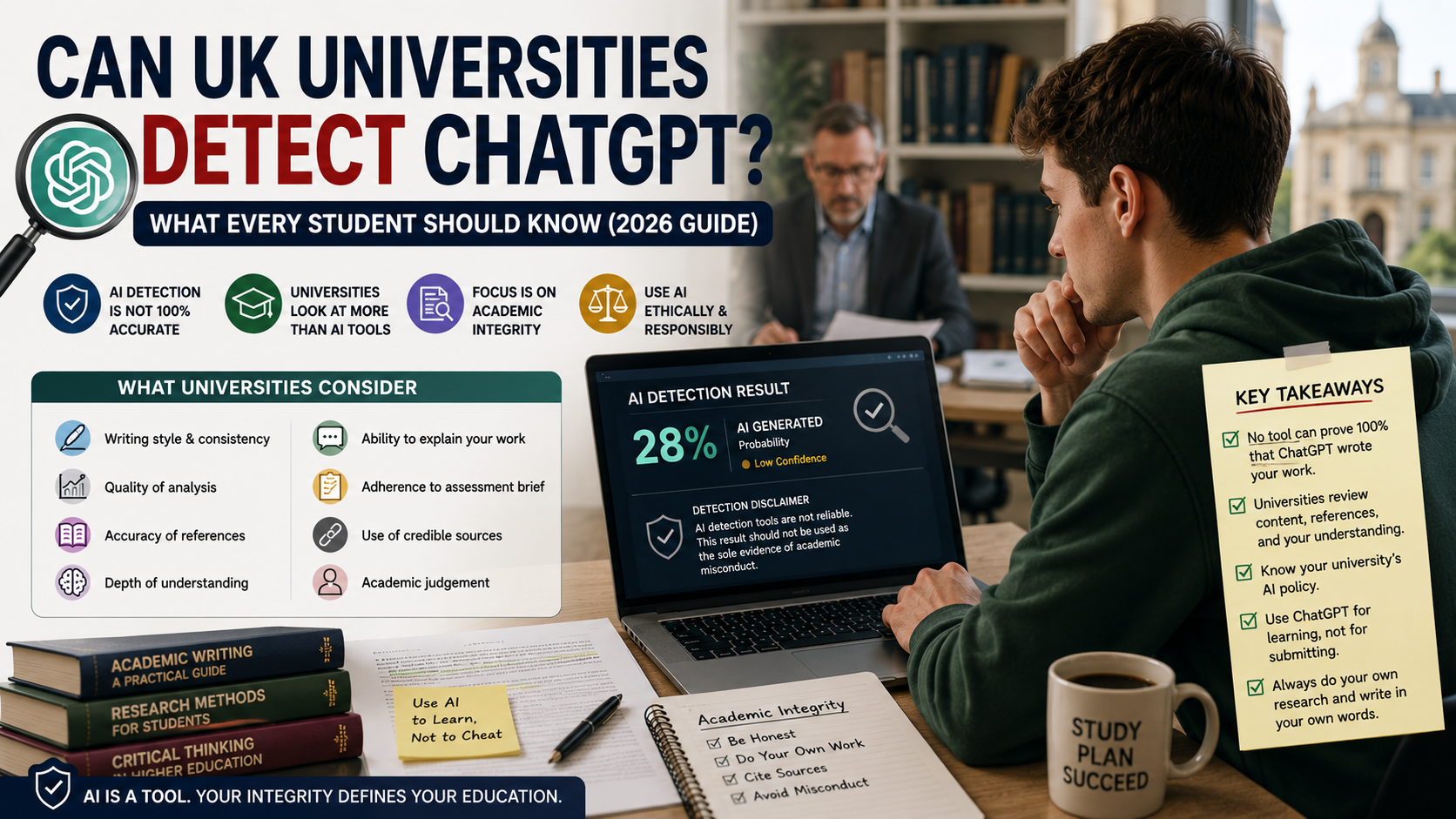
The short answer is:
UK universities may identify signs that AI has been used, but there is no tool that can reliably prove text was written by ChatGPT alone. Universities typically rely on a combination of academic judgement, assessment design, and academic integrity processes rather than AI detectors by themselves.
In this guide, you'll learn how UK universities approach AI use, what AI detectors can and cannot do, common mistakes students make, and how to use ChatGPT responsibly.
Why Are Universities Concerned About ChatGPT?
Universities are responsible for ensuring that submitted work demonstrates a student's own learning.
Assignments are designed to assess your ability to:
Conduct independent research
Think critically
Analyse evidence
Develop original arguments
Apply course knowledge
Communicate academically
If AI produces most of the work, lecturers cannot accurately assess these skills.
This is why many UK universities have updated their academic integrity guidance to address generative AI.
Can UK Universities Detect ChatGPT?
There isn't a simple "ChatGPT detector" that can definitively identify AI-generated writing.
Universities may instead look at multiple indicators, including:
Writing style that differs significantly from previous work
Inaccurate or fabricated references
Generic or superficial analysis
Inconsistent formatting or citation style
Content that doesn't address the assignment question
Evidence that the student cannot explain or defend the submitted work
Some institutions also use AI detection software as one source of information, but these tools are not considered conclusive evidence on their own because they can produce false positives and false negatives.
How Do Universities Investigate Suspected AI Use?
If a lecturer has concerns, the process usually involves reviewing the work rather than relying solely on software.
They may:
Compare the assignment with your previous submissions
Review your writing style and language patterns
Check references to ensure they exist
Examine drafts or version history if available
Ask you to explain your arguments or research choices
Review whether the work aligns with the assessment requirements
The focus is often on whether the work reflects your own understanding.
Do AI Detection Tools Always Work?
No.
Current AI detection tools have limitations.
They may:
Incorrectly flag human-written work as AI-generated.
Miss AI-generated text that has been edited.
Produce different results for the same document.
Struggle with non-native English writing.
Become less reliable as AI models improve.
For this reason, many universities advise against relying solely on AI detection scores when making academic integrity decisions.
Common Signs That Raise Suspicion
Although AI cannot always be detected directly, certain issues may attract attention.
These include:
References that do not exist
Incorrect quotations
Facts without evidence
Generic introductions
Repetitive language
Lack of critical analysis
Sudden changes in writing quality
Arguments that cannot be explained during discussions
These issues can occur whether content is written by AI or copied from another source.
Is Using ChatGPT Always Against University Rules?
Not necessarily.
Many UK universities now allow limited AI use for learning purposes.
Examples often include:
Brainstorming ideas
Understanding difficult concepts
Improving grammar
Creating study notes
Planning assignment structures
Generating revision questions
However, policies vary between institutions and even between modules.
Always read:
Your university's academic integrity policy
Faculty guidance
Assignment instructions
Lecturer recommendations
When Could AI Use Become Academic Misconduct?
AI use may become a problem if you:
Submit AI-generated writing as your own work.
Fabricate references or evidence.
Use AI during prohibited assessments.
Fail to disclose AI use where required.
Rely entirely on AI without independent research.
Academic misconduct policies differ between universities, so always follow your institution's requirements.
How to Use ChatGPT Responsibly
You can use ChatGPT ethically by treating it as a learning assistant rather than an assignment writer.
Good uses include:
Understanding Concepts
Ask AI to explain difficult topics in simpler language.
Brainstorming Ideas
Generate possible research questions or essay approaches.
Improving Grammar
Edit your own writing for clarity and readability.
Creating Study Notes
Summarise lecture content for revision.
Practising for Exams
Generate quiz questions, flashcards, and revision exercises.
Organising Assignments
Create outlines before writing independently.
Best Practices for UK Students
To stay within university expectations:
Read your institution's AI policy before using ChatGPT.
Complete your own research using academic sources.
Verify every fact and citation.
Never invent references.
Write in your own words.
Keep notes and drafts showing your work.
Be prepared to explain your assignment if asked.
Disclose AI use where required by your university.
Common Mistakes Students Make
Avoid these mistakes:
Copying ChatGPT responses directly.
Using fake citations.
Depending entirely on AI.
Ignoring assessment instructions.
Failing to verify information.
Assuming AI-generated work cannot be questioned.
Submitting work you do not understand.
Final Thoughts
ChatGPT is changing the way students learn, but it does not replace the skills universities are assessing. UK institutions are increasingly focusing on responsible AI use rather than simply trying to "detect ChatGPT."
The safest approach is to use AI as a study aid while ensuring your assignments demonstrate your own understanding, critical thinking, and research. By following your university's academic integrity policy, verifying information, and producing original work, you can benefit from AI without compromising your academic standards.
Frequently Asked Questions
Everything you need to know about our services
Related Posts

How to Use ChatGPT Ethically in University Assignments (2026 Guide)

AI Tools That Help You Study Without Breaking University Rules (2026 Guide)
