25 Best ChatGPT Alternatives for Students in 2026 (Free & Paid)
Introduction
Artificial intelligence has transformed the way students learn, research, write, and solve academic problems. While ChatGPT remains one of the most popular AI assistants, it's not always the best option for every student. Some users need better research capabilities, stronger citation support, improved grammar checking, coding assistance, or free alternatives without usage limits.
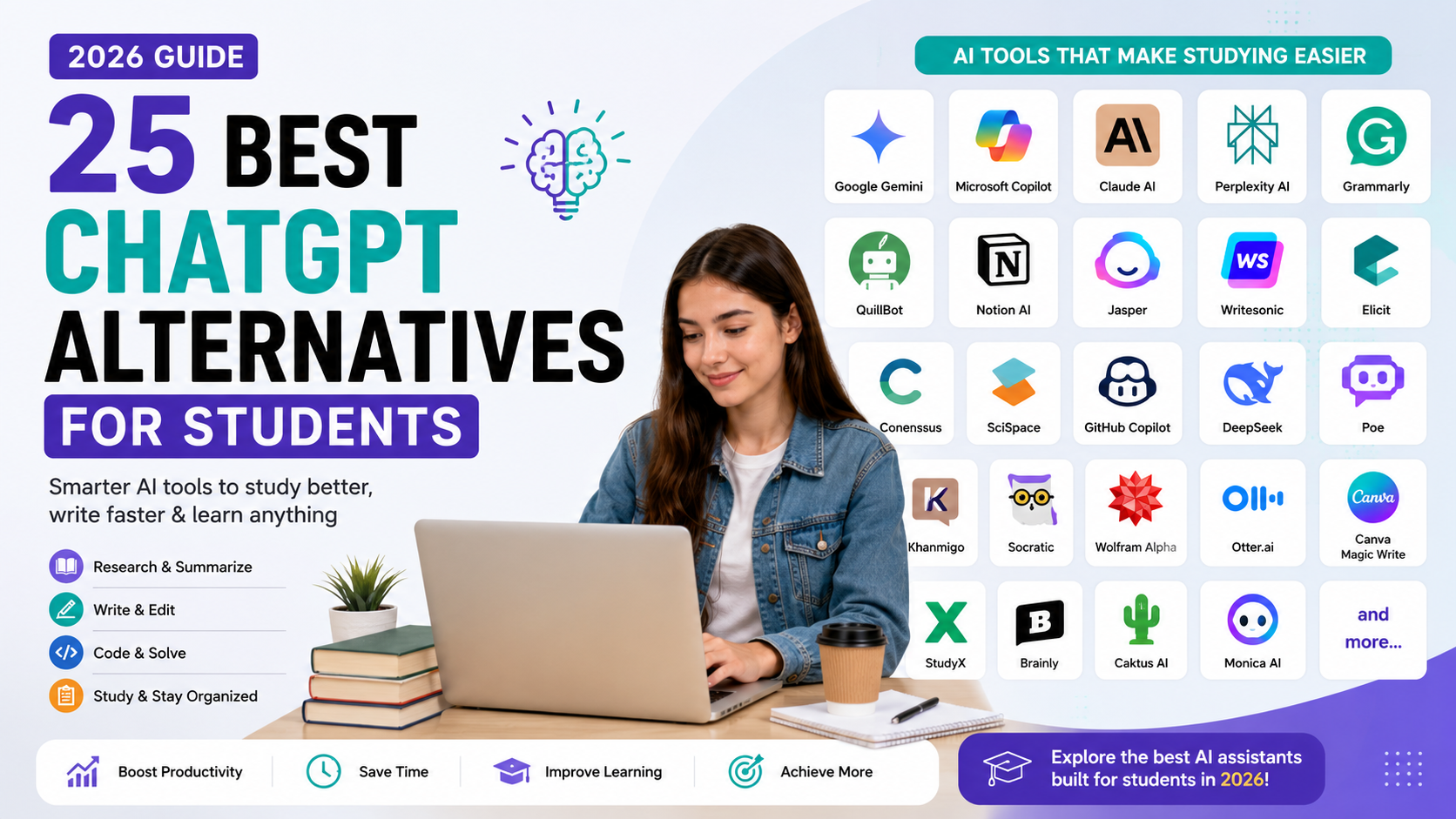
Fortunately, there are numerous AI tools designed specifically for education, writing, research, and productivity. Whether you're working on essays, solving math problems, conducting research, creating presentations, or learning new concepts, the right AI assistant can significantly improve your academic performance.
In this guide, we'll explore the 25 best ChatGPT alternatives for students, comparing their features, advantages, pricing, and ideal use cases.
Why Look for ChatGPT Alternatives?
Students choose alternatives for several reasons:
-
Better academic research capabilities
-
Accurate citations and references
-
More generous free plans
-
Subject-specific AI assistance
-
Improved writing and grammar suggestions
-
Better coding support
-
AI-powered note-taking
-
Faster response times
25 Best ChatGPT Alternatives for Students
1. Google Gemini
Best for: Research and Google Workspace integration
Google Gemini integrates seamlessly with Google Docs, Gmail, Sheets, and Drive. Students can summarize articles, generate study notes, brainstorm ideas, and receive contextual answers using Google's latest AI models.
Pros
-
Excellent web-based information
-
Google Docs integration
-
Image understanding
-
Strong reasoning
Cons
-
Some premium features require a paid plan.
2. Microsoft Copilot
Best for: Microsoft Office users
Microsoft Copilot helps students write assignments, summarize PDFs, create presentations, and analyze Excel data directly inside Microsoft 365 applications.
Pros
-
Office integration
-
Real-time web search
-
Great productivity features
3. Claude AI
Best for: Long-form writing
Claude excels at producing natural, well-structured writing. It can process lengthy documents and is ideal for essays, reports, and research summaries.
Pros
-
Excellent writing quality
-
Handles long documents
-
Strong contextual understanding
4. Perplexity AI
Best for: Academic research
Perplexity provides answers backed by citations and reliable web sources, making it one of the best AI search tools for students.
Pros
-
Source citations
-
Research-focused
-
Accurate summaries
5. Grammarly AI
Best for: Grammar and editing
Beyond grammar correction, Grammarly AI rewrites paragraphs, improves clarity, and adjusts tone for academic writing.
6. Jasper AI
Best for: Content creation
Jasper helps generate essays, blog drafts, outlines, and creative writing with customizable templates.
7. Writesonic
Best for: Fast content generation
Writesonic creates articles, summaries, emails, and assignments using multiple AI models.
8. Notion AI
Best for: Note-taking
Students can organize class notes, summarize lectures, create flashcards, and manage projects within Notion.
9. QuillBot
Best for: Paraphrasing
QuillBot helps rewrite sentences, improve clarity, and avoid repetitive wording while maintaining the original meaning.
10. GitHub Copilot
Best for: Programming students
GitHub Copilot generates code suggestions, explains programming concepts, and helps debug software projects.
11. You.com AI
Best for: AI-powered search
Offers conversational search results, citations, and research assistance.
12. Poe
Best for: Accessing multiple AI models
Poe allows students to use models from OpenAI, Anthropic, Google, and others from a single platform.
13. DeepSeek AI
Best for: Technical subjects
DeepSeek performs exceptionally well for mathematics, coding, and scientific reasoning.
14. Elicit
Best for: Literature reviews
Elicit searches academic papers and summarizes research findings using AI.
15. Consensus
Best for: Scientific research
Consensus answers research questions using peer-reviewed scientific literature.
16. SciSpace
Best for: Understanding research papers
SciSpace explains difficult academic papers in simple language.
17. Canva Magic Write
Best for: Presentations
Students can generate presentation content, project ideas, and visual designs.
18. Otter.ai
Best for: Lecture transcription
Automatically records, transcribes, and summarizes classroom lectures.
19. Khanmigo
Best for: Personalized tutoring
Powered by AI, Khanmigo provides guided learning rather than simply giving answers.
20. Socratic by Google
Best for: Homework help
Students can scan questions using their phone and receive detailed explanations.
21. Wolfram Alpha
Best for: Mathematics
An excellent tool for solving equations, statistics, calculus, chemistry, and engineering problems.
22. Caktus AI
Best for: Student assignments
Designed specifically for education, Caktus AI assists with essays, coding, mathematics, and homework.
23. StudyX AI
Best for: Homework solutions
StudyX provides AI-generated explanations and study assistance across multiple subjects.
24. Brainly AI
Best for: Community learning
Students receive AI-supported answers along with explanations from a large educational community.
25. Monica AI
Best for: Everyday productivity
Monica combines multiple AI models into a browser assistant that helps with writing, translation, summarization, and research.
Comparison Table
How to Choose the Best AI Tool
When selecting an AI assistant, consider:
-
Your academic subject
-
Budget
-
Citation requirements
-
Writing quality
-
Coding support
-
Research capabilities
-
Integration with existing software
Are ChatGPT Alternatives Better?
Not necessarily. Each tool specializes in different tasks. ChatGPT remains an excellent all-around AI assistant, while alternatives often outperform it in specific areas such as academic research, scientific citations, coding, grammar correction, or note-taking.
Final Thoughts
The best ChatGPT alternative depends on your academic needs. If you're conducting research, Perplexity AI, Consensus, and Elicit are excellent choices. For writing and editing, Claude AI, Grammarly AI, and QuillBot stand out. Programming students will benefit from GitHub Copilot and DeepSeek AI, while learners seeking tutoring can explore Khanmigo and Socratic.
Instead of relying on a single AI assistant, consider combining multiple tools to enhance your learning, improve productivity, and produce high-quality academic work.
Frequently Asked Questions
Everything you need to know about our services

