Does Turnitin Detect ChatGPT? Everything Students Need to Know (2026)
Artificial intelligence tools like ChatGPT have transformed how students research, write, and study. As AI becomes increasingly common in education, one question continues to dominate search results:
Does Turnitin detect ChatGPT?
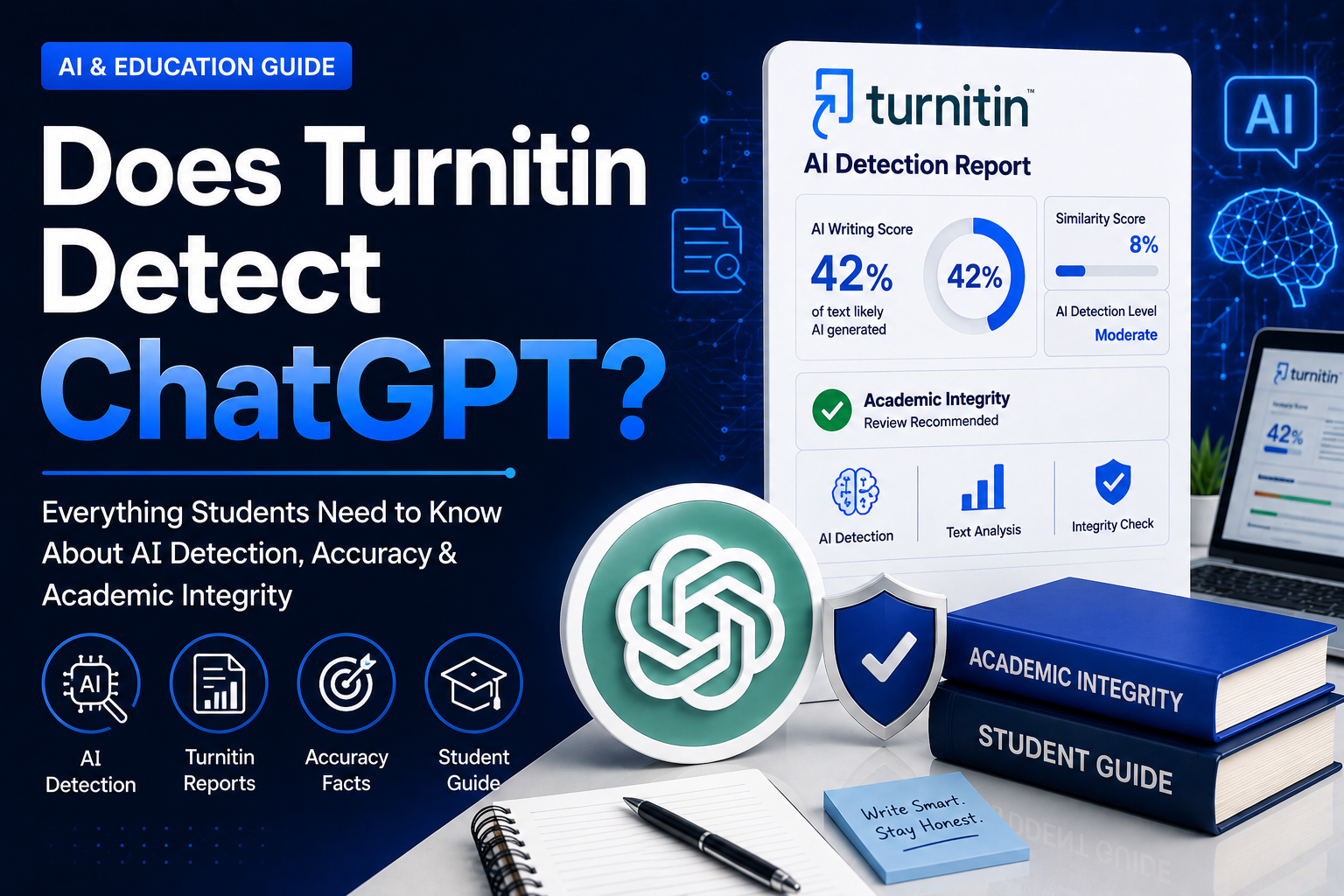
The short answer is yes, Turnitin has AI-writing detection capabilities, but the reality is more complex than many students realize. AI detectors are not perfect, universities use multiple methods to identify AI-generated content, and detection results should not be considered absolute proof of misconduct.
In this guide, we'll explain how Turnitin's AI detection works, its accuracy, limitations, and what students should know before using AI tools in academic work.
Quick Answer
Yes, Turnitin can detect text that appears to be generated by ChatGPT and other AI writing tools. However, Turnitin does not guarantee 100% accuracy. Its AI writing indicator estimates the likelihood that content was generated by artificial intelligence rather than written entirely by a human.
Universities typically use AI detection reports alongside academic judgment, writing style analysis, and institutional policies when reviewing student work.
What Is Turnitin?
Turnitin is one of the world's most widely used academic integrity platforms. Universities, colleges, and schools use it to:
Check plagiarism
Compare submissions against published sources
Identify similarity matches
Promote academic integrity
Detect potential AI-generated content
Millions of student assignments are processed through Turnitin each year, making it one of the most trusted academic assessment tools globally.
How Does Turnitin Detect ChatGPT?
Turnitin's AI writing detection system analyzes patterns commonly associated with AI-generated content.
The system evaluates factors such as:
Sentence structure consistency
Predictable word patterns
Language probability models
Writing uniformity
Text complexity
Content predictability
Large language models such as ChatGPT often generate text that appears statistically predictable compared to human writing. AI detectors attempt to identify these patterns.
Rather than searching for copied content, Turnitin evaluates whether writing resembles machine-generated text.
Does Turnitin Know If You Used ChatGPT?
Not necessarily.
Turnitin cannot directly see:
Whether you opened ChatGPT
What prompts you entered
Whether you copied content from ChatGPT
Your ChatGPT account activity
Instead, Turnitin analyzes the submitted text itself.
This means Turnitin does not "know" you used ChatGPT. It simply estimates whether portions of your writing appear likely to have been generated by AI.
Is Turnitin's AI Detection Accurate?
Turnitin claims high accuracy rates under controlled testing conditions. However, real-world results are more complicated.
Several factors can affect detection accuracy:
False Positives
A false positive occurs when human-written text is incorrectly flagged as AI-generated.
This can happen when:
Writing is highly structured
Language is extremely formal
Sentences follow predictable patterns
Non-native English speakers use simplified language
False Negatives
A false negative occurs when AI-generated text is not detected.
This may happen when:
AI content is heavily edited
Human revisions significantly alter the text
Multiple sources are combined
Personal experiences are added
For these reasons, most universities do not treat AI scores as definitive evidence.
Can Turnitin Detect Paraphrased ChatGPT Content?
Sometimes.
If students simply copy ChatGPT output and make minor changes, AI indicators may still identify patterns associated with machine-generated text.
However, when students:
Conduct independent research
Add original analysis
Rewrite content substantially
Incorporate personal insights
Use credible sources
the final result often becomes more difficult to classify as purely AI-generated.
Can Turnitin Detect ChatGPT After Rewriting?
Many students ask whether rewriting ChatGPT-generated text can avoid detection.
The answer depends on the extent of the revisions.
Small changes such as:
Replacing a few words
Rearranging sentences
Using a paraphrasing tool
may not significantly alter underlying writing patterns.
Substantial human contribution, critical thinking, and original analysis are far more important than simple rewriting.
Universities increasingly focus on learning outcomes rather than relying solely on AI detection scores.
Can Universities Detect ChatGPT Without Turnitin?
Yes.
Universities use several methods beyond AI detectors.
Writing Style Comparison
Instructors may compare a submission to a student's previous work.
Signs that may raise questions include:
Sudden improvements in writing quality
Different vocabulary usage
Changes in sentence complexity
Inconsistent academic voice
Oral Explanations
Some instructors ask students to explain:
Their arguments
Research process
Methodology
Sources
Students who cannot explain submitted work may face additional scrutiny.
Draft Reviews
Many universities now require:
Outlines
Draft submissions
Research notes
Writing reflections
These materials help demonstrate genuine authorship.
Does Turnitin Detect Other AI Tools?
Yes.
Turnitin's AI writing indicator is designed to identify patterns associated with various generative AI tools, including:
ChatGPT
Gemini
Claude
Copilot
Jasper
Other large language models
The detection process focuses on writing characteristics rather than specific software names.
What Happens If Turnitin Flags AI Writing?
A flagged AI score does not automatically mean a student has violated academic integrity policies.
Typically, the process involves:
Instructor review
Context evaluation
Assessment of evidence
Student discussion if necessary
Universities generally consider:
AI score percentage
Assignment requirements
Institutional policies
Student explanations
Supporting documentation
The final decision remains with educators rather than automated software.
Is Using ChatGPT for University Assignments Allowed?
The answer depends on your institution's policy.
Many universities now permit limited AI usage for activities such as:
Brainstorming ideas
Creating outlines
Explaining concepts
Improving grammar
Generating study notes
However, some institutions restrict or prohibit:
Submitting AI-generated work as your own
Using AI during assessments
Creating entire assignments through AI
Always review your university's latest academic integrity guidelines.
Responsible Ways to Use ChatGPT
Students can often benefit from AI tools when used responsibly.
Examples include:
Research Assistance
Ask ChatGPT to explain difficult concepts before conducting independent research.
Brainstorming
Generate topic ideas or research questions.
Grammar Support
Improve clarity and readability while maintaining original authorship.
Study Preparation
Create summaries, flashcards, and revision notes.
Feedback
Request suggestions for strengthening arguments or improving structure.
Common Myths About Turnitin and ChatGPT
Myth 1: Turnitin Can Detect ChatGPT With 100% Accuracy
False.
No AI detector is perfectly accurate.
Myth 2: AI Detection Equals Proof
False.
AI indicators are estimates, not definitive evidence.
Myth 3: Replacing a Few Words Makes AI Undetectable
False.
Minor edits may not significantly change writing patterns.
Myth 4: Universities Only Use Turnitin
False.
Educators often use multiple methods to assess authenticity.
Myth 5: ChatGPT Usage Is Always Prohibited
False.
Policies vary between institutions and assignments.
Best Practices for Students
If your institution permits AI tools, consider these guidelines:
Follow university policies.
Verify information independently.
Cite sources correctly.
Use AI for support rather than replacement.
Maintain original critical thinking.
Keep records of your research process.
Be transparent when disclosure is required.
Responsible AI usage supports learning while reducing academic integrity concerns.
Key Takeaways
Turnitin can identify writing that appears AI-generated.
AI detection is not 100% accurate.
Turnitin cannot directly see whether you used ChatGPT.
Universities often combine AI reports with human judgment.
Responsible AI use is increasingly accepted in education.
Students should always follow institutional policies regarding AI tools.
Final Thoughts
So, does Turnitin detect ChatGPT?
The answer is yes—but not with absolute certainty. Turnitin analyzes writing patterns to estimate whether content may have been generated by AI. However, detection tools are not perfect and should not be viewed as definitive proof.
As AI becomes more integrated into education, the most effective approach is responsible and transparent usage. Students who use AI ethically, conduct independent research, apply critical thinking, and follow university guidelines are far better positioned than those who rely entirely on automated content generation.
Frequently Asked Questions
Everything you need to know about our services

