How to Cite ChatGPT in APA 7 (2026 Guide with Examples)
Artificial intelligence tools like ChatGPT have become increasingly popular among students, researchers, and professionals. As more people use AI-generated content in academic work, one common question arises:
How do you cite ChatGPT in APA 7th edition?
According to the latest guidance from the American Psychological Association (APA), content generated by ChatGPT should be cited properly whenever it contributes to your academic work. This guide explains exactly how to cite ChatGPT in APA 7, including in-text citations, reference list entries, and practical examples.
Can You Use ChatGPT in Academic Writing?
Many universities allow students to use AI tools for brainstorming, outlining, research assistance, and language improvement. However, institutions generally require transparency regarding AI usage.
Before using ChatGPT in assignments, essays, dissertations, or research papers, always review your university's AI policy.
Common acceptable uses include:
-
Generating topic ideas
-
Improving grammar and clarity
-
Summarizing concepts
-
Creating study notes
-
Developing outlines
Using AI to generate entire assignments without disclosure may violate academic integrity policies.
APA 7 Guidelines for Citing ChatGPT
The APA recommends treating ChatGPT as software that generates responses rather than as a traditional author.
When citing ChatGPT, include:
-
The software name (ChatGPT)
-
The company (OpenAI)
-
The version used
-
The date of the conversation
-
A description of the prompt or output
Reference List Format
Use the following APA 7 format:
OpenAI. (Year). ChatGPT (Version) [Large language model]. URL
Example Reference
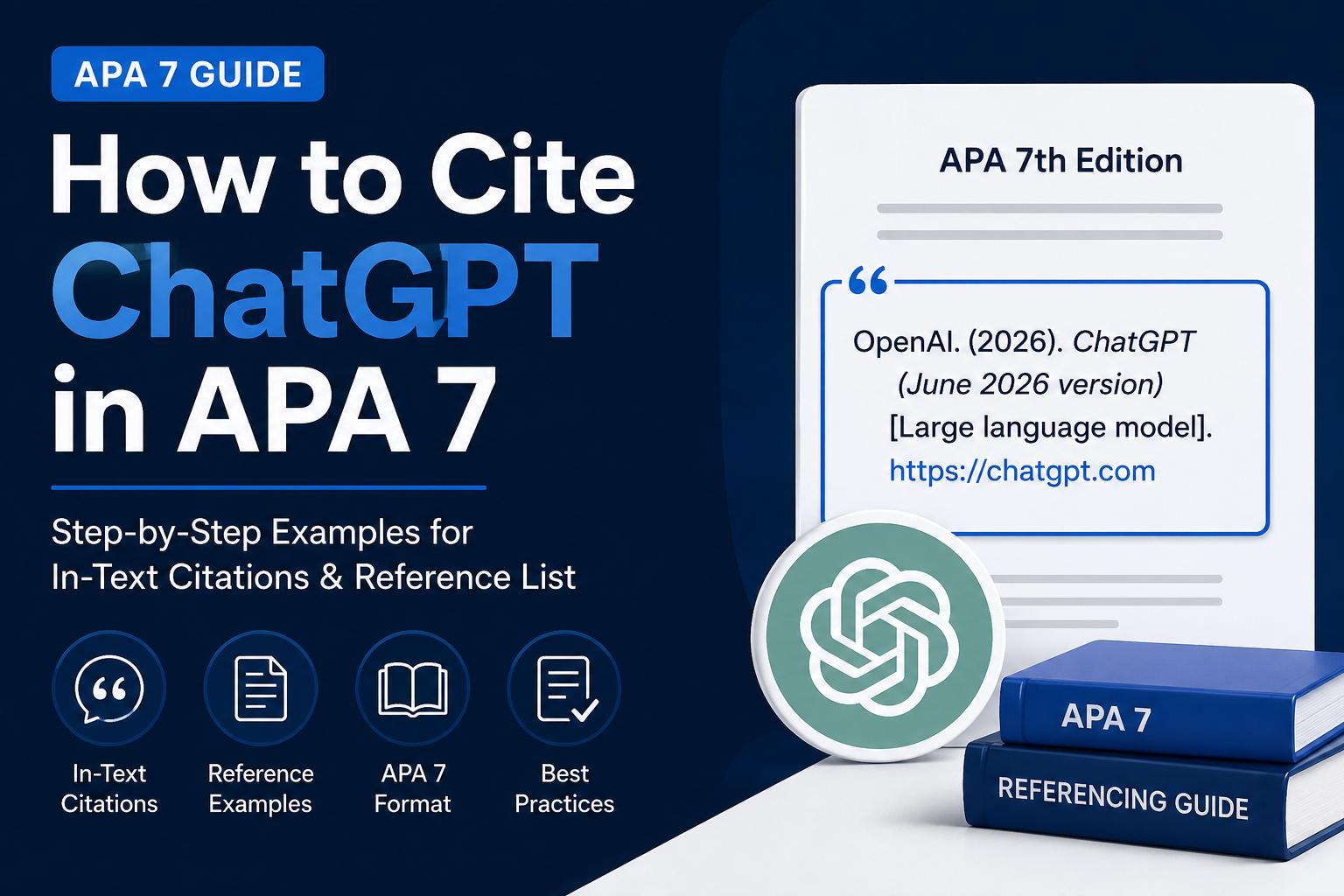
OpenAI. (2026). ChatGPT (June 2026 version) [Large language model]. https://chatgpt.com
In-Text Citation for ChatGPT
Parenthetical Citation
(OpenAI, 2026)
Narrative Citation
OpenAI (2026) explained that...
Example of ChatGPT Citation in an Essay
Suppose ChatGPT helped explain qualitative research methods.
In-Text Citation
Qualitative research focuses on understanding human experiences through non-numerical data (OpenAI, 2026).
Reference Entry
OpenAI. (2026). ChatGPT (June 2026 version) [Large language model]. https://chatgpt.com
How to Cite a Specific ChatGPT Conversation
If your instructor requires documentation of a specific AI interaction, APA recommends providing sufficient details about the conversation.
Example
Prompt:
"What are the main differences between qualitative and quantitative research methods?"
Response generated by ChatGPT on June 11, 2026.
You may mention the interaction within the text:
ChatGPT generated a summary comparing qualitative and quantitative research methods based on a user prompt entered on June 11, 2026 (OpenAI, 2026).
How to Cite ChatGPT in the Reference List
Here is a complete APA example:
OpenAI. (2026). ChatGPT (June 2026 version) [Large language model]. https://chatgpt.com
Maintain consistent formatting throughout your document.
Should ChatGPT Be Included in the Reference List?
Yes.
If information generated by ChatGPT significantly contributed to your work and is cited within the text, it should generally appear in the reference list according to your institution's requirements.
However, some universities may have their own AI disclosure guidelines.
Always verify local academic policies before submission.
How to Mention ChatGPT in a Methodology Section
Researchers increasingly disclose AI usage in methodology or acknowledgments sections.
Example:
ChatGPT (OpenAI, 2026) was used to assist with brainstorming research questions and improving language clarity. All content was reviewed, edited, and verified by the author.
This approach demonstrates transparency and responsible AI usage.
Common Mistakes When Citing ChatGPT
1. Treating ChatGPT as a Human Author
Incorrect:
ChatGPT. (2026).
Correct:
OpenAI. (2026).
2. Omitting the Version Information
Always identify the version when possible.
3. Forgetting In-Text Citations
Any AI-generated information used in your paper should be cited.
4. Submitting AI Content Without Disclosure
Many universities require disclosure of AI assistance.
5. Using Fabricated References
ChatGPT may occasionally generate inaccurate or non-existent sources.
Always verify every reference independently.
APA Citation Example Table
University Policies on AI Usage
Universities in the United States, United Kingdom, Canada, Australia, and Malaysia have increasingly adopted AI policies.
While many institutions permit limited AI assistance, students remain responsible for:
-
Accuracy
-
Originality
-
Proper attribution
-
Academic integrity compliance
Always consult your university's latest guidelines before using AI-generated content in coursework.
Best Practices for Using ChatGPT Responsibly
To maintain academic integrity:
-
Use ChatGPT as a support tool rather than a replacement for your own work.
-
Verify facts independently.
-
Cite AI-generated content appropriately.
-
Disclose AI assistance when required.
-
Follow institutional policies.
Responsible use of AI can enhance productivity while preserving academic standards.
Final Thoughts
Knowing how to cite ChatGPT in APA 7 is becoming an essential academic skill. As AI tools continue to evolve, proper attribution helps maintain transparency, credibility, and academic integrity.
The standard APA format generally includes OpenAI as the author, the ChatGPT version, a description of the software, and the URL. Students should also review their university's AI policies to ensure compliance with local academic requirements.
By following APA guidelines and using AI responsibly, you can confidently incorporate ChatGPT into your research and writing process while maintaining academic standards.
Frequently Asked Questions
Everything you need to know about our services
