AI Tools That Help You Study Without Breaking University Rules (2026 Guide)
Introduction
Artificial Intelligence (AI) has transformed the way students learn, research, and prepare for exams. From summarising lecture notes to creating flashcards and improving grammar, AI tools can make studying more efficient and enjoyable.
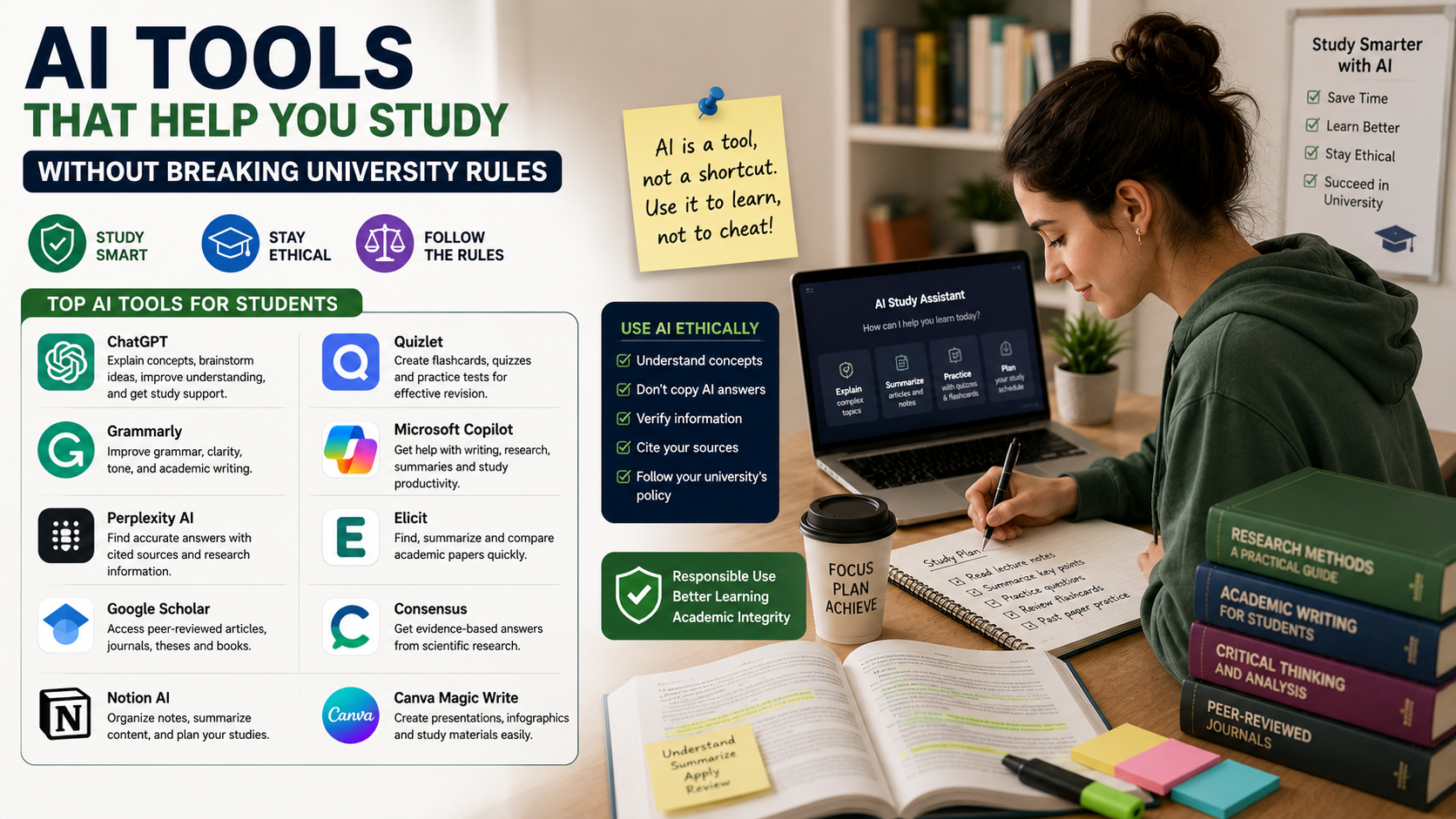
However, many students worry about crossing the line between ethical AI use and academic misconduct. Universities increasingly allow AI as a learning aid, but they expect students to produce original work, think critically, and follow academic integrity policies.
This guide explores the best AI tools that can help you study without breaking university rules, how to use them responsibly, and the mistakes you should avoid.
Why Students Are Using AI to Study
University courses involve extensive reading, note-taking, revision, and assignment preparation. AI tools can help reduce repetitive tasks, improve understanding, and save valuable study time.
When used responsibly, AI can help you:
Understand difficult concepts
Summarise lengthy research papers
Improve academic writing
Organise study notes
Create revision materials
Learn faster
Manage study schedules
Prepare for exams
The key is to use AI to support your learning—not replace it.
What Makes an AI Tool Ethical for Students?
An AI tool is generally considered ethical when it helps you learn rather than completing assessed work on your behalf.
Ethical uses include:
Explaining concepts
Brainstorming ideas
Creating study summaries
Improving grammar
Organising notes
Generating practice questions
Creating flashcards
Planning revision schedules
Avoid using AI to:
Write entire assignments
Generate fake references
Fabricate research data
Complete exams
Bypass learning outcomes
Always check your university's AI policy before using any AI tool.
1. ChatGPT
Best For
Explaining complex topics
Brainstorming assignment ideas
Study planning
Grammar improvement
Revision support
ChatGPT acts like a personal study tutor. It can explain difficult theories in simple language, answer study questions, generate revision quizzes, and help organise your learning.
Ethical Ways to Use ChatGPT
Ask for explanations instead of answers.
Generate assignment outlines.
Create revision notes.
Improve grammar after writing your own draft.
Understand lecturer feedback.
Avoid copying AI-generated text directly into assignments.
2. Grammarly
Best For
Grammar checking
Academic writing
Clarity
Sentence structure
Grammarly helps students polish their own writing by correcting spelling, punctuation, grammar, and style.
It does not replace your ideas—it improves how you communicate them.
3. Perplexity AI
Best For
Research
Finding academic sources
Summarising information
Perplexity provides answers alongside source citations, making it easier to verify information and locate credible resources.
Always read the original sources before citing them in your assignment.
4. Google Scholar
Best For
Peer-reviewed journal articles
Academic research
Literature reviews
Google Scholar remains one of the best free tools for finding credible academic literature.
Use it to locate:
Research papers
Journal articles
Conference proceedings
Theses
Books
5. Notion AI
Best For
Study organisation
Lecture notes
Task management
Revision planning
Notion AI helps students organise coursework, summarise notes, and create personalised study plans.
It's particularly useful during exam periods when managing multiple deadlines.
6. Quizlet AI
Best For
Flashcards
Revision
Self-testing
Quizlet allows students to create AI-powered flashcards and quizzes, making active recall and spaced repetition more effective.
These techniques are proven to improve long-term memory.
7. Microsoft Copilot
Best For
Microsoft Word assistance
Document drafting
Research support
Copilot integrates with Microsoft 365 and helps students summarise documents, organise notes, and improve writing.
Students should still write their own assignments and verify all AI-generated information.
8. Elicit
Best For
Literature reviews
Research discovery
Evidence summaries
Elicit uses AI to help students find and compare research papers quickly.
It's especially useful for dissertations, research projects, and evidence-based assignments.
9. Consensus
Best For
Evidence-based answers
Scientific research
Literature summaries
Consensus searches peer-reviewed research instead of general websites.
It helps students understand what published evidence says about a particular question.
10. Canva Magic Write
Best For
Presentation planning
Study posters
Infographics
Visual learning
Students creating presentations or visual study materials can use Canva AI to generate ideas and improve layouts while still producing original content.
How to Use AI Without Breaking University Rules
Follow these best practices whenever you use AI.
Read Your University's AI Policy
Different universities have different expectations.
Some allow AI for brainstorming but not writing.
Others require students to disclose AI use.
Always read your institution's academic integrity policy.
Verify Every Fact
AI tools can make mistakes.
Always confirm:
Statistics
Dates
References
Research findings
Quotes
Use peer-reviewed academic sources whenever possible.
Write in Your Own Words
After learning from AI:
Close the AI tool.
Explain the concept yourself.
Add your own analysis.
Support arguments with academic evidence.
Never Submit AI Output Directly
Your assignments should demonstrate:
Critical thinking
Independent research
Subject knowledge
Original writing
AI should support—not replace—these skills.
Common Mistakes Students Make
Avoid these common errors:
Copying AI-generated content.
Using fake references.
Trusting AI without verification.
Ignoring university AI policies.
Using AI during prohibited assessments.
Depending entirely on AI instead of studying.
Benefits of Ethical AI Use
Students who use AI responsibly can:
Save study time
Improve understanding
Strengthen academic writing
Organise coursework
Prepare better for exams
Reduce stress
Build stronger research skills
The most successful students use AI to become better learners—not to avoid learning.
Final Thoughts
Artificial intelligence is becoming an essential part of modern education. Used responsibly, AI tools can help students learn more effectively, improve writing, organise revision, and understand complex topics.
The key is to treat AI as a study assistant—not as a shortcut to completing assignments. Continue conducting independent research, verify information using credible academic sources, write in your own words, and follow your university's academic integrity policies.
Students who combine ethical AI use with critical thinking and evidence-based research will be better prepared for university success and future professional careers.
Frequently Asked Questions
Everything you need to know about our services
Related Posts

How to Use ChatGPT Ethically in University Assignments (2026 Guide)

Should Universities Publish AI Policies?
