Should Universities Publish AI Policies?
Introduction
Artificial Intelligence (AI) has transformed higher education at an unprecedented pace. From AI-powered writing assistants and research tools to automated grading systems, technology is changing how students learn and how educators teach. However, the rapid adoption of AI has also raised important questions about academic integrity, ethical use, privacy, and fairness.
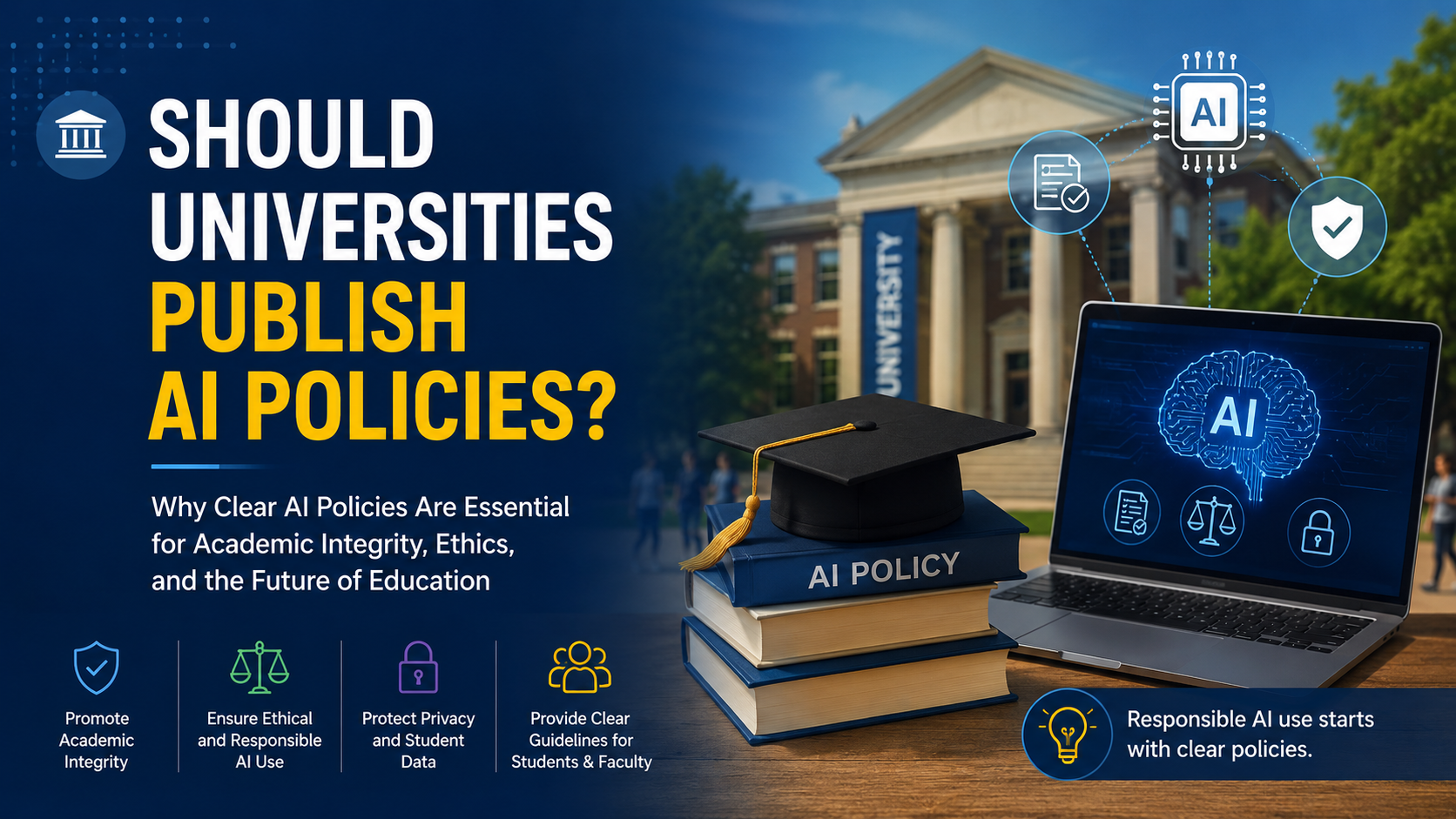
One of the biggest debates in higher education today is: Should universities publish AI policies?
The answer is increasingly yes. Clear and publicly available AI policies help students, faculty, and researchers understand how artificial intelligence can—and cannot—be used in academic settings. Without such guidelines, confusion and inconsistency can lead to misconduct, unfair penalties, and mistrust.
In this article, we'll explore why universities should publish AI policies, the benefits and challenges, what these policies should include, and how they can shape the future of education.
What Is an AI Policy?
An AI policy is a formal document that outlines how artificial intelligence tools may be used within a university. It provides guidance on acceptable practices, prohibited activities, ethical considerations, and institutional expectations.
These policies typically cover:
Student use of AI in coursework
AI-assisted research
Academic integrity
Faculty responsibilities
Privacy and data protection
Disclosure requirements
Assessment guidelines
A well-designed AI policy ensures that everyone within the institution follows the same standards.
Why Universities Need AI Policies
AI tools like ChatGPT, Gemini, Claude, and Microsoft Copilot have become widely accessible. Students now use them for brainstorming ideas, summarizing research papers, correcting grammar, generating code, and even drafting essays.
Without clear policies, students may wonder:
Is using AI considered cheating?
Can AI be used for homework?
Should AI-generated content be cited?
Are AI tools allowed during exams?
What happens if AI use is detected?
Publishing official AI policies eliminates uncertainty and provides consistent expectations.
Benefits of Publishing AI Policies
1. Promotes Academic Integrity
One of the primary reasons universities should publish AI policies is to protect academic honesty.
When students understand what constitutes acceptable AI use, they are less likely to unintentionally violate university rules.
Instead of banning AI entirely, universities can encourage responsible use while discouraging plagiarism and unauthorized content generation.
2. Provides Clear Guidelines
Different professors often have different opinions regarding AI.
Some encourage students to use AI for brainstorming.
Others prohibit AI entirely.
An institutional policy establishes consistent standards while still allowing instructors to define course-specific expectations.
3. Encourages Ethical AI Use
AI systems can produce biased, inaccurate, or misleading information.
Universities should educate students about:
Verifying AI-generated information
Avoiding misinformation
Recognizing AI limitations
Respecting intellectual property
Using AI responsibly
Teaching ethical AI usage prepares students for professional careers.
4. Protects Student Privacy
Many AI tools collect user data.
Students may unknowingly upload:
Personal information
Research data
Confidential assignments
Sensitive documents
An AI policy can specify which tools are approved and what information should never be shared with external AI platforms.
5. Supports Faculty Members
Professors also need guidance.
AI policies help instructors decide:
Whether AI can be used in assignments
How to redesign assessments
When AI disclosure is required
How to evaluate AI-assisted work
Clear policies reduce confusion across departments.
Challenges of AI Policies
Although AI policies are important, creating them is not easy.
Rapid Technological Change
AI evolves quickly.
A policy written today may become outdated within months.
Universities should review and update policies regularly.
Different Academic Disciplines
AI usage differs across subjects.
For example:
Computer science students may use AI coding assistants.
Literature students may use AI for idea generation.
Medical students may face stricter restrictions due to ethical concerns.
Policies should be flexible enough to accommodate different disciplines.
Detecting AI Use
Current AI detection tools are not always accurate.
False positives can unfairly accuse students of misconduct.
Therefore, universities should avoid relying solely on AI detectors and instead focus on transparency and evidence.
What Should an AI Policy Include?
An effective university AI policy should clearly explain:
Acceptable Uses
Examples include:
Brainstorming ideas
Grammar checking
Language translation
Creating study guides
Learning programming concepts
Unacceptable Uses
Examples include:
Submitting AI-generated assignments as original work
Using AI during closed-book exams
Fabricating research data
Creating fake citations
Completing assessments without authorization
Citation Requirements
If AI contributes significantly to academic work, students should disclose its use according to university guidelines.
Transparency promotes honesty and accountability.
Privacy Guidelines
Policies should explain:
Which AI platforms are approved
What information should never be uploaded
Data protection expectations
Confidentiality requirements
Faculty Responsibilities
Universities should also provide guidance for educators, including:
Designing AI-resilient assessments
Explaining AI expectations in syllabi
Communicating assignment-specific rules
Evaluating AI-assisted work fairly
Examples of Responsible AI Use
Students may responsibly use AI to:
Generate essay outlines
Explain difficult concepts
Practice foreign languages
Debug programming code
Improve grammar and readability
Create flashcards
Summarize lecture notes
These uses enhance learning rather than replace it.
Risks of Not Having an AI Policy
Without clear policies, universities may face:
Inconsistent grading
Increased academic misconduct
Student confusion
Faculty disagreements
Privacy violations
Legal concerns
Reduced trust in academic standards
A published policy helps avoid these problems.
Best Practices for Universities
Universities should:
Publish policies on official websites.
Review policies annually.
Consult faculty and students.
Encourage responsible AI use rather than blanket bans.
Offer AI literacy workshops.
Promote transparency in AI-assisted work.
Conclusion
Artificial intelligence is becoming a permanent part of higher education. Rather than ignoring its presence or attempting to ban it entirely, universities should embrace transparency by publishing comprehensive AI policies.
Clear policies help protect academic integrity, promote ethical AI use, safeguard privacy, and provide consistency for both students and educators. As AI continues to evolve, universities must regularly update their guidelines to reflect new technologies and emerging challenges.
Ultimately, well-designed AI policies are not just about regulating technology—they are about fostering responsible innovation, maintaining trust in academic standards, and preparing students for an AI-driven future.
Frequently Asked Questions
Everything you need to know about our services
Related Posts

Does Turnitin Detect ChatGPT? Everything Students Need to Know (2026)

How to Cite ChatGPT in APA 7 (2026 Guide with Examples)
