Should You Continue Fixing Your Dissertation Alone?
Introduction
After spending months researching, writing, revising, and formatting your dissertation, it's natural to believe that one more round of editing will make everything perfect.
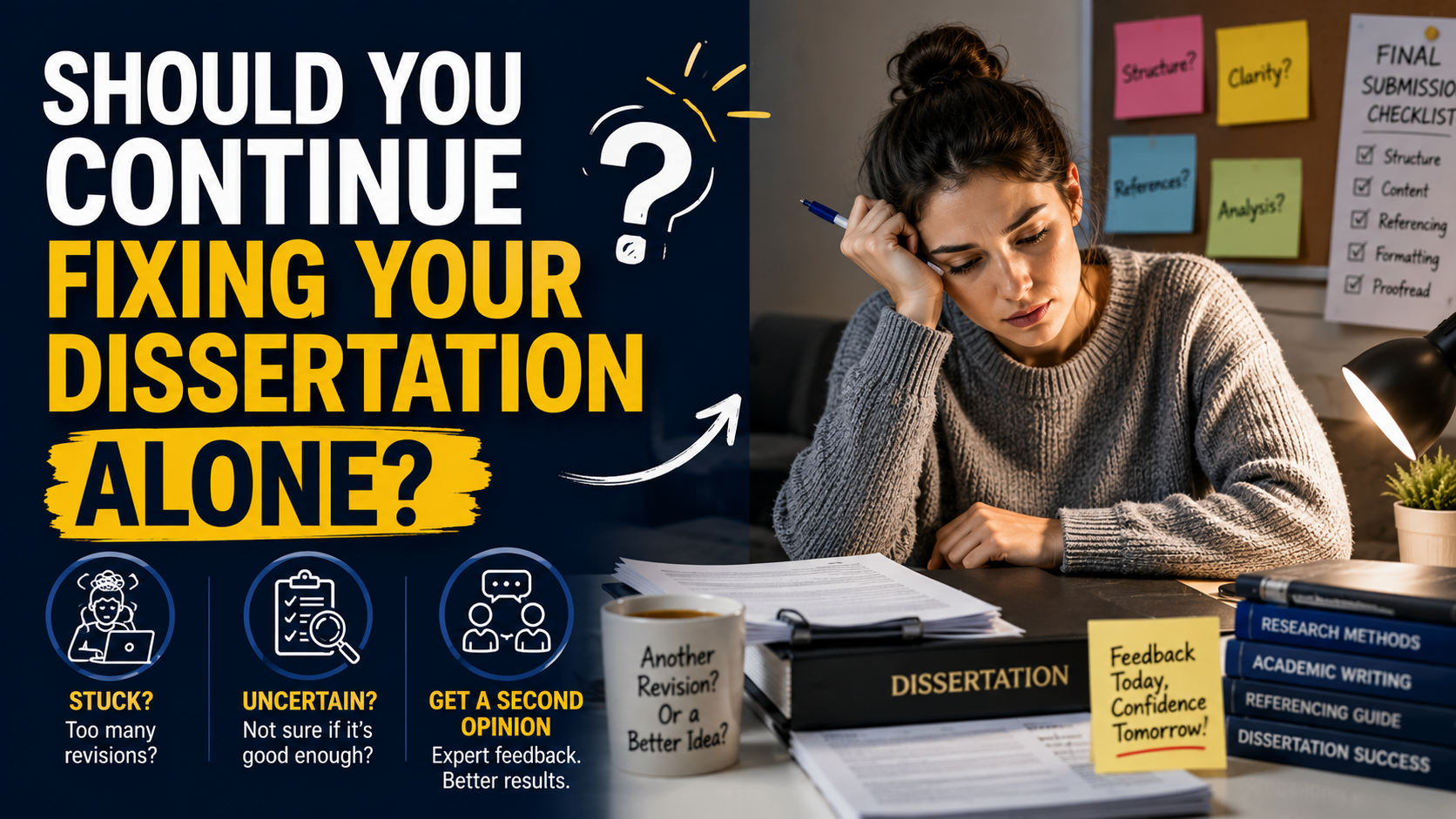
Many students continue making small changes right up until the submission deadline. They rewrite sentences, rearrange paragraphs, tweak references, and constantly question whether each chapter is "good enough."
But there comes a point where working alone becomes less productive. Instead of improving your dissertation, endless self-editing can lead to confusion, inconsistency, and unnecessary stress.
In this guide, you'll learn when self-editing is sufficient, when it becomes counterproductive, and how independent feedback can help you submit your dissertation with confidence.
Why Students Keep Editing Their Dissertation
Most students don't continue editing because their dissertation is poor—they do it because they want it to be perfect.
Common reasons include:
Fear of losing marks
Lack of confidence
Supervisor feedback that raised new questions
Worry about grammar or referencing
Perfectionism
Anxiety before submission
While these concerns are understandable, continuous revisions don't always produce better results.
The Problem With Editing the Same Document Repeatedly
The more often you read your dissertation, the more familiar it becomes.
Eventually, your brain starts reading what it expects to see rather than what's actually written.
This makes it difficult to notice:
Missing words
Grammar mistakes
Weak arguments
Repetitive ideas
Inconsistent terminology
Referencing errors
Formatting issues
This is why professional authors, researchers, and academics rarely rely solely on self-editing.
10 Signs You Should Stop Fixing Your Dissertation Alone
1. Every Editing Session Creates More Changes
Instead of solving problems, you're constantly rewriting sentences that were already acceptable.
This often indicates over-editing rather than genuine improvement.
2. You Keep Doubting Your Own Work
If you're changing the same paragraph every day, confidence—not quality—may be the real issue.
An independent perspective can help distinguish real weaknesses from unnecessary concerns.
3. You've Lost Track of Your Main Argument
After numerous revisions, some students unintentionally weaken the logical flow of their dissertation.
If your research questions, methodology, and conclusions no longer feel fully connected, it's worth getting another opinion.
4. You Can't Spot Errors Anymore
Reading the same document dozens of times makes obvious mistakes almost invisible.
Fresh readers often identify issues within minutes.
5. Your Supervisor Has Already Given Feedback
Supervisor comments provide valuable direction, but they may not identify every grammar, formatting, or consistency issue.
Additional review can help ensure those details are addressed before submission.
6. You're Constantly Searching Online for Answers
If every editing session sends you searching for:
Referencing rules
Dissertation examples
Grammar advice
Formatting guidelines
you may benefit from structured feedback instead of piecing together information from multiple sources.
7. Your Submission Deadline Is Near
As deadlines approach, stress increases while attention to detail decreases.
Having another person review your dissertation can help prioritise the most important improvements.
8. You Keep Finding New Mistakes
Every time you reopen the document, you discover something else.
This usually indicates that you're too close to the work to evaluate it objectively.
9. English Isn't Your First Language
Strong research deserves clear presentation.
Independent feedback can improve:
Academic tone
Grammar
Sentence structure
Word choice
Clarity
while preserving your original ideas.
10. Your Dissertation Carries Significant Marks
If your dissertation has a major impact on your final degree classification, investing time in a thorough review before submission can be worthwhile.
What Can You Successfully Edit Yourself?
Self-editing works well for:
Spelling corrections
Typographical errors
Basic grammar
Formatting consistency
Checking page numbers
Updating references
Ensuring chapter order
These are tasks where familiarity with your document is an advantage.
What Is Hard to Judge on Your Own?
Students often struggle to evaluate:
Area | Why It's Difficult |
|---|---|
Argument strength | You're already familiar with your reasoning. |
Clarity | Your brain fills in missing information automatically. |
Logical flow | Long-term editing makes inconsistencies harder to notice. |
Reader understanding | You already know what each section means. |
Academic tone | Small wording issues become difficult to recognise. |
Overall coherence | Individual edits may unintentionally weaken the bigger picture. |
The Benefits of Independent Feedback
An objective reviewer may help you identify:
Unclear explanations
Weak transitions
Inconsistent arguments
Referencing mistakes
Grammar issues
Formatting inconsistencies
Areas where evidence could be explained more clearly
Constructive feedback allows you to improve your own work while maintaining full ownership of your dissertation.
Avoid the Trap of Perfectionism
Many students delay submission because they believe one more edit will make the dissertation perfect.
In reality, every dissertation has limitations.
Universities assess:
Research quality
Critical thinking
Evidence
Analysis
Academic communication
—not whether every sentence is flawless.
Knowing when to stop editing is an important academic skill.
Practical Tips Before Your Final Submission
Before submitting:
Take a short break before your final proofread.
Read your dissertation aloud.
Check headings and formatting.
Verify all citations.
Review your reference list carefully.
Confirm tables and figures are numbered correctly.
Save multiple backup copies.
Allow enough time for final revisions.
Should You Ask Someone Else to Review It?
Seeking feedback doesn't mean you've failed.
Many students ask for:
Supervisor guidance
Peer feedback
Writing centre support
Independent academic review
The goal is not for someone else to write your dissertation but to help you identify areas that could be strengthened before submission.
Final Thoughts
Editing your dissertation independently is an essential part of the writing process, but there comes a stage where additional revisions produce diminishing returns. If you find yourself rewriting the same sections repeatedly, doubting every decision, or struggling to judge the quality of your own work, it may be time to seek an objective second opinion.
Balanced, constructive feedback can help you refine your dissertation, improve its clarity, and submit with greater confidence—while ensuring the research and final decisions remain entirely your own.
Frequently Asked Questions
Everything you need to know about our services


