Why Good Students Freeze When Writing Their Dissertation
Introduction
It surprises many students.
The classmates who consistently earn excellent grades, participate in seminars, and perform well in exams are often the very people who struggle the most when it comes to writing a dissertation.
Instead of making steady progress, they freeze.
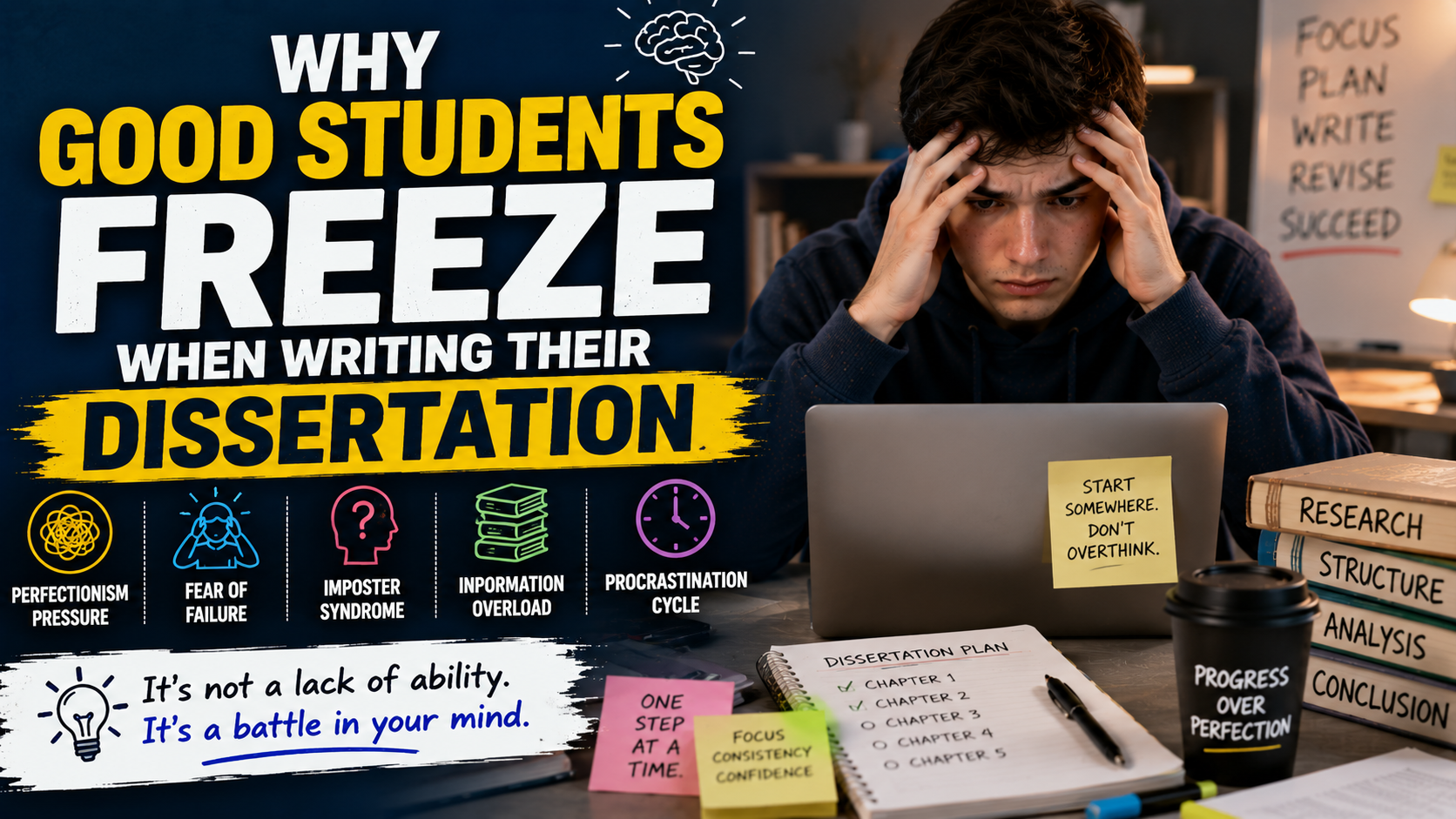
They spend hours staring at a blank document, repeatedly edit the introduction without moving forward, or postpone writing altogether despite understanding their research topic.
This isn't because they lack intelligence or academic ability. In many cases, high-achieving students freeze because they place enormous pressure on themselves to produce exceptional work.
Understanding why this happens is the first step towards overcoming it.
What Does "Freezing" Mean?
Freezing is a psychological response where students struggle to begin or continue writing despite knowing exactly what they should be doing.
It often looks like:
Opening the dissertation document but writing nothing.
Constantly rewriting the first paragraph.
Reading journal articles without producing new content.
Feeling mentally exhausted before writing even begins.
Avoiding dissertation work completely.
The problem is not a lack of knowledge.
The problem is becoming emotionally overwhelmed.
Why High-Achieving Students Freeze
They Want Everything to Be Perfect
Students who normally achieve high grades often believe their dissertation should be exceptional from the very first draft.
They think:
"This paragraph isn't good enough."
"I need stronger evidence first."
"I'll start once I fully understand every article."
Because perfection feels impossible, writing never begins.
Fear of Losing Their Academic Identity
Many high-performing students have built their confidence around academic success.
The dissertation feels different because:
It is independent.
It is longer than previous assignments.
There are fewer clear answers.
Some begin worrying:
"What if I'm not actually as capable as people think?"
This fear can become paralysing.
Imposter Syndrome
Even excellent students experience imposter syndrome.
They believe:
Their success was luck.
Other students are smarter.
Their research isn't original enough.
Eventually someone will discover they don't belong.
These thoughts reduce confidence and encourage avoidance.
Information Overload
Good students often read extensively.
Unfortunately, excessive reading sometimes replaces writing.
Instead of creating content, students continue searching for:
One more journal article.
One better source.
One stronger argument.
Research becomes a form of procrastination.
Fear of Supervisor Feedback
High-achieving students often value feedback deeply.
Some worry that criticism means failure.
Instead of submitting drafts, they wait until they believe everything is perfect.
Ironically, this delays the feedback that would improve the dissertation.
Why Exams Feel Easier Than Dissertations
Exams usually provide:
Clear questions.
Time limits.
Defined expectations.
Immediate completion.
Dissertations require:
Independent planning.
Long-term motivation.
Original research.
Continuous decision-making.
The uncertainty makes many students uncomfortable.
The Psychology Behind Freezing
When students perceive the dissertation as threatening, the brain activates a stress response.
Instead of encouraging productivity, the brain prioritises reducing discomfort.
Students may then:
Delay writing.
Organise notes repeatedly.
Clean their workspace.
Watch productivity videos.
These activities feel productive but avoid the actual task.
Signs You May Be Freezing
You might recognise yourself if you:
Keep delaying your first chapter.
Constantly revise your plan.
Read without writing.
Feel anxious every time you open your dissertation.
Believe you're "not ready yet."
Compare your work to others.
These behaviours are extremely common.
Why Waiting Makes Things Worse
The longer students delay writing:
Anxiety increases.
Deadlines become closer.
Confidence decreases.
Pressure becomes greater.
Eventually the dissertation feels impossible.
Starting small interrupts this cycle.
Practical Strategies to Overcome Freezing
Give Yourself Permission to Write Poorly
Your first draft is not your final dissertation.
Its purpose is to create material you can improve later.
Progress matters more than perfection.
Break Writing Into Tiny Tasks
Instead of:
"Write Chapter Two."
Try:
Write one paragraph.
Summarise one journal article.
Explain one concept.
Write 300 words.
Small wins create momentum.
Set Time Goals Instead of Word Goals
Rather than aiming for 1,000 words, commit to:
30 minutes of focused writing.
One uninterrupted session.
Consistent effort is more sustainable.
Separate Research From Writing
Avoid researching while writing.
Instead:
Morning:
Read articles.
Afternoon:
Write using your notes.
This prevents endless information gathering.
Submit Imperfect Drafts
Supervisor feedback exists to improve your work.
Waiting until everything feels perfect only delays valuable guidance.
Stop Comparing Yourself
Every dissertation differs in:
Topic.
Methodology.
Supervisor expectations.
Research complexity.
Focus on your own progress.
Confidence Grows Through Action
Many students wait to feel confident before writing.
In reality:
Writing creates confidence.
Each completed paragraph proves you can continue.
Healthy Thinking vs Freezing
Healthy Approach | Freezing Mindset |
|---|---|
Start imperfectly | Wait for perfection |
Write first, edit later | Edit before writing |
Accept feedback | Fear criticism |
Focus on progress | Focus on flawless results |
Complete small tasks | Think about the entire dissertation |
Final Thoughts
If you've frozen during your dissertation, it does not mean you lack ability—it often means you care deeply about producing excellent work. Ironically, the very qualities that make students successful in exams and coursework, such as high standards and attention to detail, can become obstacles when tackling an independent research project.
The solution is not to lower your standards but to change your approach. By accepting imperfect first drafts, breaking your dissertation into manageable tasks, seeking feedback early, and focusing on steady progress instead of perfection, you can overcome the fear that keeps you stuck. Remember, dissertations are completed one paragraph at a time, and every small step forward brings you closer to submission and academic success.
Frequently Asked Questions
Everything you need to know about our services
Related Posts

The Emotional Side of Dissertation Writing Nobody Talks About

Why Perfectionism Can Ruin Your Dissertation
