The Confidence Trap That Hurts Dissertation Grades
Introduction
Confidence is essential during dissertation writing. It helps students make decisions, defend arguments, and complete one of the most demanding academic projects of their degree.
However, there is a fine line between healthy confidence and overconfidence.
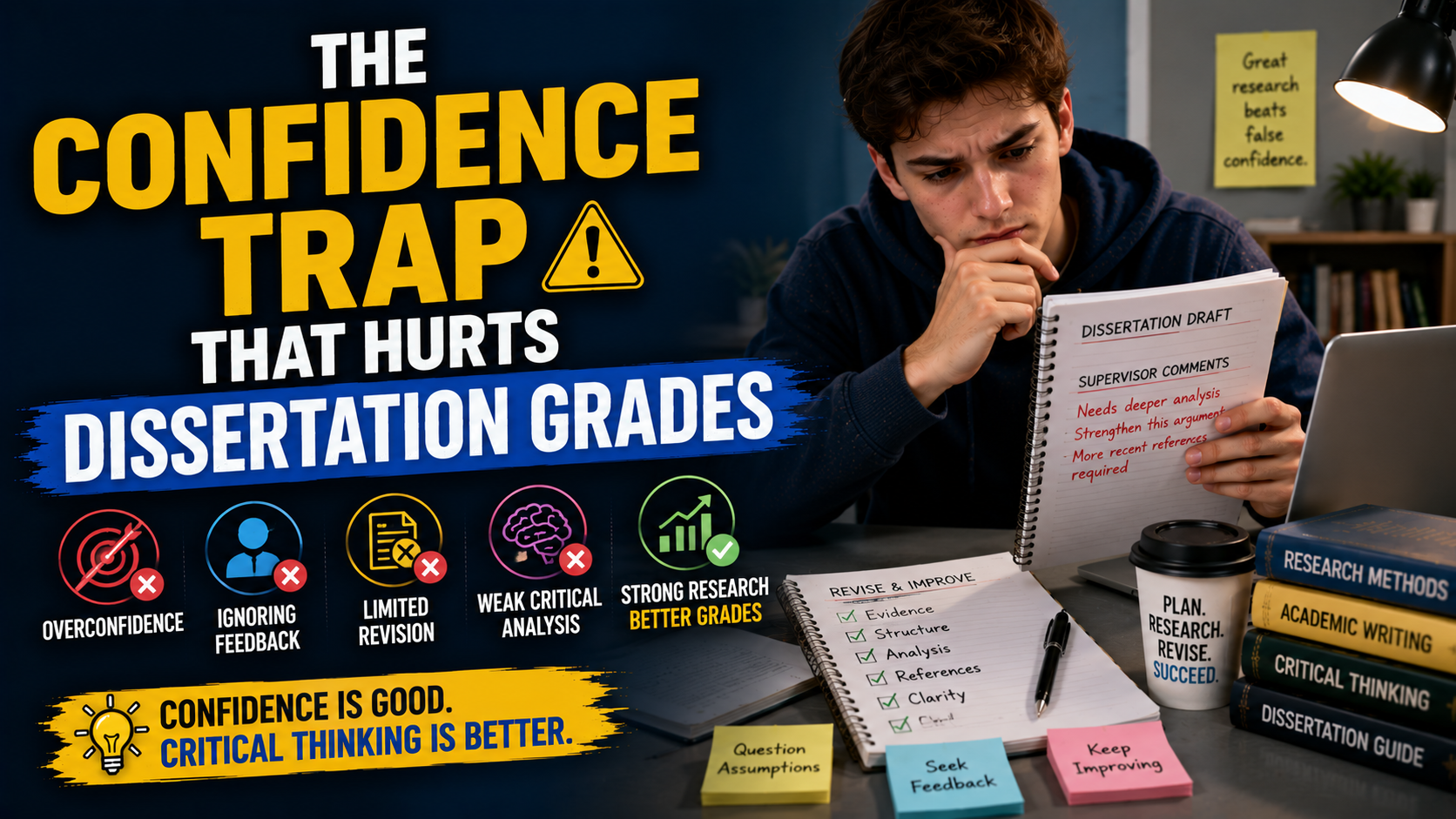
Many students assume that confidence always improves performance. Surprisingly, excessive confidence can quietly damage dissertation quality by reducing critical thinking, limiting revisions, and encouraging avoidable mistakes.
This hidden problem—often called the confidence trap—affects students across undergraduate, master's, and doctoral programmes.
Understanding how overconfidence influences dissertation writing can help you achieve stronger academic results while avoiding common pitfalls.
What Is the Confidence Trap?
The confidence trap occurs when students become so confident in their work that they stop questioning it.
Instead of asking:
"Can this argument be improved?"
"Have I supported this claim with enough evidence?"
"Could my methodology be stronger?"
they assume their first solution is already correct.
Academic research requires curiosity, critical thinking, and continuous improvement.
Overconfidence often interrupts that process.
Healthy Confidence vs Overconfidence
Healthy confidence means:
Trusting your preparation.
Making informed decisions.
Remaining open to feedback.
Continuing to improve.
Overconfidence means:
Believing your first draft is already excellent.
Ignoring constructive criticism.
Assuming you cannot make mistakes.
Avoiding further revisions.
The difference may seem small, but it has a significant impact on dissertation quality.
Why Students Become Overconfident
Several factors contribute to excessive confidence.
Previous Academic Success
Students who have consistently achieved high grades sometimes assume the dissertation will be similar to previous coursework.
However, dissertations require:
Independent research.
Original thinking.
Advanced critical analysis.
Strong methodological decisions.
Past success does not automatically guarantee future performance.
Positive Early Feedback
Receiving encouraging comments from a supervisor is valuable.
However, some students incorrectly interpret positive feedback as meaning:
"My dissertation is finished."
In reality, supervisors usually provide guidance on specific sections rather than evaluating the entire dissertation.
Familiarity With the Topic
After spending months researching one subject, students naturally become knowledgeable.
This familiarity can create the illusion that:
Every argument is clear.
Every explanation is complete.
Every conclusion is convincing.
Fresh readers often identify weaknesses that the writer no longer notices.
How Overconfidence Affects Dissertation Grades
Fewer Revisions
Students may stop editing too early.
As a result:
Weak arguments remain.
Grammar errors survive.
References stay incomplete.
Logical gaps remain unnoticed.
Revision is where many dissertations improve significantly.
Ignoring Supervisor Feedback
Some students selectively accept feedback.
They may think:
"I know what my examiner wants."
Ignoring constructive feedback can reduce dissertation quality and ultimately lower marks.
Weak Critical Analysis
Confident students sometimes assume their opinions are sufficient.
Academic writing requires:
Evidence.
Evaluation.
Alternative viewpoints.
Critical discussion.
Confidence should never replace academic evidence.
Limited Proofreading
Students who believe their dissertation is already excellent often perform only minimal proofreading.
Common issues include:
Formatting inconsistencies.
Typographical errors.
Incorrect citations.
Broken references.
Although individually small, these issues collectively affect professionalism.
The Confidence Trap and Confirmation Bias
Overconfidence often leads to confirmation bias.
Students begin looking only for evidence that supports their own ideas while ignoring contradictory research.
Strong dissertations evaluate multiple perspectives before reaching conclusions.
Why Examiners Value Critical Thinking
Examiners do not expect perfection.
They expect students to demonstrate:
Independent thinking.
Balanced analysis.
Research awareness.
Evidence-based conclusions.
Students who remain open to improving their work often produce stronger dissertations.
How to Avoid the Confidence Trap
Keep Questioning Your Work
Ask yourself:
Is this supported by evidence?
Have I explained this clearly?
Could another interpretation exist?
Continuous questioning strengthens academic writing.
Treat Feedback as an Opportunity
Supervisor comments are not criticism.
They are opportunities to improve.
Students who actively engage with feedback often produce stronger dissertations.
Leave Time Between Drafts
Taking short breaks before editing helps you:
Notice mistakes.
Improve clarity.
Strengthen arguments.
Distance creates better judgement.
Read Your Dissertation Like an Examiner
Imagine you have never seen your dissertation before.
Ask:
Is every claim supported?
Does every chapter flow logically?
Are limitations discussed honestly?
Viewing your work objectively reduces overconfidence.
Ask Someone Else to Read It
Fresh readers often notice:
Unclear explanations.
Missing information.
Repetition.
Formatting issues.
Independent feedback is invaluable.
Confidence Should Grow With Evidence
Healthy confidence comes from:
Thorough research.
Careful planning.
Multiple revisions.
Strong evidence.
Constructive feedback.
It does not come from assuming your first draft is already perfect.
Healthy Confidence vs Confidence Trap
Healthy Confidence | Confidence Trap |
|---|---|
Welcomes feedback | Ignores feedback |
Revises regularly | Stops editing early |
Questions assumptions | Assumes everything is correct |
Uses evidence | Relies on opinion |
Continues improving | Believes improvement is unnecessary |
Final Thoughts
Confidence is essential for completing a dissertation, but unchecked confidence can become a hidden obstacle to achieving higher grades. The strongest dissertations are rarely produced by students who believe their first draft is flawless—they are produced by those who continuously question, refine, and improve their work.
Healthy confidence allows you to trust your abilities while remaining open to feedback, new ideas, and constructive criticism. By balancing confidence with critical thinking, careful revision, and evidence-based decision-making, you can avoid the confidence trap and submit a dissertation that reflects your highest academic potential.
Frequently Asked Questions
Everything you need to know about our services
Related Posts

Why Perfectionism Can Ruin Your Dissertation

Dissertation Burnout: The Signs Most Students Ignore
