Should Universities Stop Giving Take-Home Assignments?
Introduction
Take-home assignments have been a cornerstone of higher education for decades. From essays and case studies to research projects and reflective reports, universities rely heavily on assignments to assess students' understanding beyond classroom learning.
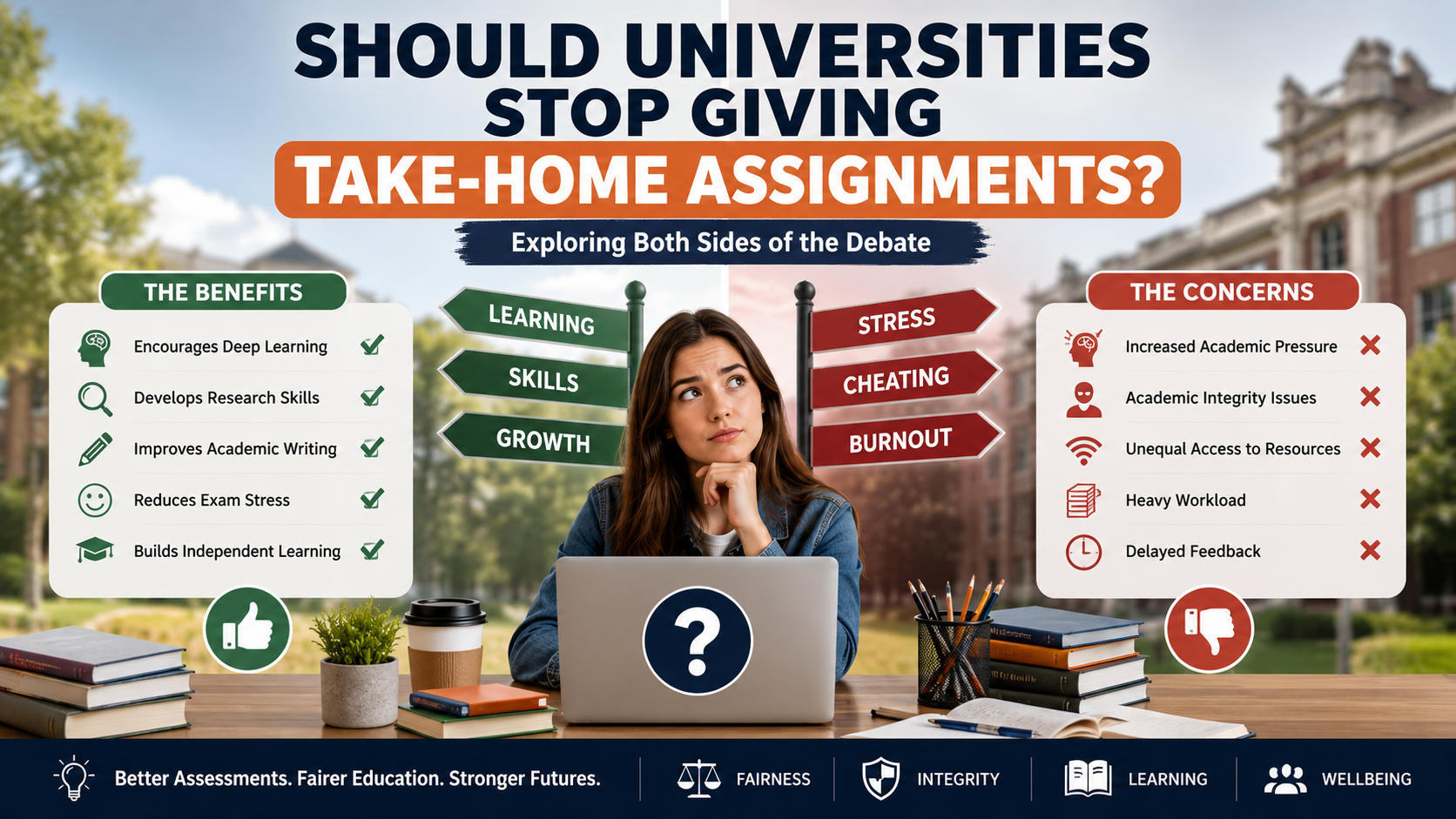
However, in recent years, many students and educators have started questioning whether take-home assignments are still the best method of assessment. Rising concerns about student mental health, academic integrity, artificial intelligence, and unequal access to resources have fueled an ongoing debate.
So, should universities stop giving take-home assignments?
The answer isn't as simple as yes or no. While take-home assignments offer several educational benefits, they also come with significant challenges that universities cannot ignore.
This article explores both sides of the debate and discusses possible alternatives that could create a fairer and more effective learning experience.
What Are Take-Home Assignments?
Take-home assignments are academic tasks that students complete outside the classroom before a specified deadline.
Examples include:
Research papers
Essays
Case studies
Literature reviews
Reports
Reflective journals
Programming projects
Business analyses
Design portfolios
Unlike timed examinations, these assignments allow students to research, revise, and edit their work over several days or weeks.
Why Universities Use Take-Home Assignments
Universities design take-home assignments to measure skills that traditional exams often cannot evaluate.
These include:
Critical thinking
Independent research
Academic writing
Problem-solving
Information analysis
Referencing skills
Time management
Assignments encourage students to engage deeply with a topic rather than memorizing information for an exam.
The Arguments in Favor of Take-Home Assignments
1. Encourages Deeper Learning
Students have time to:
Read academic literature
Compare different viewpoints
Develop original arguments
Reflect on complex concepts
This creates a much richer learning experience than answering questions under exam pressure.
2. Develops Research Skills
Almost every professional career requires research.
Assignments teach students how to:
Find credible sources
Evaluate evidence
Cite references correctly
Organize information logically
These skills remain valuable long after graduation.
3. Improves Academic Writing
Writing is a skill developed through practice.
Take-home assignments help students learn:
Academic tone
Paragraph structure
Critical analysis
Citation styles
Logical argumentation
These abilities are essential for dissertations, postgraduate study, and professional communication.
4. Reduces Exam Anxiety
Many students struggle with timed examinations due to:
Stress
Test anxiety
Medical conditions
Learning differences
Assignments provide a less stressful environment where students can demonstrate their knowledge more effectively.
5. Encourages Independent Learning
Rather than relying solely on lectures, students learn how to:
Research independently
Solve problems
Manage deadlines
Take responsibility for their learning
These are important life skills.
The Arguments Against Take-Home Assignments
1. Increased Academic Pressure
Many students juggle:
Multiple modules
Part-time jobs
Internships
Family responsibilities
Receiving several assignments at the same time can become overwhelming.
This often contributes to burnout and reduced academic performance.
2. Academic Integrity Concerns
One of the biggest criticisms is that take-home assignments make cheating easier.
Students may:
Copy from online sources
Purchase assignments
Ask others to complete their work
Misuse AI writing tools
Universities now invest heavily in plagiarism detection software and AI policies to maintain academic integrity.
3. Unequal Access to Resources
Not every student has:
A quiet study environment
Reliable internet access
Personal laptops
Academic support at home
These inequalities may affect assignment quality regardless of a student's actual ability.
4. Heavy Workload
Students often receive several assignments during the same week.
Instead of encouraging learning, excessive workloads may encourage:
Rushed work
Surface learning
Procrastination
Poor mental health
Quality may decline when quantity becomes excessive.
5. Delayed Feedback
Students sometimes wait weeks before receiving assignment results.
By then, they may have already completed similar assignments without learning from previous mistakes.
Timely feedback is essential for improvement.
The Impact of Artificial Intelligence
The rise of AI tools has transformed academic writing.
While AI can assist students with:
Brainstorming
Grammar improvement
Research organization
Language support
It has also raised concerns about originality and authorship.
Universities increasingly emphasize responsible AI use, requiring students to demonstrate independent thinking and proper disclosure when AI tools are used.
What Do Students Think?
Many students appreciate take-home assignments because they:
Reduce exam stress
Allow flexible scheduling
Encourage creativity
Support deeper learning
However, students also report challenges such as:
Tight deadlines
Conflicting assignments
Lack of motivation
Difficulty balancing work and study
The issue may not be assignments themselves but how they are designed and scheduled.
Possible Alternatives to Traditional Take-Home Assignments
Instead of eliminating assignments completely, universities could diversify assessment methods.
Examples include:
Open-book examinations
Students apply knowledge rather than memorize facts.
Presentations
Assess communication and subject understanding.
Group projects
Develop teamwork and collaboration skills.
Reflective journals
Measure personal learning and critical reflection.
Practical assessments
Ideal for engineering, healthcare, science, and creative disciplines.
Continuous assessment
Smaller assessments spread throughout the semester reduce pressure from high-stakes deadlines.
How Universities Can Improve Take-Home Assignments
Rather than removing assignments, universities could:
Space deadlines more evenly
Provide clearer assessment criteria
Offer faster feedback
Encourage ethical AI use
Focus on real-world problem-solving
Reduce unnecessary workload
Include flexible submission options where appropriate
These improvements could enhance learning while addressing many current concerns.
Should Universities Stop Giving Take-Home Assignments?
Probably not.
Take-home assignments remain one of the most effective ways to develop research, writing, and critical thinking skills.
However, universities should reconsider how assignments are designed rather than whether they should exist.
Modern assessment should balance:
Student wellbeing
Academic integrity
Learning outcomes
Practical skill development
Fairness
A combination of assignments, presentations, projects, and examinations may provide the most accurate picture of a student's abilities.
Final Thoughts
The debate over take-home assignments reflects broader changes in higher education. As technology evolves and student needs change, universities must adapt their assessment methods to remain fair, relevant, and effective.
Rather than eliminating take-home assignments, institutions should focus on improving their quality, balancing workloads, and integrating diverse forms of assessment. When thoughtfully designed, take-home assignments continue to play an essential role in preparing students for academic success and future careers.
Frequently Asked Questions
Everything you need to know about our services
Related Posts

How to Write a Dissertation from Scratch

How to Write a Gibbs Reflective Cycle: 15 Real Examples for Students
