How to Write a Gibbs Reflective Cycle: 15 Real Examples for Students
Introduction
Reflection is an essential part of learning in higher education. Whether you're studying nursing, business, education, psychology, engineering, or social work, your lecturer may ask you to write a reflective assignment using the Gibbs Reflective Cycle.
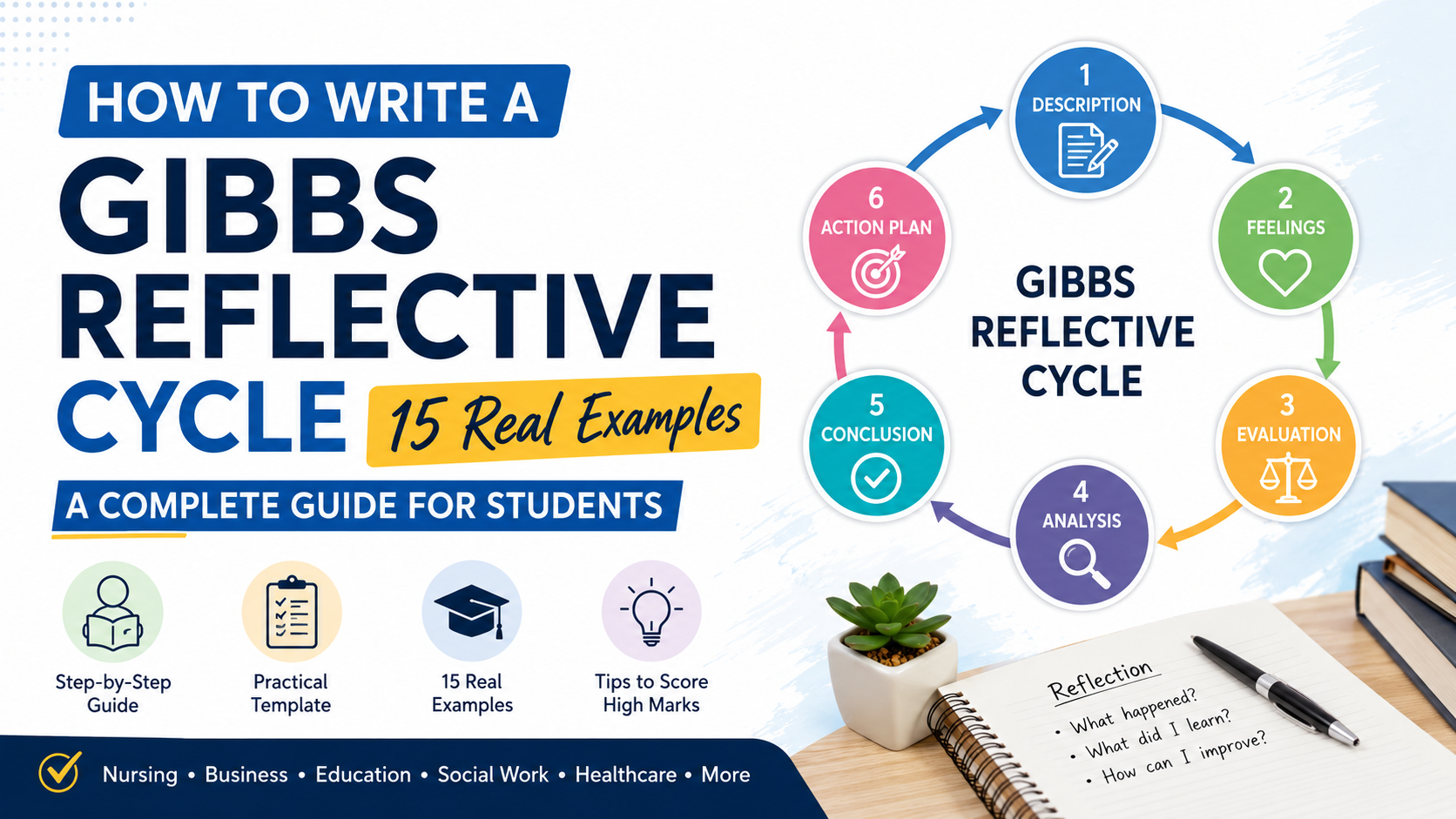
The Gibbs Reflective Cycle is a six-stage framework that helps students analyze experiences, identify lessons learned, and improve future performance. Developed by Graham Gibbs in 1988, the model includes Description, Feelings, Evaluation, Analysis, Conclusion, and Action Plan. It is widely used in nursing, education, business, healthcare, social work, and university assignments because it encourages critical thinking rather than simply describing events.
Many students struggle with reflective writing because they focus only on describing what happened rather than critically analyzing their experience. A high-quality Gibbs reflection requires you to explore your emotions, evaluate outcomes, understand why events occurred, identify lessons learned, and create an action plan for future improvement.
This comprehensive guide explains how to write a Gibbs Reflective Cycle assignment step by step. You'll also find 15 real-world examples, a practical template, writing tips, and common mistakes to avoid.
What Is Gibbs Reflective Cycle?
The Gibbs Reflective Cycle is a structured reflective model developed by Graham Gibbs in 1988. The framework encourages learners to reflect on experiences in a systematic way to improve future performance.
Unlike simply recalling an event, Gibbs' model focuses on learning from experience through structured self-reflection.
The six stages are:
-
Description
-
Feelings
-
Evaluation
-
Analysis
-
Conclusion
-
Action Plan
Each stage builds on the previous one, helping students develop deeper critical thinking and professional skills.
Why Do Universities Use Gibbs Reflective Cycle?
Universities use reflective models because employers value graduates who can evaluate their own performance and continuously improve.
Reflective writing helps students:
-
Develop critical thinking skills
-
Improve decision-making
-
Learn from mistakes
-
Build professional confidence
-
Connect theory with practice
-
Improve communication skills
-
Prepare for workplace challenges
The model is commonly used in:
-
Nursing
-
Healthcare
-
Social Work
-
Teaching
-
Psychology
-
Business Management
-
Engineering
-
Leadership Studies
The Six Stages of Gibbs Reflective Cycle Explained
1. Description – What Happened?
This section explains the situation without opinions or analysis.
Ask yourself:
-
What happened?
-
Where did it happen?
-
Who was involved?
-
What was your role?
-
What was the outcome?
Example
During my nursing placement, I was asked to assist a senior nurse in administering medication to a patient recovering from surgery. It was my first experience with medication administration in a clinical setting.
Keep this section factual and concise.
2. Feelings – What Were You Thinking and Feeling?
Reflection is not only about events but also about emotions.
Discuss:
-
Your initial feelings
-
Thoughts during the experience
-
Feelings afterward
-
How your emotions affected your actions
Example
Initially, I felt nervous because I was afraid of making a mistake. As the procedure progressed, I became more confident after receiving guidance from my supervisor.
Avoid exaggeration and stay professional.
3. Evaluation – What Went Well and What Didn't?
Evaluate both positive and negative aspects.
Questions to answer:
-
What worked well?
-
What could have gone better?
-
Were expectations met?
-
What challenges occurred?
Example
Positive:
-
Good communication
-
Careful preparation
-
Supervisor support
Negative:
-
Lack of confidence
-
Slow decision-making
-
Limited practical experience
Balanced evaluation demonstrates critical thinking.
4. Analysis – Why Did It Happen?
This is the most important section of your reflection.
Instead of describing events, explain why they occurred.
Include:
-
Relevant theories
-
Academic literature
-
Research evidence
-
Professional standards
Example
My hesitation was largely due to limited clinical experience. According to experiential learning theory, confidence develops through repeated practice and reflection. The guidance provided by my supervisor reduced my anxiety and improved my performance.
Analysis transforms your reflection into an academic assignment.
5. Conclusion – What Have You Learned?
Summarize the lessons learned.
Example:
This experience taught me the importance of preparation, communication, and seeking support when faced with unfamiliar clinical procedures.
Focus on personal growth.
6. Action Plan – What Will You Do Next Time?
Explain how you'll improve.
Example:
-
Attend additional workshops.
-
Practice communication skills.
-
Review procedures before placement.
-
Seek constructive feedback regularly.
The action plan demonstrates continuous improvement.
The action plan demonstrates continuous improvement.
Gibbs Reflective Cycle Template
Use this simple template when writing your assignment.
| Stage | Guiding Questions |
|---|---|
| Description | What happened? |
| Feelings | What did you think and feel? |
| Evaluation | What was good and bad? |
| Analysis | Why did it happen? |
| Conclusion | What did you learn? |
| Action Plan | What will you do differently next time? |
Example 1: Nursing Placement Reflection
Description
During my hospital placement, I assisted a registered nurse with administering medication to patients under supervision.
Feelings
I felt anxious because I was worried about making an error. However, my confidence increased as I received guidance throughout the procedure.
Evaluation
The supervision ensured patient safety, and I followed the correct procedures. However, I took longer than expected because I double-checked each step.
Analysis
My lack of experience contributed to my hesitation. Observing experienced nurses demonstrated how preparation improves efficiency.
Conclusion
I realized that confidence develops through experience and preparation.
Action Plan
Before future placements, I will review medication protocols and practice dosage calculations.
Example 2: Group Assignment
Description
Our team of four students completed a marketing presentation.
Feelings
Initially, I was excited but became frustrated because some members missed deadlines.
Evaluation
Communication was effective early in the project, but inconsistent participation delayed progress.
Analysis
The team lacked clear responsibilities and regular meetings.
Conclusion
Clear delegation improves teamwork.
Action Plan
In future projects, I will establish responsibilities during the first meeting.
Example 3: Classroom Presentation
Description
I presented a business proposal to my class.
Feelings
I felt nervous before speaking but became comfortable after the introduction.
Evaluation
My slides were well-designed, but I spoke too quickly.
Analysis
Anxiety affected my pacing.
Conclusion
Preparation reduces presentation anxiety.
Action Plan
I will rehearse several times before future presentations.
Example 4: Customer Service Experience
Description
During my retail internship, I handled an unhappy customer.
Feelings
I felt pressured but remained calm.
Evaluation
Listening carefully helped resolve the issue.
Analysis
Active listening reduced conflict and improved customer satisfaction.
Conclusion
Patience is essential in customer service.
Action Plan
I will continue developing conflict-resolution skills.
Example 5: Teaching Placement
Description
I delivered a mathematics lesson to Year 8 students.
Feelings
I felt confident preparing the lesson but nervous about classroom management.
Evaluation
Students participated actively, although time management could have been better.
Analysis
Some activities took longer than expected because instructions were unclear.
Conclusion
Effective lesson planning includes realistic timing.
Action Plan
I'll simplify instructions and allocate extra time for questions.
Example 6: Clinical Placement
Description
I observed a patient assessment conducted by my mentor.
Feelings
I was eager to learn but unsure about asking questions.
Evaluation
Observation improved my understanding, although I missed opportunities to participate.
Analysis
Confidence grows through active involvement rather than passive observation.
Conclusion
Participation enhances learning.
Action Plan
I'll volunteer for supervised tasks during future placements.
Example 7: Leadership Project
Description
I led a team project during my business management course.
Feelings
I enjoyed leading but struggled with delegation.
Evaluation
The project achieved its objectives, although workload distribution was uneven.
Analysis
Delegating tasks improves efficiency and team motivation.
Conclusion
Leadership involves trust and communication.
Action Plan
I'll assign responsibilities according to individual strengths.
Example 8: Laboratory Experiment
Description
I conducted a chemistry experiment in the university laboratory.
Feelings
I felt prepared but became concerned when unexpected results appeared.
Evaluation
Following safety procedures prevented mistakes.
Analysis
The unexpected results highlighted the importance of accurate measurements.
Conclusion
Scientific work requires attention to detail.
Action Plan
I'll verify calculations before beginning future experiments.
Key Tips for Writing a High-Scoring Gibbs Reflection
-
Write in the first person unless instructed otherwise.
-
Focus on critical analysis, not just description.
-
Be honest but professional.
-
Support your analysis with academic literature where required.
-
Link your experience to learning outcomes.
-
End with a realistic action plan.
-
Maintain a logical structure using the six stages.
Example 9: Social Work Placement Reflection
Description
During my social work placement, I attended a meeting with a family experiencing financial hardship. My role was to observe the senior social worker and assist in documenting the discussion. The meeting involved discussing available support services and creating an action plan for the family.
Feelings
Initially, I felt empathetic toward the family's situation but also nervous about interacting with them professionally. I was concerned about saying something inappropriate or making assumptions. As the meeting progressed, I became more comfortable after observing the social worker's communication techniques.
Evaluation
The meeting was successful because the family felt heard and agreed to the proposed support plan. However, I realized I remained too passive and missed opportunities to ask relevant questions.
Analysis
The experience highlighted the importance of active listening and professional communication. Social workers must balance empathy with objectivity while ensuring clients feel respected. My hesitation stemmed from limited practical experience rather than lack of knowledge.
Conclusion
I learned that confidence develops through practice and preparation.
Action Plan
For future placements, I will prepare discussion points beforehand and participate more actively during supervised client meetings.
Example 10: Engineering Project Reflection
Description
Our engineering team designed a bridge model as part of a structural engineering assignment.
Feelings
I was excited about applying theoretical concepts but became frustrated when our initial design failed stress testing.
Evaluation
The failure allowed us to identify weaknesses before the final submission. Although the redesign required extra work, it improved the final outcome.
Analysis
Engineering design is an iterative process. Failure often leads to innovation by encouraging teams to evaluate assumptions and improve designs.
Conclusion
Testing is just as important as design.
Action Plan
I will perform smaller prototype tests before completing future engineering projects.
Example 11: Internship Reflection
Description
During my marketing internship, I helped develop a social media campaign for a local business.
Feelings
I felt enthusiastic because it was my first opportunity to work on a live campaign.
Evaluation
The campaign increased online engagement, although our posting schedule was inconsistent.
Analysis
Planning content in advance would have improved consistency and audience reach.
Conclusion
Marketing success depends on both creativity and strategic planning.
Action Plan
I'll use content calendars and scheduling tools in future campaigns.
Example 12: Sports Coaching Reflection
Description
I coached a junior football team during a weekend tournament.
Feelings
I felt responsible for motivating the players and maintaining team morale.
Evaluation
The players improved throughout the tournament, although communication during matches could have been clearer.
Analysis
Positive reinforcement increased player confidence, while unclear instructions occasionally caused confusion.
Conclusion
Effective coaching combines leadership with communication.
Action Plan
I'll simplify tactical instructions and provide more frequent feedback.
Example 13: Research Project Reflection
Description
I completed an independent research project investigating consumer purchasing behaviour.
Feelings
I enjoyed collecting data but found statistical analysis challenging.
Evaluation
The research answered the objectives successfully, although time management became difficult during the final weeks.
Analysis
Breaking the project into smaller milestones would have reduced stress.
Conclusion
Research requires consistent planning rather than last-minute effort.
Action Plan
I'll create a project timeline before starting future research assignments.
Example 14: Hospitality Placement Reflection
Description
I worked in a busy hotel reception during my hospitality placement.
Feelings
Initially, I struggled with handling multiple customer requests simultaneously.
Evaluation
Customer satisfaction remained high because staff worked together effectively.
Analysis
Teamwork and communication reduced pressure during busy periods.
Conclusion
Excellent customer service depends on collaboration.
Action Plan
I'll continue improving multitasking and communication skills.
Example 15: Volunteer Experience Reflection
Description
I volunteered at a community charity event helping organize donations.
Feelings
I felt proud to contribute to the local community.
Evaluation
The event successfully collected supplies for families in need, although volunteer coordination could have been improved.
Analysis
Clear role allocation increases efficiency during large community events.
Conclusion
Volunteering strengthened both my teamwork and leadership skills.
Action Plan
Next time, I'll help organize volunteers before the event begins.
Common Mistakes Students Make
Many students lose marks because they misunderstand reflective writing. Avoid these common mistakes:
1. Describing Instead of Reflecting
Simply explaining what happened is not enough. Always explain why the experience mattered and what you learned.
2. Ignoring Feelings
The Feelings stage should explain how your emotions influenced your decisions and actions.
3. Missing Critical Analysis
Analysis should connect your experience with theory, professional standards, or academic literature where appropriate.
4. Writing an Unrealistic Action Plan
Avoid vague statements like "I'll do better next time." Instead, create specific and measurable improvement goals.
5. Being Too Negative
Reflection is about balanced learning. Acknowledge strengths as well as weaknesses.
Gibbs Reflective Cycle vs. Kolb's Reflective Cycle
Tips to Score High Marks
-
Follow all six stages in order. -
Use the first person ("I") unless your university advises otherwise. -
Support analysis with relevant theories or references. -
Be honest and objective. -
Focus on learning rather than storytelling. -
Write clearly and logically. -
Proofread your work before submission. -
End with a realistic action plan.
Final Thoughts
The Gibbs Reflective Cycle remains one of the most effective reflective writing models used in higher education. Its structured six-stage approach encourages students to think critically about their experiences, identify strengths and weaknesses, and develop practical strategies for future improvement.
Whether you're writing about a nursing placement, teaching practice, business presentation, research project, or group assignment, following the Gibbs model will help you produce a well-organized and insightful reflection.
Remember, a strong reflective assignment is not about describing events—it's about demonstrating how your experiences have contributed to your personal, academic, and professional development.
By using the examples, template, and writing tips provided in this guide, you'll be better prepared to create a reflective piece that meets university expectations and showcases your ability to learn from experience.
Frequently Asked Questions
Everything you need to know about our services


