Harvard Referencing Guide for UK Students (2026)
Introduction
Referencing is one of the most important academic skills every university student must master. Whether you're writing an essay, dissertation, coursework, or research report, using the correct referencing style demonstrates academic integrity and helps you avoid plagiarism.
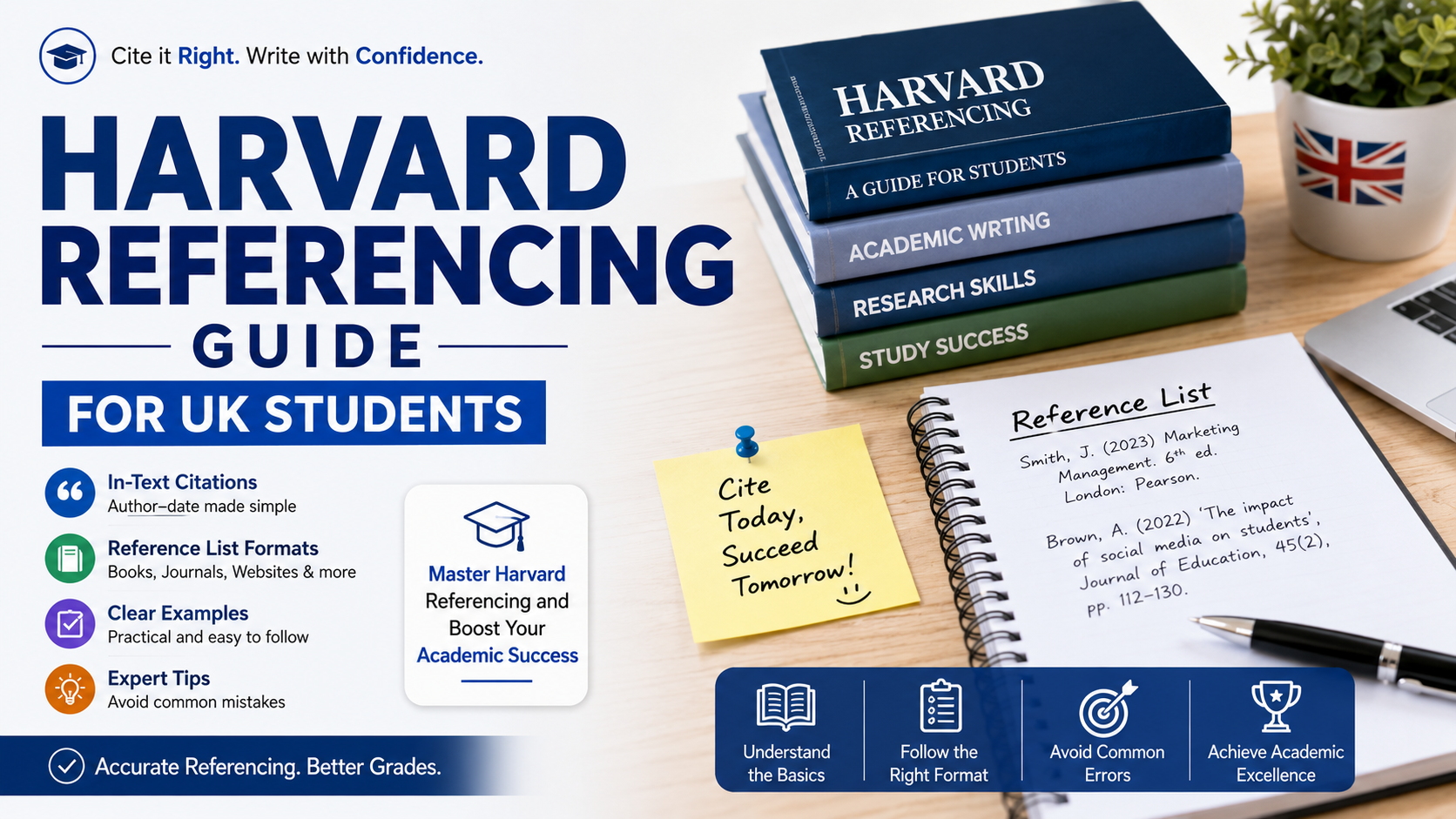
Among all citation styles used in UK universities, Harvard referencing remains one of the most popular. While different institutions may have slight variations of the Harvard system, the basic principles remain the same.
This comprehensive guide explains everything UK students need to know about Harvard referencing, including in-text citations, reference lists, examples for different source types, and common mistakes to avoid.
What Is Harvard Referencing?
Harvard referencing is an author-date citation system. Instead of using numbered footnotes, it identifies sources using:
-
Author's surname
-
Year of publication
For example:
Artificial intelligence is transforming education (Smith, 2023).
Every in-text citation must correspond to a full reference in the reference list at the end of your assignment.
Why Is Harvard Referencing Important?
Correct referencing helps students:
-
Avoid plagiarism
-
Give proper credit to original authors
-
Improve academic credibility
-
Support arguments with reliable evidence
-
Meet university assessment requirements
Most UK universities consider poor referencing an academic offence, even when unintentional.
Basic Structure of Harvard Referencing
Harvard referencing has two parts:
1. In-Text Citation
Inserted within your assignment whenever you use someone else's work.
Example:
Online learning has significantly increased after the pandemic (Brown, 2022).
2. Reference List
Appears at the end of your assignment and contains full publication details.
Example:
Brown, J. (2022) Digital Learning in Higher Education. London: Sage Publications.
Harvard In-Text Citation Examples
One Author
(Smith, 2023)
or
Smith (2023) argues that...
Two Authors
(Jones and Taylor, 2022)
Three or More Authors
(Wilson et al., 2024)
Direct Quote
Include page numbers.
"Critical thinking is essential for university success" (Johnson, 2021, p. 56).
Multiple Sources
(Brown, 2021; Smith, 2022; Green, 2024)
How to Reference Books
Format
Author Surname, Initial. (Year) Book Title. Edition. Place: Publisher.
Example
Cottrell, S. (2023) The Study Skills Handbook. 6th ed. London: Red Globe Press.
How to Reference Journal Articles
Format
Author Surname, Initial. (Year) 'Article title', Journal Name, Volume(Issue), pp. xx-xx.
Example
Williams, P. (2024) 'Artificial intelligence in higher education', Journal of Educational Technology, 45(2), pp. 112–130.
How to Reference Websites
Format
Author/Organisation (Year) Title. Available at: URL (Accessed: Day Month Year).
Example
University of Oxford (2024) Academic Skills. Available at: https://www.ox.ac.uk (Accessed: 10 June 2025).
How to Reference Government Publications
Format
Government Department (Year) Title. Place: Publisher.
Example
Department for Education (2024) Higher Education Statistics. London: HMSO.
How to Reference Online Reports
Organisation (Year) Report Title. Available at: URL (Accessed: Date).
Harvard Referencing Examples Table
Every source you cite in your assignment should appear in your reference list, and every reference list entry should have a matching in-text citation. Always follow your university's required Harvard referencing style, as formatting may vary slightly between institutions.
Common Harvard Referencing Mistakes
Many students lose marks because of avoidable referencing errors.
Missing References
Every citation must appear in the reference list.
Incorrect Dates
Always use the publication year rather than the access date.
Missing Page Numbers
Required when directly quoting.
Inconsistent Formatting
Use one Harvard style consistently throughout your assignment.
Incorrect Author Names
Always write authors exactly as published.
Harvard Reference List Rules
Your reference list should:
-
Be arranged alphabetically
-
Include every cited source
-
Use consistent formatting
-
Include publication details
-
Include access dates for online sources
Do not separate books, journals, and websites into different sections unless your university specifically requests it.
Harvard Referencing Tips for UK Students
Read Your University's Referencing Guide
Some institutions have their own Harvard variation.
Keep References While Researching
Record sources immediately to avoid searching for them later.
Use Reference Management Software
Tools like Zotero, Mendeley, and EndNote can help organise citations.
Proofread Your Reference List
Check spelling, punctuation, italics, and publication details carefully.
Double-Check Every Citation
Ensure each in-text citation appears in the final reference list.
Final Thoughts
Mastering Harvard referencing is an essential skill for academic success in UK universities. Accurate citations strengthen your work, demonstrate academic honesty, and help you avoid plagiarism penalties.
By understanding how to cite books, journals, websites, reports, and other sources correctly, you'll produce professional, well-structured assignments that meet university standards. Always refer to your institution's specific Harvard referencing guidelines, proofread your citations carefully, and maintain consistency throughout your work.
Developing good referencing habits now will not only improve your grades but also prepare you for future academic and professional writing.
Frequently Asked Questions
Everything you need to know about our services

