MLA Citation Guide (Latest Edition): Complete Guide with Examples for Students
Introduction
Correctly citing your sources is one of the most important aspects of academic writing. Whether you're writing an essay, research paper, literature review, or thesis, following the Modern Language Association (MLA) citation style helps you maintain academic integrity and avoid plagiarism.
The latest MLA Handbook (9th Edition) provides updated guidelines for citing books, websites, journal articles, videos, AI-generated content, and other digital resources.
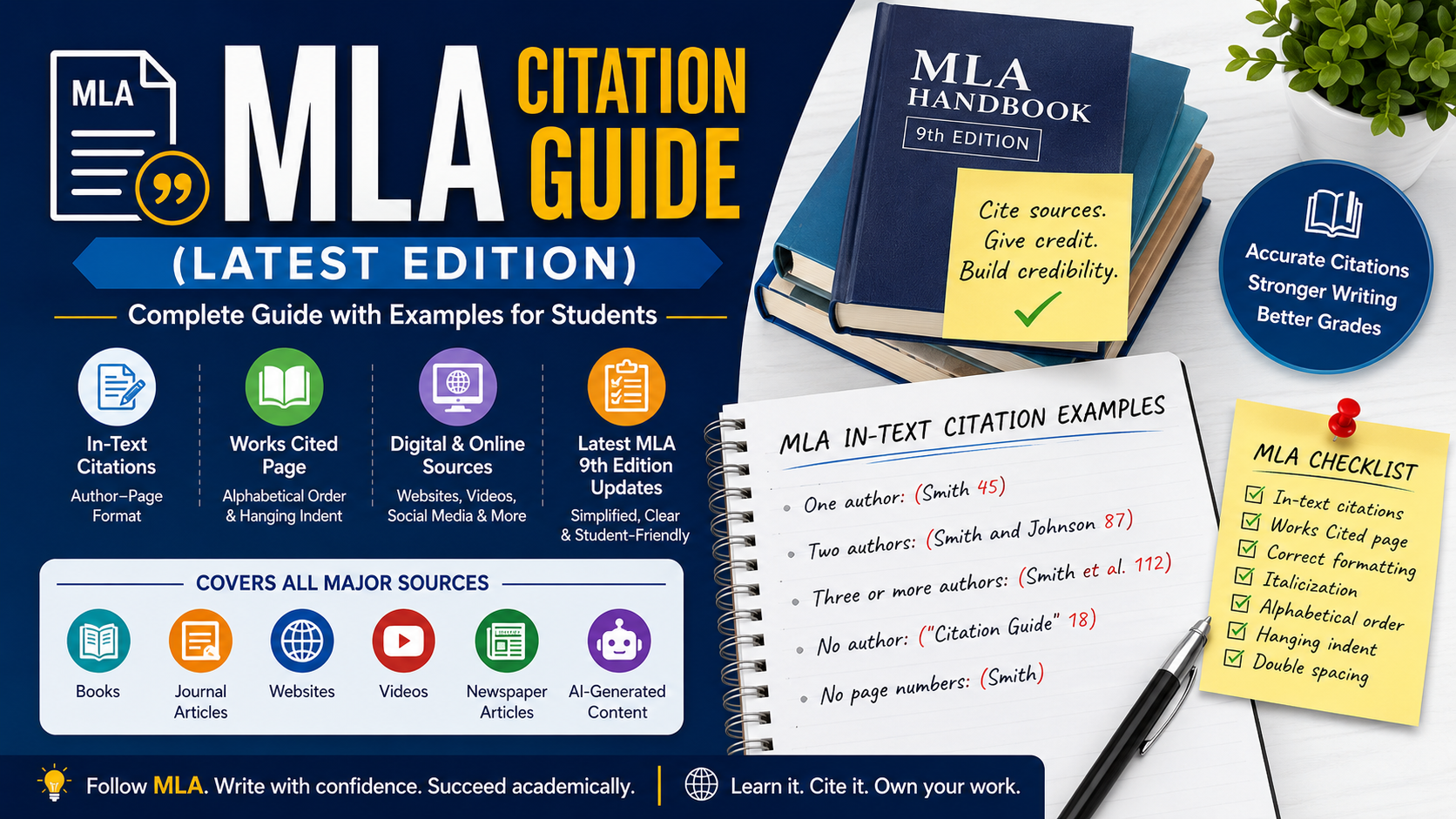
This guide explains everything you need to know about MLA formatting, in-text citations, Works Cited entries, and common mistakes—with practical examples.
What Is MLA Citation?
MLA (Modern Language Association) citation style is a standardized method of acknowledging sources used in academic writing. It is widely used in:
English Literature
Humanities
Language Studies
Cultural Studies
Philosophy
Arts
MLA helps readers identify the sources you used and locate them easily.
What's New in the Latest MLA Edition?
The MLA 9th Edition continues to emphasize flexibility while adapting to modern digital sources.
Key updates include:
Simplified citation rules for online content.
More guidance for social media and streaming platforms.
Better instructions for citing AI-generated content.
Consistent treatment of digital publications.
Greater emphasis on containers and DOIs.
MLA Paper Formatting Guidelines
Before adding citations, ensure your paper follows MLA formatting requirements.
ElementMLA RequirementFontTimes New Roman, 12 ptLine SpacingDouble-spacedMargins1 inch on all sidesAlignmentLeft-alignedParagraph Indent0.5 inchPage NumbersTop-right cornerHeaderLast Name + Page NumberTitleCentered, no bold or underline
MLA In-Text Citations
MLA uses the author-page format.
Basic Format
(Author Page Number)
Example
Artificial intelligence is transforming education (Smith 45).
Two Authors
(Smith and Johnson 87)
Three or More Authors
(Smith et al. 112)
No Author
Use the shortened title.
("Citation Guide" 18)
No Page Numbers
For websites without page numbers:
(Smith)
MLA Works Cited Page
The Works Cited page appears at the end of your paper.
General rules:
Alphabetize entries.
Double-space everything.
Use hanging indentation.
Italicize book and journal titles.
Include URLs without "https://" only if your instructor prefers; otherwise use the full URL according to current MLA recommendations.
MLA Citation Examples
Book
Format
Author Last Name, First Name. Book Title. Publisher, Year.
Example
Smith, John. Academic Writing Essentials. Oxford University Press, 2024.
Journal Article
Format
Author. "Article Title." Journal Name, vol. xx, no. xx, Year, pp. xx–xx.
Example
Brown, Lisa. "Citation Best Practices." Journal of Academic Research, vol. 18, no. 2, 2024, pp. 112–130.
Website
Format
Author. "Page Title." Website Name, Publisher, Publication Date, URL.
Example
Johnson, Emily. "MLA Citation Guide." Writing Center Online, 5 Jan. 2025, www.example.com/mla-guide.
Online Video
Format
"Video Title." YouTube, uploaded by Channel Name, Date, URL.
Newspaper Article
Author. "Article Title." Newspaper Name, Date, URL.
AI-Generated Content
If your institution permits AI tools, follow its policy. A common MLA approach is to identify the AI tool, describe the prompt if relevant, include the date of use, and follow your instructor's requirements.
How to Create MLA Citations Step by Step
Step 1
Identify the source type.
Step 2
Collect publication information.
Step 3
Create the in-text citation.
Step 4
Add the full Works Cited entry.
Step 5
Proofread formatting before submission.
Common MLA Citation Mistakes
Students frequently make these mistakes:
Forgetting in-text citations.
Missing Works Cited entries.
Incorrect author names.
Improper italics.
Inconsistent formatting.
Missing page numbers for books.
Incorrect capitalization.
Broken or incomplete URLs.
MLA Citation Checklist
Before submitting your assignment, verify that:
✔ Every in-text citation matches a Works Cited entry.
✔ Author names are correct.
✔ Titles are properly capitalized.
✔ Book and journal titles are italicized.
✔ Entries are alphabetized.
✔ Hanging indent is applied.
✔ The paper is double-spaced.
✔ Page numbers are included where applicable.
Case Study 1: Avoiding Plagiarism
A university student paraphrased multiple journal articles without adding MLA in-text citations.
Result
The instructor flagged the assignment for improper attribution.
Lesson
Even paraphrased ideas require citations.
Case Study 2: Incorrect Website Citation
A student copied a URL into the Works Cited page without the author's name or page title.
Result
Several formatting marks were deducted.
Lesson
Always include as many core MLA elements as possible.
Case Study 3: Inconsistent Formatting
A research paper mixed MLA and APA styles.
Issues
APA in-text citations
MLA Works Cited page
Incorrect italics
Outcome
Despite strong research, the student lost formatting marks.
Best Practices for MLA Citations
Record source details while researching.
Use one citation style consistently.
Verify every citation manually.
Check spelling and punctuation.
Keep Works Cited entries updated.
Follow your instructor's formatting requirements.
Conclusion
Mastering the MLA Citation Guide (Latest Edition) is essential for producing credible, plagiarism-free academic work. By understanding the latest MLA formatting rules, creating accurate in-text citations, and building a properly formatted Works Cited page, students can improve the quality of their assignments and meet academic standards with confidence.
Always double-check your citations before submitting your work, and consult your instructor if you have questions about citing unusual or emerging source types.
Frequently Asked Questions
Everything you need to know about our services

