Common Reasons Students Lose Marks (And How to Avoid Them)
Introduction
Every student dreams of achieving excellent grades, but many lose valuable marks due to avoidable mistakes rather than a lack of knowledge. Whether you're in school, college, or university, understanding these common pitfalls can significantly improve your academic performance.
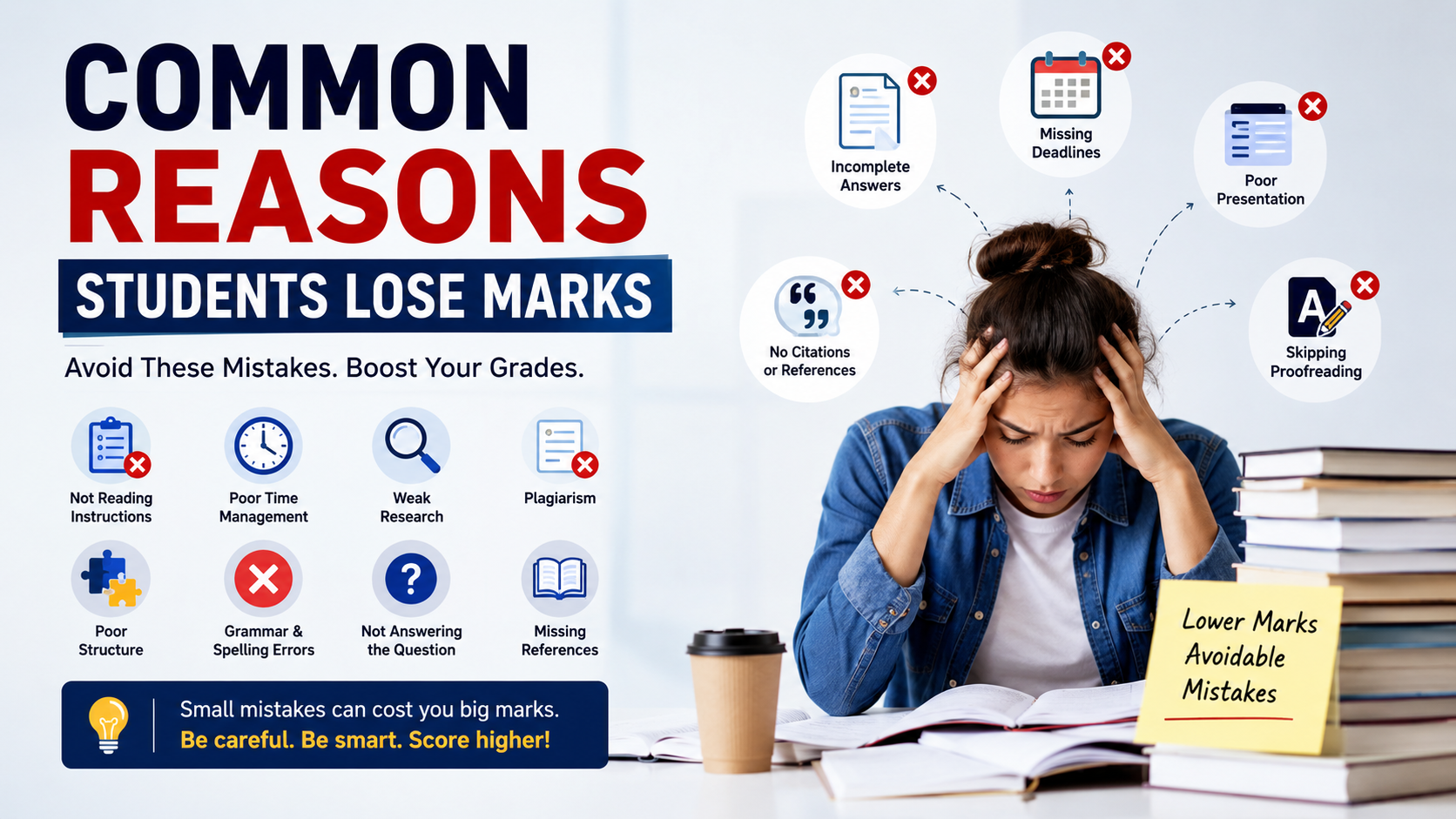
In this guide, we'll discuss the most common reasons students lose marks and provide practical tips to help you maximize your scores in assignments, exams, and projects.
1. Not Reading the Instructions Carefully
One of the biggest reasons students lose marks is failing to read assignment or exam instructions thoroughly.
Common Mistakes
Ignoring word count requirements
Missing formatting guidelines
Answering only part of the question
Submitting the wrong file format
How to Avoid It
Read the instructions at least twice.
Highlight important keywords.
Create a checklist before submitting.
2. Poor Time Management
Many students start their assignments too late, resulting in rushed work filled with mistakes.
Effects
Incomplete answers
Weak research
Poor editing
Missed deadlines
Solution
Break large tasks into smaller goals.
Use a planner or digital calendar.
Finish assignments a day before the deadline whenever possible.
3. Weak Research
Assignments based on unreliable websites or outdated information often receive lower grades.
Avoid
Random blogs
Unverified websites
Wikipedia as the primary source
Use Instead
Google Scholar
Academic journals
Library databases
Government publications
Peer-reviewed articles
4. Plagiarism
Copying content without proper citation is one of the fastest ways to lose marks and may even lead to disciplinary action.
Examples
Copy-pasting from websites
Using AI-generated text without editing or verification
Forgetting citations
Best Practice
Write in your own words.
Cite every source correctly.
Use plagiarism-checking software before submission.
5. Poor Structure
Even excellent ideas can lose marks if they are presented poorly.
A Good Assignment Includes
Clear introduction
Logical headings
Well-developed paragraphs
Strong conclusion
Proper references
A well-organized paper is easier for instructors to read and assess.
6. Grammar and Spelling Errors
Frequent grammar mistakes create a poor impression and reduce readability.
Common Errors
Incorrect punctuation
Spelling mistakes
Sentence fragments
Wrong verb tense
Improve By
Proofreading carefully.
Reading your work aloud.
Using grammar-checking tools.
7. Not Answering the Question
Students often write everything they know instead of answering what was actually asked.
For example:
Question: Discuss the advantages and disadvantages of online learning.
Incorrect Response: Writing only about the history of online education.
Always focus on the keywords in the question, such as:
Discuss
Compare
Evaluate
Analyze
Explain
Critically assess
8. Lack of Critical Analysis
Higher education assignments require analysis, not just description.
Instead of simply explaining facts, students should:
Compare viewpoints
Evaluate evidence
Discuss strengths and weaknesses
Draw conclusions supported by research
Critical thinking often separates average grades from excellent ones.
9. Missing References
Many assignments lose marks because references are incomplete or incorrectly formatted.
Common citation styles include:
APA
MLA
Harvard
Chicago
Always follow your instructor's preferred referencing style.
10. Ignoring Feedback
Teachers provide feedback to help students improve, yet many students repeat the same mistakes.
Review comments carefully and apply the suggestions in future assignments.
11. Poor Presentation
Presentation influences first impressions.
Avoid:
Different font styles
Inconsistent spacing
Large text blocks
Missing page numbers
Instead:
Use clear headings.
Keep formatting consistent.
Add tables or diagrams when appropriate.
12. Skipping Proofreading
Many small mistakes can be caught by simply reviewing your work before submission.
Check for:
Grammar
Spelling
Formatting
References
Missing sections
Incorrect numbering
Even a 15-minute proofreading session can improve your final grade.
Quick Checklist Before Submission
✅ Read all instructions carefully
✅ Answer every part of the question
✅ Conduct quality research
✅ Avoid plagiarism
✅ Cite all sources correctly
✅ Check grammar and spelling
✅ Follow formatting guidelines
✅ Proofread your work
✅ Submit before the deadline
Tips to Score Higher in Assignments
Start early instead of procrastinating.
Use reliable academic sources.
Create an outline before writing.
Support arguments with evidence.
Edit multiple times.
Ask a friend or mentor to review your work.
Learn from previous feedback.
Stay organized throughout the semester.
Conclusion
Losing marks isn't always about lacking knowledge—it's often the result of avoidable mistakes such as poor planning, weak research, incorrect formatting, or insufficient proofreading. By understanding these common issues and adopting better study habits, students can improve the quality of their assignments and achieve higher grades.
Academic success comes from preparation, attention to detail, and continuous improvement. By applying the tips in this guide, you'll be well on your way to producing stronger assignments and maximizing your academic performance.
Frequently Asked Questions
Everything you need to know about our services


