Assignment Editing Checklist: 20 Things to Review Before You Submit
Introduction
Submitting an assignment without editing is one of the biggest mistakes students make. Even a well-researched paper can lose valuable marks because of grammar mistakes, formatting errors, weak arguments, or incorrect citations.
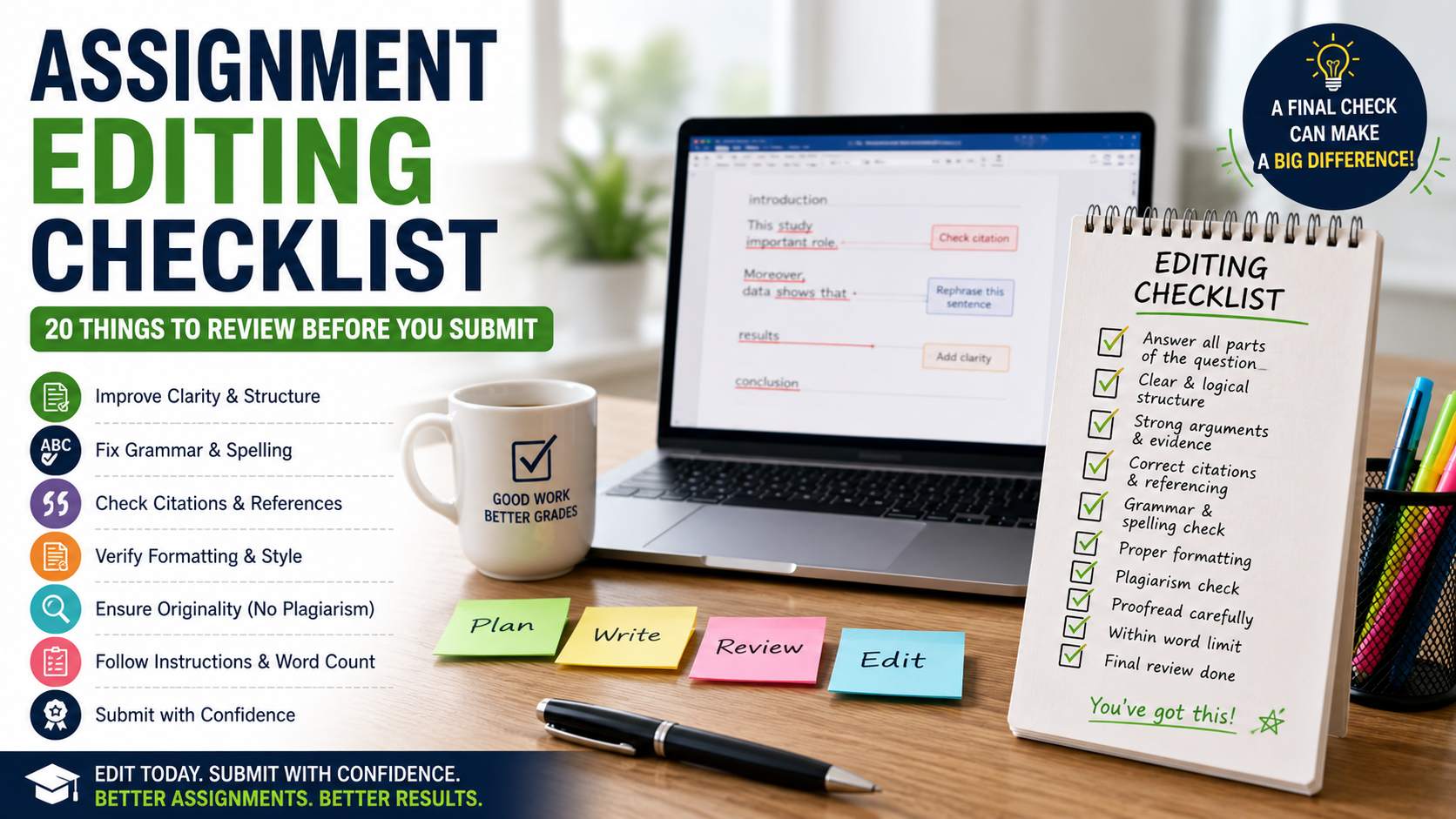
Editing isn't just about fixing spelling mistakes—it's about improving clarity, accuracy, organization, and professionalism.
This comprehensive assignment editing checklist will help you review every important aspect of your work before submission, increasing your chances of earning higher grades.
Quick Answer
Before submitting your assignment, check the assignment requirements, structure, grammar, spelling, formatting, citations, plagiarism, evidence, word count, and overall readability. A final proofreading session can significantly improve the quality of your work.
Why Editing Your Assignment Matters
Many students spend hours researching and writing but only a few minutes reviewing their work.
Editing helps you:
Eliminate grammar and spelling mistakes
Improve sentence clarity
Strengthen arguments
Correct referencing errors
Maintain academic tone
Improve readability
Avoid plagiarism
Meet university guidelines
Increase assignment marks
The Ultimate Assignment Editing Checklist
1. Read the Assignment Question Again
Make sure every requirement has been answered.
Ask yourself:
Did I answer every part of the question?
Have I followed all instructions?
Is my topic focused?
2. Check Your Assignment Structure
A good assignment should include:
Title page (if required)
Introduction
Main body
Conclusion
References
Appendices (if required)
Each section should flow naturally.
3. Review Your Introduction
Your introduction should:
Introduce the topic
Provide background
Present your thesis statement
Explain what the assignment covers
4. Check Paragraph Structure
Each paragraph should contain:
Topic sentence
Supporting evidence
Explanation
Link to the next idea
Avoid overly long paragraphs.
5. Improve Clarity
Replace:
❌ Difficult wording
With:
✅ Simple academic language
Remove unnecessary repetition.
6. Fix Grammar Errors
Check for:
Subject-verb agreement
Verb tense consistency
Articles (a, an, the)
Prepositions
Punctuation
Grammar mistakes reduce credibility.
7. Correct Spelling Mistakes
Use spell-check, but don't rely on it completely.
Watch for words like:
Affect vs Effect
Their vs There
Principal vs Principle
8. Maintain an Academic Tone
Avoid:
Slang
Contractions
Informal language
Personal opinions (unless required)
Write objectively.
9. Verify Facts and Statistics
Double-check:
Dates
Names
Numbers
Statistics
Research findings
Incorrect facts reduce trustworthiness.
10. Review Citations
Ensure:
Every in-text citation appears in the reference list.
Every reference is cited in the text.
Citation style is consistent.
11. Check Referencing Style
Use the required style:
APA 7th
Harvard
MLA 9th
Chicago
Follow formatting rules carefully.
12. Look for Plagiarism
Ensure:
Proper paraphrasing
Correct quotations
Accurate citations
Original writing
Always review similarity reports before submission if available.
13. Improve Transitions
Use transition words like:
Furthermore
However
Therefore
Moreover
Consequently
These improve readability.
14. Check Formatting
Review:
Font
Font size
Margins
Line spacing
Page numbers
Headings
Follow your university's formatting guidelines.
15. Review Tables and Figures
Ensure:
Correct numbering
Captions
Labels
Source citations
References in the text
16. Check Word Count
Stay within the permitted limit.
Many universities allow approximately ±10%.
17. Read Your Assignment Aloud
Reading aloud helps identify:
Awkward wording
Long sentences
Missing words
Repeated phrases
18. Proofread One Final Time
Take a short break before proofreading.
A fresh perspective helps you spot hidden mistakes.
19. Ask Someone to Review It
A second opinion often catches mistakes you've overlooked.
Peer feedback can improve clarity and argument quality.
20. Final Submission Checklist
Before clicking Submit, confirm:
✅ Assignment question answered
✅ Correct file format
✅ Grammar checked
✅ Spelling checked
✅ References completed
✅ Formatting correct
✅ Plagiarism reviewed
✅ Figures labelled
✅ Word count within limit
✅ File name correct
Common Editing Mistakes Students Make
Editing immediately after writing
Ignoring formatting guidelines
Missing citation errors
Relying only on spell-check
Forgetting the reference list
Not checking plagiarism
Submitting the wrong file
Avoiding these mistakes can improve your assignment quality significantly.
Best Tools for Assignment Editing
Using the right editing tools can significantly improve the quality of your assignment before submission. Grammarly helps identify grammar, spelling, punctuation, and sentence structure errors, while the Hemingway Editor improves readability by highlighting complex sentences, passive voice, and unnecessary words. Google Docs offers built-in spelling suggestions and makes collaboration easy through real-time editing and commenting. Microsoft Word Editor provides advanced grammar, formatting, and style recommendations to ensure a polished document. For academic referencing, Zotero simplifies citation management by organizing research sources and automatically generating citations in multiple styles, while Mendeley helps students store, manage, annotate, and cite research papers efficiently. Combining these tools ensures your assignment is clear, error-free, well-formatted, and properly referenced.
Final Thoughts
Editing is the final step that transforms a good assignment into an excellent one. By following this assignment editing checklist, you can eliminate common mistakes, improve readability, strengthen your arguments, and submit polished academic work with confidence. Taking a little extra time to review your assignment before submission can make a significant difference to your final grade.
Frequently Asked Questions
Everything you need to know about our services


