What Is Critical Analysis in UK Universities? A Complete Student Guide
Introduction
If you've recently started studying at a UK university, you've probably heard lecturers say, "Be more critical in your writing." For many students—especially international students—this advice can be confusing. Does being critical mean finding faults? Should you disagree with every source? How do you demonstrate critical thinking in an essay?
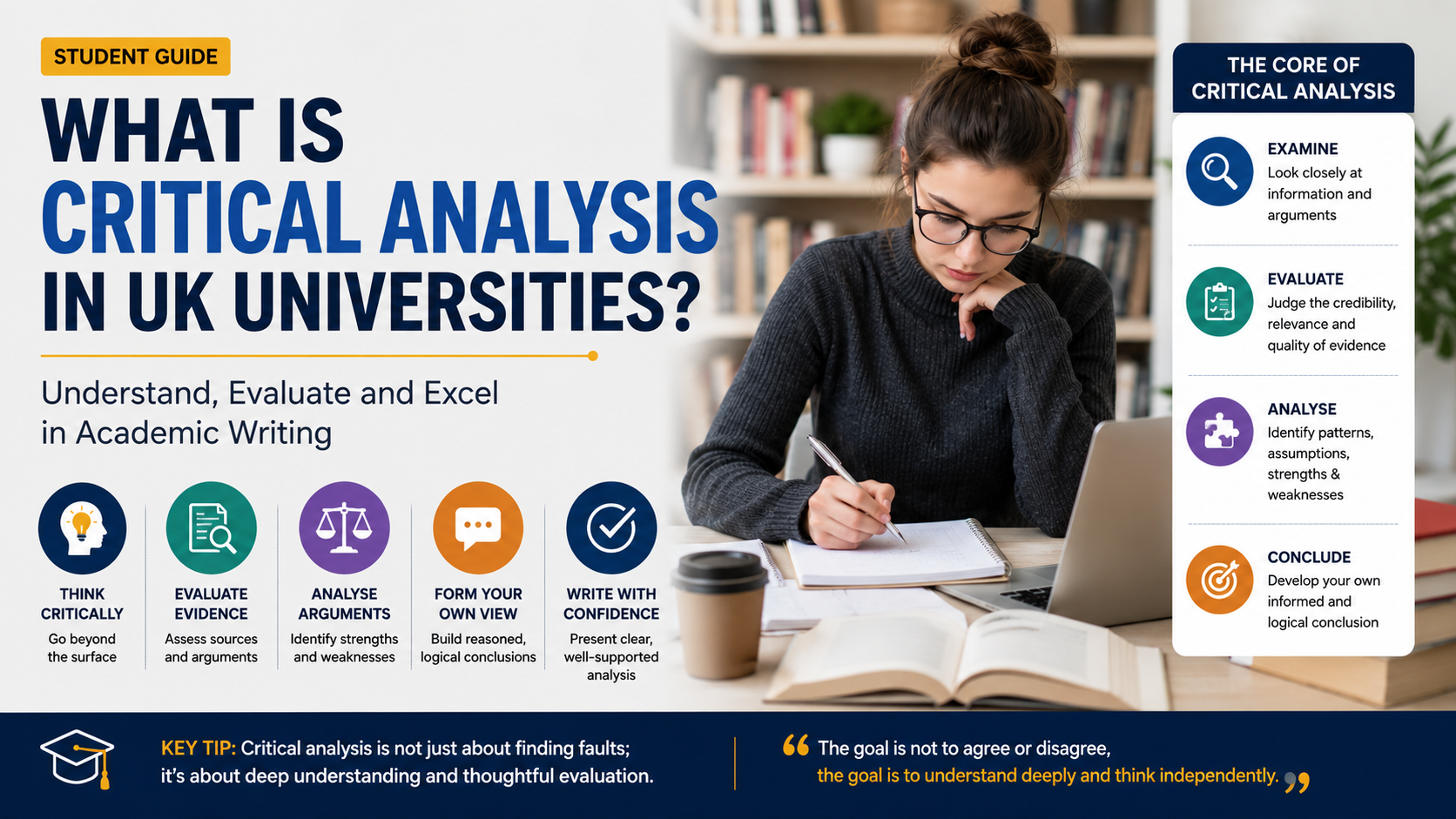
The truth is that critical analysis is one of the most important academic skills expected in UK higher education. Whether you're writing essays, reports, dissertations, or literature reviews, your ability to critically analyse information often determines the difference between an average grade and a first-class submission.
Unlike descriptive writing, which simply explains facts, critical analysis requires you to evaluate evidence, compare viewpoints, identify strengths and weaknesses, and present your own well-supported argument.
This guide explains everything you need to know about critical analysis in UK universities, including why it's important, how to develop it, practical examples, and common mistakes to avoid.
What Is Critical Analysis?
Critical analysis is the process of carefully examining information, ideas, arguments, or research to determine their accuracy, reliability, strengths, weaknesses, and relevance.
Rather than accepting information at face value, you actively question it by asking:
Is the evidence reliable?
What assumptions does the author make?
Are there alternative viewpoints?
Does the conclusion logically follow the evidence?
Is the research current and relevant?
Critical analysis isn't about criticising an author. Instead, it's about making informed judgments using evidence and logical reasoning.
Why Is Critical Analysis Important in UK Universities?
UK universities place strong emphasis on independent thinking rather than memorisation. Lecturers expect students to demonstrate that they can engage with academic material rather than simply repeat it.
Critical analysis helps students:
Develop independent thinking
Build stronger academic arguments
Evaluate research objectively
Improve essay and dissertation quality
Produce evidence-based conclusions
Demonstrate higher-order thinking skills
Achieve better academic grades
Students who consistently use critical analysis often receive higher marks because they show deeper understanding of their subject.
Critical Analysis vs Descriptive Writing
One of the biggest mistakes students make is confusing description with analysis.
Descriptive WritingCritical AnalysisExplains what happenedEvaluates why it happenedSummarises informationQuestions and interprets informationReports factsExamines evidenceLists ideasCompares different viewpointsAccepts informationEvaluates credibility
Example
Descriptive
Smith (2023) states that social media improves communication among university students.
Critical Analysis
While Smith (2023) argues that social media improves student communication, the study focuses solely on undergraduate participants from one institution, limiting its wider applicability. Furthermore, Jones (2024) found contrasting evidence, suggesting that excessive social media use may reduce academic engagement.
Notice how the second example evaluates the evidence rather than merely reporting it.
Key Elements of Critical Analysis
Effective critical analysis includes several essential components.
1. Evaluation
Assess the quality and credibility of information.
Ask yourself:
Is the evidence reliable?
Is the source peer-reviewed?
Is the information current?
2. Comparison
Academic writing often involves comparing different perspectives.
For example:
Which author presents stronger evidence?
Why do researchers disagree?
Which argument is more convincing?
3. Interpretation
Go beyond stating facts.
Explain:
Why findings matter
What they imply
How they relate to your research question
4. Evidence
Support every claim with credible academic sources rather than personal opinion.
Good critical writing relies on:
Journal articles
Academic books
Government reports
Official statistics
Peer-reviewed research
5. Conclusion
Critical analysis ends with a reasoned judgment based on evidence—not assumptions.
How to Perform Critical Analysis
Follow these steps whenever you analyse an academic source.
Step 1: Read Carefully
Understand:
Main argument
Research question
Methodology
Findings
Step 2: Identify the Purpose
Ask:
Why was this research conducted?
What problem does it address?
Step 3: Evaluate the Evidence
Consider:
Sample size
Research methods
Data quality
Biases
Limitations
Step 4: Compare Other Sources
Rarely should one source stand alone.
Look for:
Supporting evidence
Contradicting evidence
Alternative interpretations
Step 5: Form Your Own Judgement
Use evidence to explain which arguments are strongest and why.
Questions to Ask During Critical Analysis
When reading any academic source, ask yourself:
Is the argument logical?
What assumptions are made?
Is the evidence sufficient?
Are there weaknesses?
Does the author acknowledge limitations?
Is the information outdated?
What do other researchers say?
Is there bias?
Can the findings be generalised?
These questions encourage deeper engagement with academic literature.
Example of Critical Analysis
Imagine you're analysing research about online learning.
Weak Response
Online learning became popular during COVID-19.
Strong Critical Response
Although online learning expanded significantly during the COVID-19 pandemic, Brown (2022) argues that student engagement declined in virtual environments. However, later studies indicate that engagement improved once institutions adopted interactive teaching strategies, suggesting that teaching methods rather than online delivery itself may influence learning outcomes.
The second example evaluates, compares, and interprets evidence.
Common Mistakes Students Make
Many students lose marks because they misunderstand what critical analysis involves.
Avoid these common errors:
Only summarising sources
Your lecturer has already read the research.
Instead, explain:
Why it matters
Whether it's convincing
How it relates to other studies
Using unsupported opinions
Avoid statements such as:
I think this research is wrong.
Instead, support your evaluation with academic evidence.
Ignoring alternative viewpoints
Strong academic writing recognises different perspectives before reaching a conclusion.
Relying on one source
Use multiple high-quality academic references to strengthen your argument.
Not discussing limitations
Every study has limitations.
Discussing them demonstrates deeper critical understanding.
Tips to Improve Your Critical Analysis Skills
Developing critical analysis takes practice.
Here are some practical tips:
Read peer-reviewed journal articles regularly.
Compare multiple academic sources.
Ask questions while reading.
Evaluate evidence instead of accepting it.
Support arguments with credible references.
Avoid emotional or biased language.
Practice writing literature reviews.
Seek feedback from lecturers.
Revise your work with a focus on analysis rather than description.
How Critical Analysis Affects Your Grades
Assessment criteria at UK universities often reward students who:
Demonstrate independent thinking
Critically evaluate evidence
Build logical arguments
Support conclusions with research
Compare different perspectives
Show originality
Students who simply describe information without analysing it usually receive lower marks.
Final Thoughts
Critical analysis is a cornerstone of academic success in UK universities. It goes beyond summarising information by encouraging students to evaluate evidence, question assumptions, compare viewpoints, and develop independent conclusions supported by credible research.
Although it may seem challenging at first, critical analysis becomes easier with regular practice. Reading widely, questioning evidence, and engaging thoughtfully with academic sources will not only improve your assignments but also strengthen your problem-solving and decision-making skills beyond university.
Mastering critical analysis is an investment that benefits your academic journey and future career alike.
Frequently Asked Questions
Everything you need to know about our services
Related Posts

How to Write an Assignment Introduction That Impresses Professors

What Is a 2:1 Degree in the UK? Meaning, Classification, Benefits & Career Opportunities
