What Is a 2:1 Degree in the UK? Meaning, Classification, Benefits & Career Opportunities
Introduction
If you've been researching UK universities or reading graduate job descriptions, you've probably come across the term 2:1 degree. Many employers and postgraduate programmes list it as a minimum academic requirement, making it one of the most recognised degree classifications in the UK.
But what exactly is a 2:1 degree, and why does it matter so much?
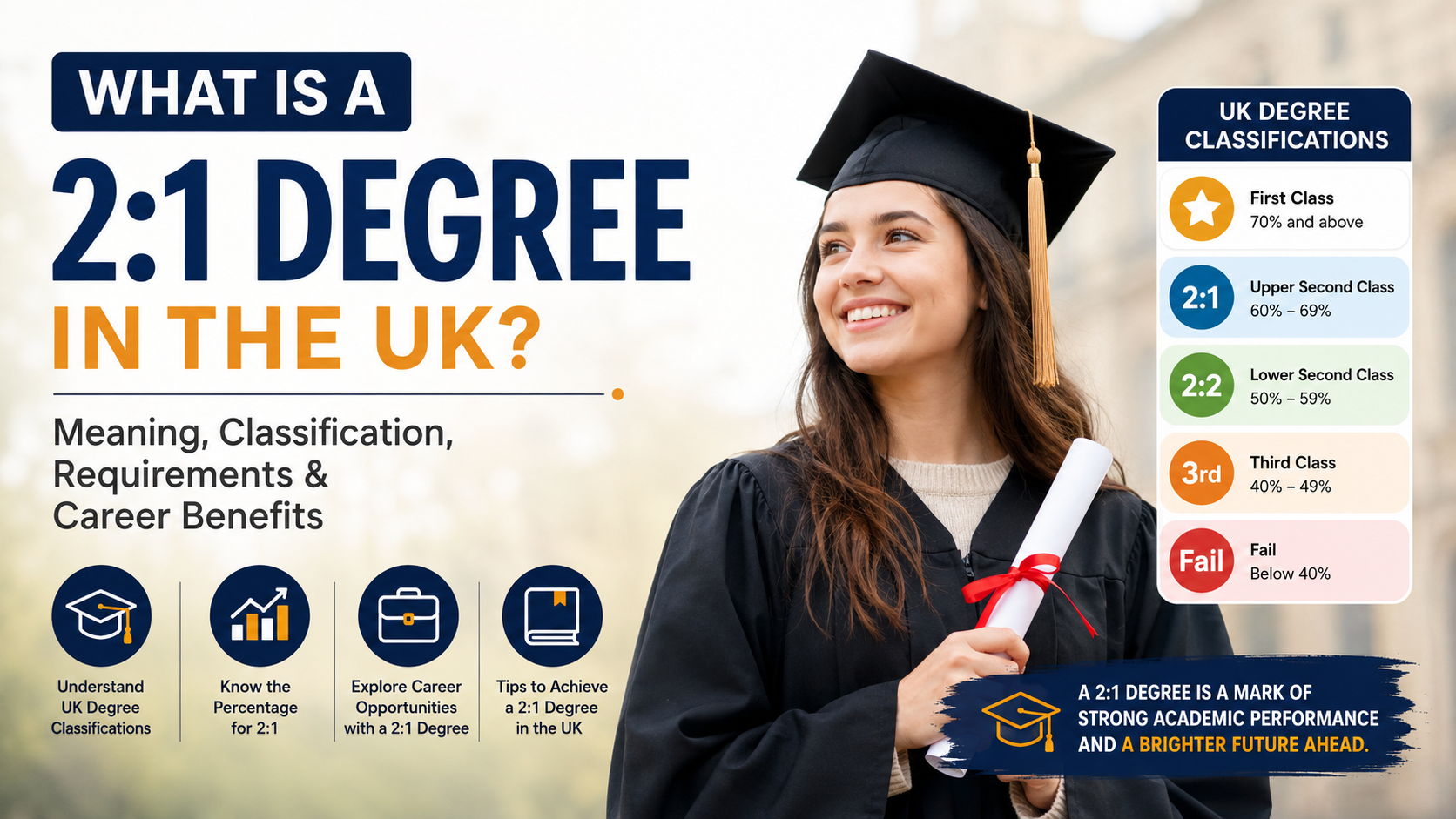
Simply put, a 2:1 degree, also known as an Upper Second-Class Honours degree, is awarded to students who achieve an overall average between 60% and 69% in their undergraduate studies. It is widely regarded as a strong academic achievement and is often preferred by employers, graduate recruiters, and universities.
Whether you're planning to study in the UK, already enrolled at university, or aiming for postgraduate education, understanding the UK degree classification system can help you set realistic academic goals.
In this guide, we'll explain:
-
What a 2:1 degree means
-
UK degree classifications explained
-
Percentage required for a 2:1
-
Career opportunities with a 2:1 degree
-
Difference between a First-Class and a 2:1
-
How to improve your grades
-
Frequently asked questions
Let's begin by understanding the UK honours degree classification system.
Understanding the UK Degree Classification System
Unlike many countries that rely solely on GPA, universities in the UK classify undergraduate honours degrees into different categories based on a student's final average.
These classifications provide employers and academic institutions with a quick overview of a graduate's academic performance.
UK Degree Classification Table
Among these classifications, the Upper Second-Class Honours (2:1) is often considered the benchmark for graduate employability.
What Does a 2:1 Degree Mean?
A 2:1 degree (Upper Second-Class Honours) indicates that a student has consistently achieved a high standard throughout their university course.
To earn a 2:1, students generally need an overall weighted average between 60% and 69%, although the exact calculation may vary slightly depending on the university.
Many UK universities calculate the final classification based primarily on marks achieved in the second and third years (or the final two years) rather than the first year.
For example:
-
Year 1 may not contribute to the final classification.
-
Year 2 could account for 40%.
-
Final Year could account for 60%.
This means strong performance in your final years has the greatest impact on achieving a 2:1.
Why Is a 2:1 Degree So Important?
A 2:1 degree has become the unofficial standard expected by many graduate employers across the UK.
Large organisations receive thousands of applications every year. To manage this volume, many recruiters use academic performance as an initial screening criterion.
Holding a 2:1 can therefore increase your chances of progressing through recruitment processes.
Some sectors where a 2:1 is commonly requested include:
-
Banking
-
Finance
-
Law
-
Engineering
-
Technology
-
Civil Service
-
Graduate Schemes
-
Healthcare Management
-
Consulting
-
Marketing
While not every employer requires a 2:1, having one generally provides greater flexibility when applying for competitive roles.
Is a 2:1 Degree Good?
Yes.
A 2:1 degree is considered a very good academic achievement in the UK.
In fact, the majority of students aim for this classification because it balances strong academic performance with broad career opportunities.
Benefits of earning a 2:1 include:
-
Greater employability
-
Eligibility for many graduate schemes
-
Better postgraduate opportunities
-
Competitive edge in job applications
-
Strong academic credibility
For many students, achieving a 2:1 represents the ideal balance between academic excellence and realistic attainability.
2:1 Degree vs First-Class Degree
Many students wonder whether they should aim for a First or whether a 2:1 is sufficient.
Here's a quick comparison.
Although a First-Class degree is the highest classification, many employers view both Firsts and 2:1s favourably. Skills, work experience, internships, and extracurricular activities often play an equally important role in recruitment.
Can You Get a Good Job With a 2:1 Degree?
Absolutely.
Thousands of graduates secure excellent careers every year with a 2:1 degree.
In many industries, recruiters value practical skills, communication, teamwork, leadership, and relevant experience alongside academic performance.
A 2:1 can open opportunities in:
-
Graduate training programmes
-
Government jobs
-
Teaching
-
Software development
-
Finance
-
Human resources
-
Digital marketing
-
Project management
-
Healthcare administration
-
Business consulting
Many multinational companies list a 2:1 as their minimum academic requirement, making it one of the most valuable degree classifications for employability.
Benefits of Having a 2:1 Degree
Achieving a 2:1 degree isn't just about earning a respectable classification—it can significantly influence your future career and educational opportunities. While employers consider various factors during recruitment, many still use degree classification as an initial benchmark.
Here are some of the key benefits of graduating with a 2:1.
1. Greater Graduate Job Opportunities
Many leading employers in the UK specify a minimum 2:1 degree when recruiting graduates. This is especially common for competitive graduate schemes in sectors such as:
-
Finance
-
Law
-
Engineering
-
IT and Software
-
Healthcare
-
Marketing
-
Public Sector
-
Consultancy
Although experience, skills, and interviews remain important, meeting the academic requirement helps ensure your application isn't filtered out early.
2. Better Chances of Studying a Master's Degree
Many UK universities require applicants to hold at least a 2:1 honours degree for postgraduate taught and research programmes.
A 2:1 can improve your chances of gaining admission to:
-
Master's (MSc, MA)
-
MBA programmes
-
Research degrees
-
Professional qualifications
-
Teacher training programmes
Some universities may accept students with a 2:2, but a 2:1 generally makes your application more competitive.
3. Stronger Career Prospects
Graduates with a 2:1 often have access to a wider range of career opportunities. Employers frequently associate this classification with:
-
Strong analytical skills
-
Consistent academic performance
-
Effective time management
-
Critical thinking
-
Commitment to learning
These qualities are valuable across many industries.
2:1 Degree vs First-Class Degree
Many students wonder whether a First-Class degree is significantly better than a 2:1.
While a First-Class Honours degree is the highest academic classification, a 2:1 remains highly respected and is accepted by the majority of employers and universities.
2:1 Degree vs 2:2 Degree
Although both classifications represent honours degrees, a 2:1 is generally viewed more favourably by employers and postgraduate institutions.
A 2:1 degree generally opens more doors to graduate schemes, postgraduate study, and competitive job opportunities. However, a 2:2 degree does not define your future career. Employers increasingly value practical experience, transferable skills, networking, internships, and professional development alongside academic qualifications, allowing many graduates with a 2:2 to build successful and rewarding careers.
How Is a 2:1 Degree Calculated?
Most UK universities calculate your final degree classification using a weighted average of your module marks.
Although every institution has its own regulations, a common approach is:
-
First Year – Does not count (or carries a small weighting)
-
Second Year – 40%
-
Final Year – 60%
For example:
-
Second Year Average: 62%
-
Final Year Average: 66%
Overall Weighted Average:
(62 × 40%) + (66 × 60%) = 64.4%
Final Classification: Upper Second-Class Honours (2:1)
Always check your university's assessment regulations, as weighting systems may vary.
Tips to Achieve a 2:1 Degree
Reaching a 2:1 requires consistent effort rather than last-minute studying. Here are some practical strategies that can improve your academic performance.
Start Assignments Early
Avoid rushing coursework close to deadlines. Starting early gives you enough time for research, writing, editing, and proofreading.
Attend Lectures Regularly
Many assessment questions are based on concepts discussed during lectures and seminars. Regular attendance helps build a stronger understanding of your modules.
Improve Your Academic Writing
Clear structure, critical analysis, and accurate referencing can significantly improve assignment grades.
Use Reliable Academic Sources
Support your arguments with peer-reviewed journals, academic books, and credible government publications rather than relying solely on websites.
Seek Feedback
If tutors provide feedback on assignments, use it to identify areas for improvement before your next submission.
Practise Effective Time Management
Breaking larger assignments into smaller tasks can reduce stress and improve productivity throughout the semester.
Use Reliable Academic Sources
High-quality sources improve the credibility of your assignments and demonstrate strong research skills. Prioritise:
-
Peer-reviewed journal articles
-
Academic books
-
Government publications
-
Industry reports
-
Reputable university resources
Avoid relying solely on blogs, forums, or unverified websites.
Seek Feedback
Lecturers and tutors often provide valuable feedback on assignments. Understanding common mistakes can help you improve future grades and move closer to a 2:1 or even a First-Class degree.
Proofread Before Submission
Many students lose marks because of simple spelling, grammar, formatting, and referencing errors. Always leave enough time to review your work before submitting it.
Common Challenges Students Face When Aiming for a 2:1
Achieving a 2:1 is realistic for many students, but several common obstacles can affect performance.
Poor Time Management
Leaving assignments until the final few days often leads to rushed work and avoidable mistakes.
Weak Referencing Skills
Incorrect referencing can result in lost marks and, in some cases, academic misconduct concerns.
Limited Critical Analysis
University assessments require more than simply describing information. Students are expected to evaluate evidence, compare viewpoints, and develop well-supported arguments.
Inconsistent Study Habits
Studying only before exams can make it difficult to retain information and perform consistently across modules.
Recognising these challenges early can help students develop better academic habits throughout their degree.
Is a 2:1 Degree Enough for a Master's?
In most cases, yes.
Many UK universities list a 2:1 honours degree as the standard entry requirement for postgraduate study.
Common postgraduate programmes requiring a 2:1 include:
-
Master of Science (MSc)
-
Master of Arts (MA)
-
Master of Business Administration (MBA)
-
Teacher Training (PGCE)
-
Research Degrees (MRes)
However, admission criteria vary between institutions and courses.
Some universities may accept applicants with a 2:2 if they can demonstrate:
-
Relevant professional experience
-
Strong references
-
Additional qualifications
-
Exceptional personal statements
Always check the specific entry requirements of the programme you're applying for.
Is a 2:1 Degree Good for International Students?
Absolutely.
A 2:1 degree is widely recognised by employers and educational institutions around the world. For international students studying in the UK, achieving a 2:1 can strengthen applications for:
-
Graduate jobs
-
International employment opportunities
-
Postgraduate study
-
Scholarship applications
-
Professional accreditation programmes
Because the UK degree classification system is highly respected globally, a 2:1 is often viewed as evidence of strong academic performance.
Key Takeaways
-
A 2:1 degree is also known as an Upper Second-Class Honours degree.
-
It is typically awarded to students who achieve 60–69% overall.
-
A 2:1 is one of the most sought-after degree classifications in the UK.
-
Many employers use a 2:1 as the minimum requirement for graduate schemes.
-
Most postgraduate programmes accept applicants with a 2:1 degree.
-
Consistent study habits, strong academic writing, and effective time management can help students achieve a 2:1.
Final Thoughts
A 2:1 degree remains one of the most valuable academic achievements for UK university students. It demonstrates strong subject knowledge, effective study skills, and consistent academic performance.
While degree classification is important, it is only one part of your overall profile. Employers and universities increasingly value practical experience, transferable skills, and extracurricular achievements alongside academic success.
If you're aiming for a 2:1, focus on developing strong research skills, improving your academic writing, managing your time effectively, and seeking feedback throughout your studies. These habits can help you maximise your potential and create more opportunities after graduation.
Need Help Improving Your Assignment Grades?
Achieving a 2:1 often requires well-researched, properly structured, and accurately referenced assignments. If you're struggling with deadlines, academic writing, or referencing requirements, professional academic guidance can make a significant difference.
At AssignmentCart, we support UK students with assignment assistance, proofreading, editing, and academic writing guidance to help improve confidence and academic performance throughout university.
Frequently Asked Questions
Everything you need to know about our services