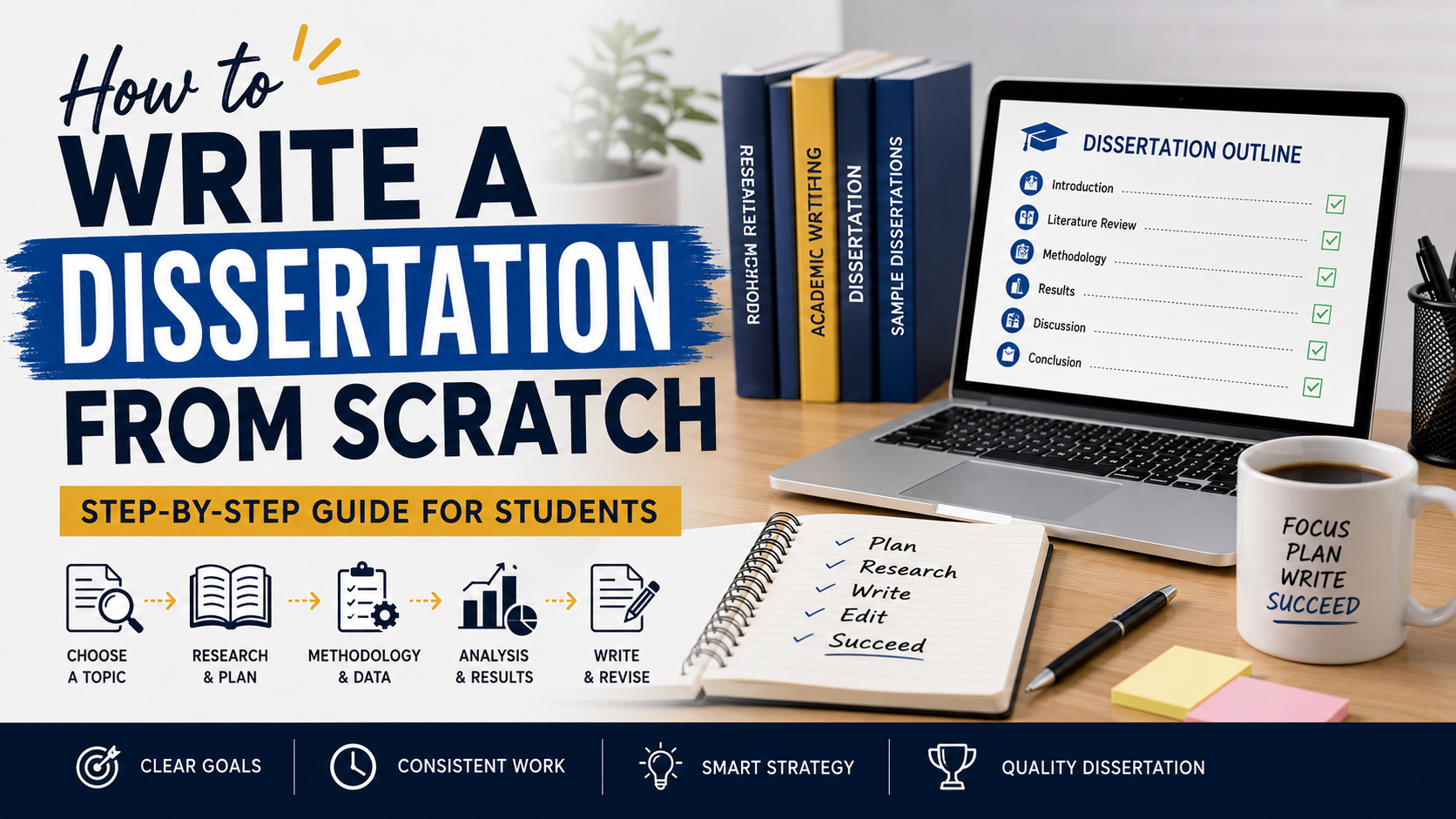
How to Write a Dissertation from Scratch
Writing a dissertation is one of the biggest academic challenges students face during university. Whether you're pursuing an undergraduate, master's, or PhD degree, your dissertation demonstrates your ability to conduct independent research, analyze information critically, and present well-supported arguments.
For many students, however, the dissertation process feels overwhelming. Questions like Where do I start?, How do I choose a topic?, How many chapters should I write?, and How long should a dissertation be? are incredibly common.
The good news is that writing a dissertation doesn't have to be stressful. Once you break it into smaller, manageable steps, the entire process becomes much easier.
In this comprehensive guide, you'll learn exactly how to write a dissertation from scratch—from selecting a research topic and conducting a literature review to writing each chapter, referencing correctly, and submitting a polished final paper.
What Is a Dissertation?
A dissertation is an extensive academic research project completed as part of a university degree. It allows students to investigate a specific research problem, collect and analyze evidence, and contribute new insights to an existing field of study.
Unlike regular essays or assignments, a dissertation requires:
-
Independent research
-
Critical thinking
-
Academic writing
-
Proper referencing
-
Original analysis
-
Logical conclusions
Depending on your university and course, dissertations usually range from 8,000 to 20,000 words for undergraduate and master's degrees, while doctoral dissertations can exceed 80,000 words.
Why Is a Dissertation Important?
Your dissertation is often the most significant piece of academic work you'll complete during your degree. It demonstrates that you can:
-
Conduct independent research
-
Evaluate academic literature
-
Solve research problems
-
Apply theoretical knowledge
-
Present evidence-based arguments
-
Communicate professionally
A well-written dissertation can also strengthen your CV, improve postgraduate opportunities, and showcase valuable research skills to future employers.
Before You Start Writing
Many students make the mistake of opening Microsoft Word and immediately trying to write Chapter One.
Instead, successful dissertations begin with careful planning.
Before writing, you should:
-
Understand your university's dissertation guidelines
-
Know the required word count
-
Review the marking criteria
-
Learn the referencing style (APA, Harvard, MLA, Chicago, etc.)
-
Create a realistic timeline
-
Meet with your dissertation supervisor
Planning before writing can save weeks of unnecessary revisions later.
Step 1: Choose the Right Dissertation Topic
Choosing a topic is often the hardest part of writing a dissertation.
A good topic should be:
-
Interesting to you
-
Relevant to your degree
-
Researchable
-
Specific rather than broad
-
Supported by sufficient academic literature
For example:
❌ Social Media
✅ The Impact of Instagram Marketing on Small Business Growth in the UK
Notice how the second topic is far more focused and researchable.
Questions to Ask Yourself
-
Does the topic genuinely interest me?
-
Can I find enough academic sources?
-
Is it manageable within the word count?
-
Can I complete the research within the available time?
Step 2: Conduct Preliminary Research
Before finalizing your topic, explore existing academic research.
Search for:
-
Journal articles
-
Books
-
Government publications
-
Industry reports
-
Peer-reviewed studies
-
Conference papers
Take notes on:
-
Major findings
-
Research gaps
-
Common methodologies
-
Frequently cited authors
-
Emerging trends
This preliminary research helps confirm whether your topic has enough credible sources.
Step 3: Develop a Strong Research Question
Your dissertation should answer one clear research question.
For example:
Instead of asking:
How does technology affect education?
Ask:
How has artificial intelligence influenced student learning outcomes in UK universities?
A strong research question is:
-
Clear
-
Specific
-
Researchable
-
Focused
-
Relevant
Everything in your dissertation should help answer this question.
Step 4: Write a Dissertation Proposal
Many universities require students to submit a dissertation proposal before beginning the full project.
A proposal usually includes:
-
Working title
-
Research background
-
Aim
-
Objectives
-
Research questions
-
Literature overview
-
Methodology
-
Timeline
-
References
Once approved, you can confidently move forward with your research.
Step 5: Conduct a Literature Review
The literature review explains what previous researchers have discovered about your topic.
Rather than simply summarizing articles, compare, evaluate, and analyze different viewpoints.
Your literature review should identify:
-
Existing theories
-
Major debates
-
Research trends
-
Contradictions
-
Knowledge gaps
For example:
Several studies suggest that online learning improves accessibility for students. However, recent research indicates that increased flexibility may also reduce student engagement when adequate support systems are unavailable.
Notice how this compares different perspectives rather than merely describing one study after another.
Step 6: Choose Your Research Methodology
The methodology chapter explains how your research was conducted.
Common research methods include:
Qualitative Research
-
Interviews
-
Focus groups
-
Case studies
-
Observations
Best for exploring opinions, experiences, and behaviours.
Quantitative Research
-
Surveys
-
Experiments
-
Statistical analysis
Best for measuring relationships and testing hypotheses.
Mixed Methods
Combines qualitative and quantitative approaches for a more comprehensive analysis.
Your methodology should explain:
-
Research design
-
Participants
-
Sampling method
-
Data collection
-
Ethical considerations
-
Data analysis techniques
Step 7: Collect Your Research Data
Now it's time to gather the information needed to answer your research question.
The data collection method depends on your research design. Common methods include:
-
Online surveys
-
Face-to-face interviews
-
Focus groups
-
Questionnaires
-
Case studies
-
Experiments
-
Observation
-
Secondary data from journals, government reports, and databases
Before collecting data, ensure you have any required ethical approval from your university, especially if human participants are involved.
Tips for Effective Data Collection
-
Use reliable and valid research instruments.
-
Keep accurate records of responses.
-
Avoid bias when collecting or interpreting data.
-
Organize your data from the beginning to save time during analysis.
Step 8: Analyse Your Findings
Once you've collected the data, the next step is analysing it to identify patterns, relationships, and key findings.
For quantitative research, you may use software such as:
-
SPSS
-
Excel
-
R
-
Python
Common analyses include:
-
Descriptive statistics
-
Correlation
-
Regression analysis
-
Hypothesis testing
For qualitative research, you might use:
-
Thematic analysis
-
Content analysis
-
Coding interviews
-
Narrative analysis
The aim is to present clear, objective findings without interpreting them too deeply—that comes in the discussion chapter.
Step 9: Write the Results Chapter
The results chapter presents your findings in a logical and organized way.
Include:
-
Tables
-
Charts
-
Graphs
-
Statistical outputs
-
Survey responses
-
Interview themes
Present the facts clearly without adding personal opinions.
For example:
Out of 250 participants, 72% reported using AI-powered learning tools at least once per week, while only 11% had never used them.
Each figure or table should include a title and be referenced within the text.
Step 10: Write the Discussion Chapter
The discussion chapter explains what your findings mean.
Instead of repeating the results, interpret them by linking them back to your research question and previous studies.
Ask yourself:
-
Why did these results occur?
-
Do they support previous research?
-
Were there any unexpected findings?
-
What are the practical implications?
Example:
The findings support previous studies indicating that AI enhances personalised learning. However, unlike earlier research, participants also highlighted concerns regarding academic integrity and over-reliance on technology.
This chapter demonstrates your critical thinking skills.
Step 11: Write the Conclusion
The conclusion brings your dissertation to a close.
Summarise:
-
Research aim
-
Key findings
-
Main conclusions
-
Practical implications
-
Recommendations for future research
Avoid introducing new evidence or arguments.
A strong conclusion should leave readers with a clear understanding of how your research answered the research question.
Step 12: Add References Correctly
Every source you use must be cited properly.
Universities commonly require:
-
APA 7th Edition
-
Harvard Referencing
-
MLA
-
Chicago
-
OSCOLA (Law)
Common referencing mistakes include:
-
Missing citations
-
Inconsistent formatting
-
Incorrect author names
-
Outdated references
-
Broken URLs
Using reference management software can save significant time.
Popular tools include:
-
Zotero
-
Mendeley
-
EndNote
Recommended Dissertation Structure
| Chapter | Purpose |
|---|---|
| 📄 Title Page | Includes the dissertation title, student details, university name, department, and submission date. |
| 📝 Abstract | A concise summary of the research objectives, methodology, findings, and conclusions. |
| 🙏 Acknowledgements | An optional section to thank supervisors, participants, family, or anyone who supported the research. |
| 📑 Table of Contents | Provides a clear navigation of chapters, headings, tables, figures, and appendices. |
| 🚀 Introduction | Introduces the research topic, background, problem statement, objectives, research questions, and significance. |
| 📚 Literature Review | Critically evaluates previous studies, identifies research gaps, and builds the theoretical framework. |
| ⚙️ Methodology | Explains the research design, methods, data collection techniques, sampling, and ethical considerations. |
| 📊 Results | Presents research findings objectively using tables, charts, graphs, or statistical analysis. |
| 💡 Discussion | Interprets the results, compares findings with previous research, and explains their significance. |
| ✅ Conclusion | Summarises the research, highlights key findings, acknowledges limitations, and suggests future research. |
| 📖 References | Lists all cited books, journal articles, websites, and other sources in the required citation style. |
| 📎 Appendices | Contains supporting materials such as questionnaires, interview transcripts, raw data, consent forms, or additional documents. |
Common Dissertation Mistakes to Avoid
Many students lose valuable marks because of avoidable mistakes.
1. Choosing a Topic That Is Too Broad
A broad topic makes research difficult and lacks focus.
2. Weak Literature Review
Simply summarising articles without analysing them reduces academic quality.
3. Poor Time Management
Leaving everything until the final month often results in rushed work and unnecessary stress.
4. Ignoring Supervisor Feedback
Your supervisor's suggestions are intended to strengthen your dissertation. Apply them carefully.
5. Weak Referencing
Incorrect citations can lead to plagiarism issues.
6. Poor Academic Writing
Avoid:
-
Informal language
-
Personal opinions
-
Unsupported claims
-
Long, confusing sentences
Write clearly and objectively.
7. Not Proofreading
Grammar mistakes, spelling errors, formatting inconsistencies, and broken references create a poor impression.
Always proofread your dissertation multiple times before submission.
Dissertation Writing Tips for Success
Writing a dissertation becomes much easier when you follow a structured approach.
Here are some practical tips:
-
Start early rather than waiting until the deadline.
-
Break the project into weekly goals.
-
Read academic literature every day.
-
Write consistently, even if it's only 500 words.
-
Back up your work using cloud storage.
-
Meet your supervisor regularly.
-
Use plagiarism detection software before submission.
-
Proofread carefully.
-
Take breaks to avoid burnout.
-
Keep your research question visible while writing every chapter.
📅 15-Week Dissertation Writing Timeline
| Week | Task |
|---|---|
| Week 1 | 🎯 Choose your dissertation topic |
| Week 2 | 🔍 Conduct preliminary research |
| Week 3 | 📝 Prepare your dissertation proposal |
| Week 4–6 | 📚 Write the literature review |
| Week 7 | ⚙️ Develop the research methodology |
| Week 8–10 | 📊 Collect research data |
| Week 11 | 📈 Analyze collected data |
| Week 12 | 📑 Write the results chapter |
| Week 13 | 💡 Discuss findings and interpretations |
| Week 14 | ✅ Write the conclusion |
| Week 15 | ✏️ Edit, proofread, and finalize the dissertation |
Dissertation Checklist Before Submission
Use this checklist before submitting your dissertation:
✅ Research question clearly answered
✅ All chapters completed
✅ Word count meets university requirements
✅ Proper formatting applied
✅ Tables and figures labelled correctly
✅ Grammar and spelling checked
✅ References formatted correctly
✅ Plagiarism checked
✅ Supervisor feedback incorporated
✅ Final proofread completed
Final Thoughts
Writing a dissertation from scratch may seem overwhelming at first, but breaking the process into clear, manageable steps makes it far more achievable. Start by selecting a focused topic, conduct thorough research, develop a strong methodology, and write each chapter with a clear purpose. Don't leave everything until the last minute—consistent progress and regular revisions are the keys to success.
Remember, a dissertation is not about writing the perfect paper on your first attempt. It's about demonstrating your ability to think critically, conduct independent research, and communicate your findings effectively. With careful planning, dedication, and attention to detail, you can produce a dissertation that meets academic standards and reflects your hard work.
Whether you're just beginning your research journey or polishing your final draft, following this step-by-step guide will help you stay organized, avoid common mistakes, and submit your dissertation with confidence.
Frequently Asked Questions
Everything you need to know about our services
Related Posts

What Is Critical Analysis in UK Universities? A Complete Student Guide

What Is a 2:1 Degree in the UK? Meaning, Classification, Benefits & Career Opportunities
