How to Improve a Failed Assignment Before Resubmission
Failing an assignment can feel discouraging, but it doesn't have to define your academic journey. Many UK universities allow students to resubmit failed coursework through referrals or reassessments, giving you a valuable opportunity to improve your work and achieve a passing grade.
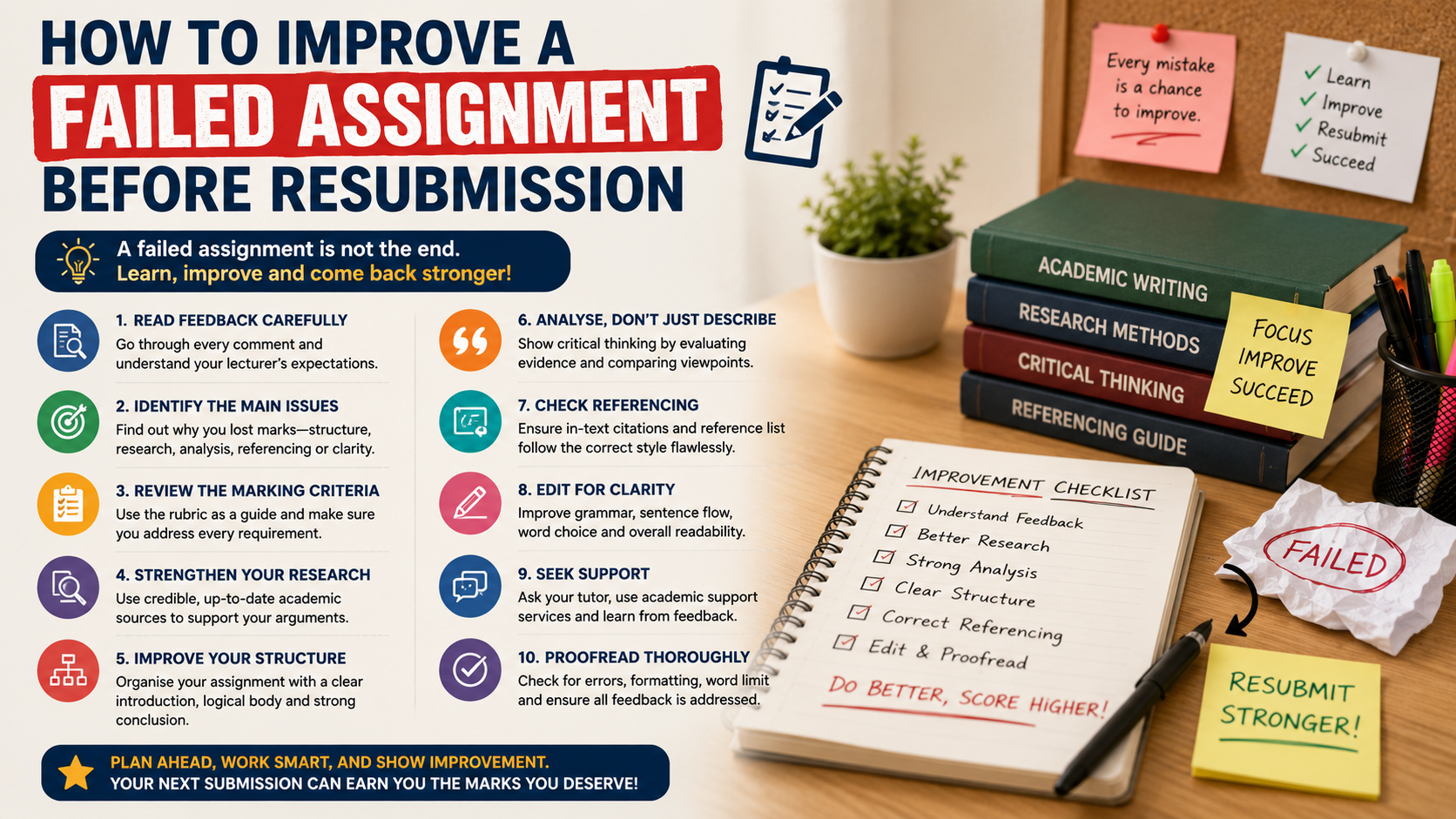
The key to success is not simply correcting a few mistakes but understanding why your assignment failed in the first place. By carefully reviewing feedback, addressing weaknesses, and following your university's resubmission guidelines, you can significantly improve your chances of passing.
In this guide, we'll explain how to improve a failed assignment before resubmission and share practical tips to help you submit stronger, higher-quality coursework.
Can You Resubmit a Failed Assignment?
Yes. Many UK universities allow students to resubmit failed assignments, although the rules vary between institutions.
Depending on your university's assessment regulations, you may be offered:
A referral assignment
A reassessment opportunity
A resubmission of your original coursework
A replacement assignment
Keep in mind that some universities cap the mark for resubmitted work at the module pass mark, while others may award the full grade if mitigating circumstances apply.
Always check your university's assessment handbook before making changes.
Step 1: Read Your Feedback Carefully
The most valuable resource for improving your assignment is your lecturer's feedback.
Instead of focusing only on the grade, read every comment carefully.
Look for recurring issues such as:
Weak arguments
Poor structure
Lack of critical analysis
Insufficient research
Referencing mistakes
Poor grammar and spelling
Failure to answer the assignment question
Make a checklist of every point your marker has highlighted.
Step 2: Understand Why You Failed
Before rewriting your assignment, identify the root cause of the low mark.
Common reasons include:
Poor Understanding of the Question
Students sometimes answer a different question than the one being asked.
Re-read the assignment brief and identify command words such as:
Analyse
Evaluate
Compare
Discuss
Critically assess
Explain
Understanding these instructions helps ensure your revised assignment meets the assessment criteria.
Weak Research
Using too few academic sources or relying on unreliable websites can weaken your work.
Improve your assignment by using:
Peer-reviewed journal articles
Academic books
Government publications
University library databases
Professional reports
Support every major claim with credible evidence.
Lack of Critical Thinking
Many students simply describe information instead of analysing it.
Critical analysis involves:
Comparing viewpoints
Evaluating evidence
Identifying strengths and weaknesses
Explaining why evidence matters
Forming balanced conclusions
This is often one of the biggest differences between a pass and a higher grade.
Step 3: Review the Marking Criteria
Every assignment is assessed against specific marking criteria or a grading rubric.
Compare your assignment with the assessment criteria and ask yourself:
Have I answered every part of the question?
Is my argument clear?
Have I supported my points with evidence?
Have I demonstrated critical analysis?
Is my referencing accurate?
Treat the marking rubric as your improvement checklist.
Step 4: Improve Your Assignment Structure
A well-organised assignment is easier to read and demonstrates logical thinking.
Most university assignments include:
Introduction
Clearly explain:
The purpose of the assignment
Key topics
Your overall argument
Main Body
Each paragraph should include:
A clear topic sentence
Supporting evidence
Critical discussion
Academic references
A link to your main argument
Avoid long paragraphs that cover multiple ideas.
Conclusion
Summarise your findings without introducing new evidence.
Your conclusion should directly answer the assignment question.
Step 5: Strengthen Your Evidence
Strong academic writing relies on high-quality evidence.
Replace weak sources with:
Recent journal articles
Scholarly books
Government reports
Official statistics
Reputable academic publications
Where appropriate, include more recent research to demonstrate current knowledge.
Step 6: Improve Your Referencing
Incorrect referencing is one of the most common reasons students lose marks.
Check:
In-text citations
Reference list formatting
Author names
Publication dates
Page numbers (where required)
Consistency throughout the assignment
Use the referencing style required by your university, such as Harvard, APA, MLA, or OSCOLA.
Step 7: Edit for Clarity and Grammar
Even strong ideas can lose marks if the writing is unclear.
Review your work for:
Grammar mistakes
Spelling errors
Repetitive wording
Long sentences
Informal language
Typographical errors
Reading your assignment aloud can help identify awkward phrasing.
Step 8: Address Every Feedback Comment
Don't ignore your lecturer's recommendations.
Create a checklist and confirm that every issue has been addressed before resubmitting.
For example:
✔ Improved introduction
✔ Added more academic sources
✔ Strengthened critical analysis
✔ Corrected referencing
✔ Improved conclusion
This systematic approach reduces the chance of repeating previous mistakes.
Step 9: Seek Academic Support
If you're unsure how to improve your assignment, ask for help.
Useful sources of support include:
Module tutors
Academic writing centres
University library services
Study skills workshops
Peer study groups
Many universities provide free academic support to help students succeed.
Step 10: Proofread Before Resubmission
Never submit your revised assignment immediately after editing.
Instead:
Take a short break.
Read the assignment again with fresh eyes.
Check formatting requirements.
Verify page numbers.
Ensure references are complete.
Confirm you've met the word count.
A final proofreading session can catch small errors that affect your marks.
Common Mistakes to Avoid During Resubmission
When revising a failed assignment, avoid these common errors:
Ignoring lecturer feedback
Making only minor edits
Using unreliable sources
Copying large sections from your previous submission without improvement
Failing to update references
Missing the resubmission deadline
Forgetting to follow formatting guidelines
Treat the resubmission as an opportunity to produce a significantly improved piece of work.
Tips to Increase Your Chances of Passing
Start revising early.
Follow the marking rubric closely.
Use more academic sources.
Improve critical analysis.
Check your referencing carefully.
Ask questions if feedback is unclear.
Proofread multiple times before submitting.
Small improvements across several areas can make a significant difference to your final grade.
Final Thoughts
A failed assignment isn't the end of your academic journey—it's an opportunity to learn and improve. By carefully reviewing your lecturer's feedback, strengthening your research, improving your structure, and addressing every weakness identified in your original submission, you can greatly increase your chances of passing your resubmission.
Remember that every university has different reassessment policies, so always check your institution's guidelines before resubmitting your work. With careful planning, attention to detail, and a commitment to improvement, your next submission can be a much stronger reflection of your abilities.
Frequently Asked Questions
Everything you need to know about our services


