How Master's Assignments Differ From Undergraduate Work
Introduction
Many students begin a master's degree believing it will simply involve writing longer versions of undergraduate assignments. However, postgraduate study is significantly different. Universities expect master's students to demonstrate deeper critical thinking, independent research, sophisticated academic writing, and the ability to contribute to scholarly discussions.
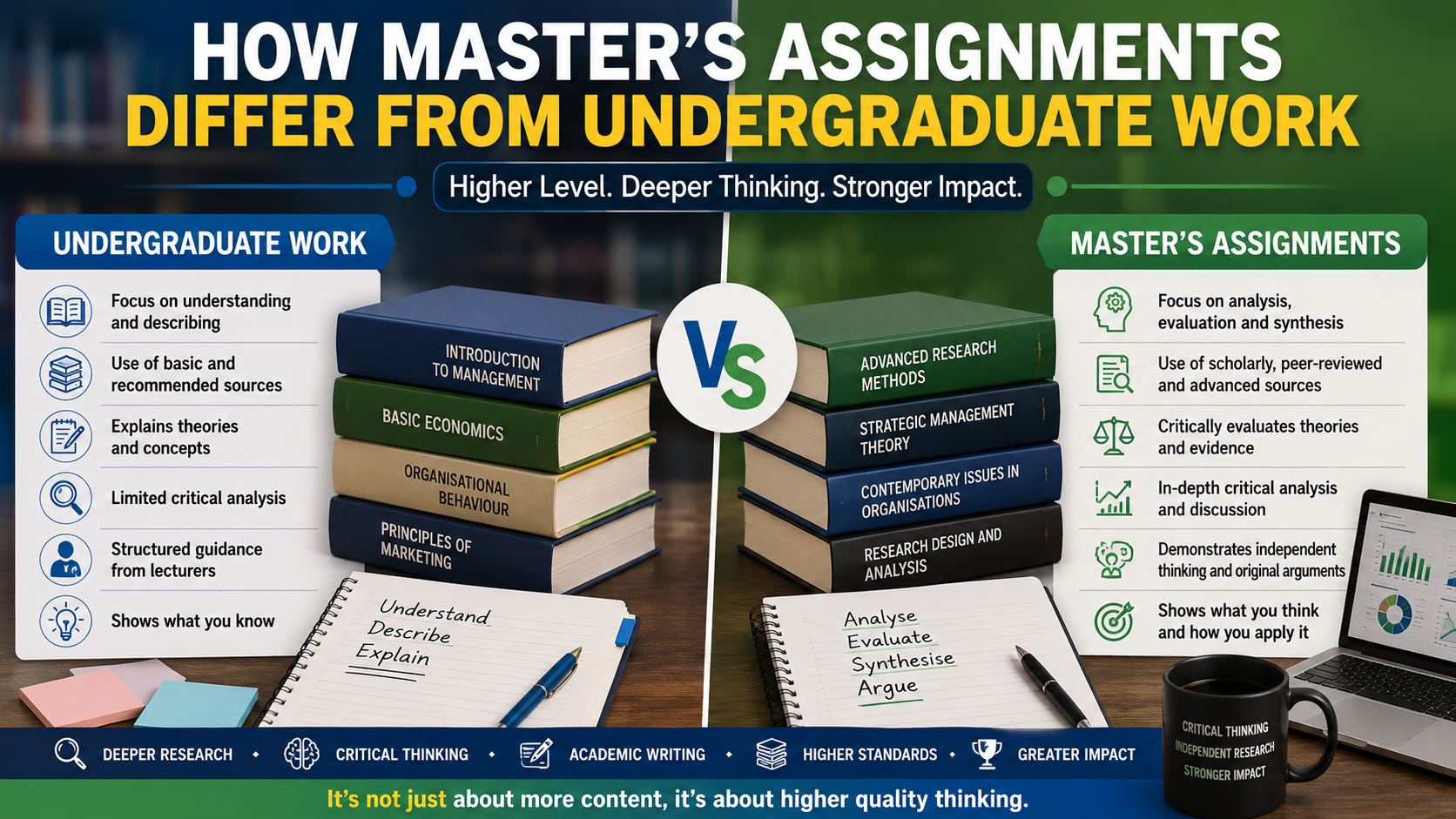
The transition from undergraduate to postgraduate education can be challenging because assessment standards increase considerably. What earned high marks during a bachelor's degree may only receive an average grade at master's level.
Understanding these differences helps students adapt their writing, improve academic performance, and meet postgraduate expectations.
In this guide, you'll learn:
Why the Difference Matters
Universities design master's programmes to develop advanced academic and professional skills.
Rather than testing whether students understand existing knowledge, postgraduate assessments evaluate whether students can:
Analyse complex ideas
Critically evaluate evidence
Conduct independent research
Solve academic problems
Develop original arguments
Understanding these expectations is essential for achieving distinction-level grades.
Undergraduate vs Master's Assignments
Although both involve essays, reports, and research projects, the academic expectations are very different.
Undergraduate Assignments
Undergraduate work primarily focuses on:
Demonstrating knowledge
Understanding theories
Applying concepts
Following academic conventions
Students often explain and summarise established ideas.
Master's Assignments
Master's assignments require students to:
Critically evaluate literature
Compare competing viewpoints
Identify research gaps
Develop independent arguments
Apply theory to complex situations
Simply describing information is no longer sufficient.
Difference 1: Depth of Research
One of the biggest differences is the amount and quality of research expected.
Undergraduate Research
Students often use:
Textbooks
Recommended readings
Basic journal articles
The emphasis is on understanding core concepts.
Master's Research
Postgraduate students are expected to consult:
Peer-reviewed journal articles
Recent academic research
Professional reports
Government publications
Advanced scholarly literature
Research becomes broader, deeper, and more independent.
Difference 2: Critical Analysis
Critical analysis is arguably the most important difference.
Undergraduate Level
Students typically explain:
What happened
What researchers found
How theories work
Master's Level
Students evaluate:
Whether evidence is convincing
Strengths and weaknesses
Alternative interpretations
Methodological limitations
Practical implications
Critical thinking replaces simple description.
Difference 3: Independent Thinking
Master's students are expected to develop their own academic position.
Rather than repeating existing research, they should:
Evaluate evidence
Form balanced conclusions
Justify their opinions using academic literature
Independent judgement is highly valued.
Difference 4: Assignment Structure
Both academic levels follow a similar structure:
Introduction
Main body
Conclusion
However, master's assignments contain:
More sophisticated arguments
Better transitions
Stronger paragraph development
Clearer logical progression
Every section contributes to a central argument.
Difference 5: Academic Writing Style
Postgraduate writing is:
More analytical
More precise
More objective
More formal
Students avoid:
Informal language
Personal opinions without evidence
Overly simplistic explanations
Professional academic writing improves credibility.
Difference 6: Use of Evidence
At undergraduate level, evidence often supports explanations.
At master's level, evidence supports evaluation.
Students compare findings from multiple researchers rather than relying on one source.
Difference 7: Literature Engagement
Master's students are expected to engage actively with academic literature.
This involves:
Comparing studies
Identifying disagreements
Evaluating research quality
Synthesising multiple viewpoints
The literature review becomes far more sophisticated.
Difference 8: Referencing Expectations
Referencing standards also increase.
Postgraduate assignments generally include:
More scholarly sources
More recent research
Greater citation accuracy
Consistent referencing style
Quality remains more important than quantity.
Difference 9: Originality
Master's assignments should demonstrate originality.
This does not necessarily mean producing entirely new research.
Instead, originality may involve:
New interpretations
Different perspectives
Innovative application of theory
Thoughtful synthesis of existing research
Difference 10: Assessment Criteria
Master's assignments are commonly assessed using criteria such as:
Critical analysis
Research quality
Originality
Argument development
Academic writing
Evidence integration
Referencing
Independent thinking
These standards exceed undergraduate expectations.
Common Challenges When Transitioning
Many students initially struggle because they continue using undergraduate writing habits.
Common difficulties include:
Describing instead of analysing
Using too few academic sources
Weak critical discussion
Limited independent thinking
Poor synthesis of literature
Recognising these challenges is the first step towards improvement.
Practical Tips for Adapting
Read More Widely
Expand beyond recommended reading lists.
Consult current journal articles and scholarly publications.
Analyse Every Source
Instead of asking:
"What does this author say?"
Ask:
Is the evidence reliable?
What are its limitations?
How does it compare with other research?
Focus on Academic Debate
Show that you understand differing viewpoints rather than presenting one perspective.
Plan Before Writing
Create a detailed outline to ensure logical argument development.
Proofread Carefully
Editing improves:
Clarity
Grammar
Referencing
Overall presentation
Strong assignments rarely emerge from a first draft.
Skills Master's Students Develop
Completing postgraduate assignments helps students build:
Research skills
Critical thinking
Academic writing
Problem-solving
Independent learning
Evidence evaluation
These skills remain valuable beyond university.
Master's Assignment Success Checklist
Before submitting, ask yourself:
✔ Have I answered the assignment question?
✔ Have I demonstrated critical analysis?
✔ Have I compared multiple viewpoints?
✔ Have I supported arguments with credible evidence?
✔ Is my writing formal and academic?
✔ Have I referenced consistently?
✔ Have I proofread thoroughly?
If yes, your assignment is much closer to postgraduate expectations.
Key Takeaways
Master's assignments require deeper research than undergraduate work.
Critical analysis is more important than description.
Independent thinking is highly valued.
Academic writing should be analytical and evidence based.
Strong research strengthens academic credibility.
Originality comes from interpretation rather than invention.
Careful planning and editing improve assignment quality.
Conclusion
Master's assignments are not simply longer undergraduate essays. They require a completely different approach that emphasises critical thinking, independent research, scholarly debate, and evidence-based argumentation.
Students who understand these differences early in their postgraduate studies are better prepared to meet university expectations, produce distinction-level work, and develop the advanced academic skills required for professional success.
Frequently Asked Questions
Everything you need to know about our services


