Common Master's Assignment Mistakes (And How to Avoid Them)
Introduction
Writing a master's assignment is one of the biggest academic challenges students face during postgraduate study. Expectations at this level are much higher than undergraduate coursework, and even capable students often lose valuable marks because of avoidable mistakes.
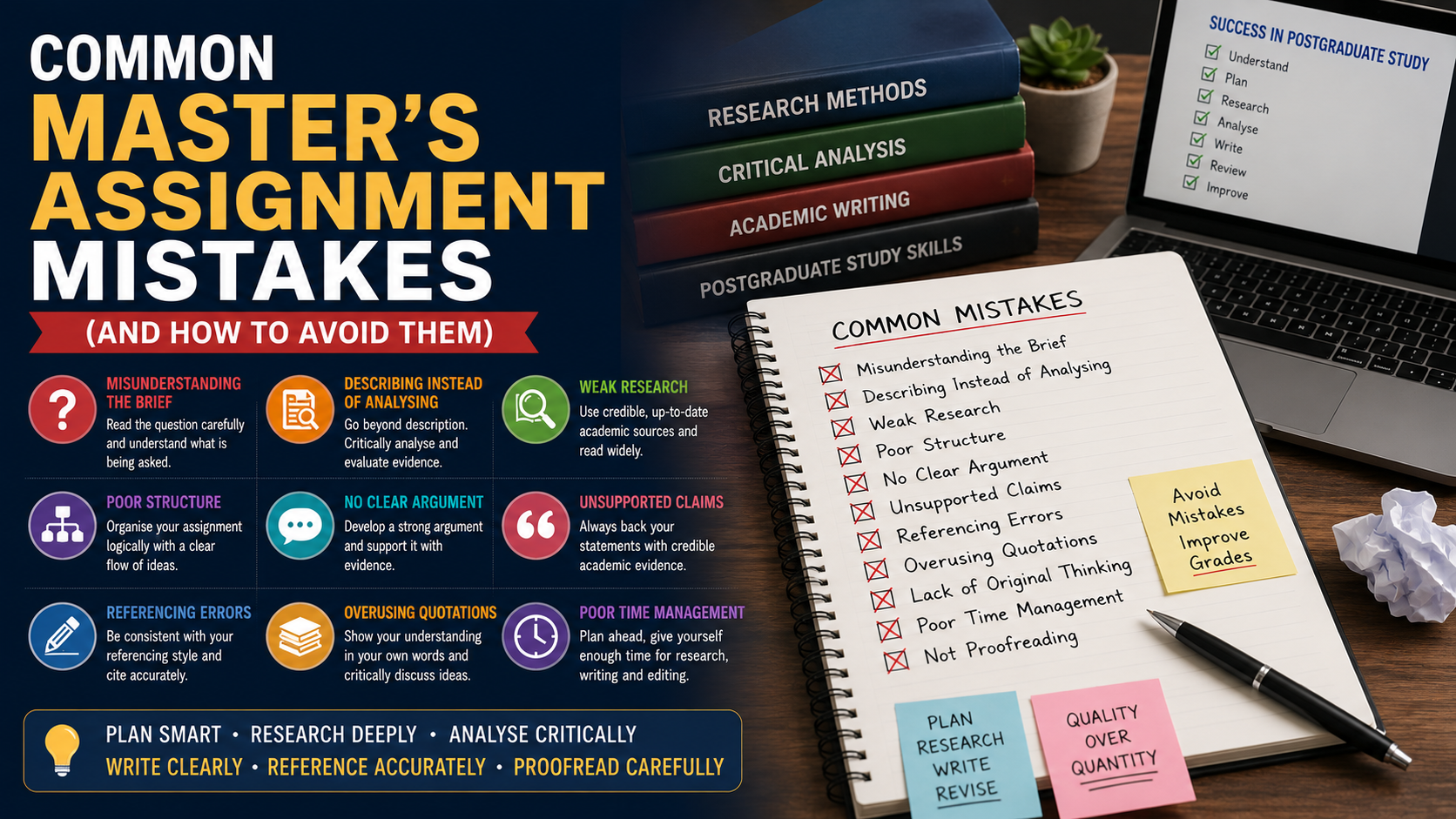
Many master's students assume that writing longer assignments or including more references automatically leads to higher grades. In reality, lecturers assess the quality of your research, critical thinking, academic writing, and ability to answer the assignment question—not simply the amount of content.
Understanding the most common master's assignment mistakes can help you improve your work, meet postgraduate standards, and achieve distinction-level grades.
In this guide, you'll discover:
Why Master's Assignments Are More Challenging
Master's assignments require students to demonstrate:
Independent research
Advanced critical analysis
Evidence-based arguments
Original thinking
Professional academic writing
Lecturers expect students to engage with scholarly debates rather than simply describe existing knowledge.
Because expectations are higher, even small weaknesses can significantly affect grades.
Mistake 1: Misunderstanding the Assignment Brief
One of the most common reasons students lose marks is failing to answer the actual question.
Many students begin researching before carefully reading the assignment instructions.
As a result, they:
Answer the wrong question
Miss key requirements
Ignore learning outcomes
How to Avoid It
Before starting:
Read the brief several times.
Highlight command words.
Check assessment criteria.
Clarify uncertainties with your lecturer.
Understanding the brief saves time and improves focus.
Mistake 2: Describing Instead of Critically Analysing
This is perhaps the biggest difference between undergraduate and postgraduate writing.
Many students describe theories instead of evaluating them.
For example:
Weak writing:
"Author A states that leadership improves organisational performance."
Stronger writing:
"Although Author A argues that leadership improves organisational performance, subsequent research suggests the relationship depends on organisational culture and employee engagement."
Critical analysis demonstrates independent thinking.
Mistake 3: Weak Academic Research
Some students rely heavily on:
Websites
News articles
Outdated sources
Master's assignments require extensive engagement with scholarly literature.
Better Sources Include
Peer-reviewed journal articles
Academic books
Government publications
Professional reports
High-quality research strengthens academic credibility.
Mistake 4: Using Too Few References
Limited research often results in:
Weak arguments
Poor evidence
Lower grades
Master's assignments usually require broader reading than undergraduate work.
However, quality remains more important than quantity.
Mistake 5: Poor Assignment Structure
Even excellent research becomes difficult to follow without logical organisation.
Common structural problems include:
Weak introductions
Disorganised paragraphs
Repetition
Abrupt transitions
A strong structure guides readers through your argument.
Mistake 6: No Clear Argument
Some assignments simply summarise research without presenting a central argument.
Master's assignments should:
Develop a position
Support it with evidence
Address opposing viewpoints
Reach justified conclusions
Your argument should remain consistent throughout the assignment.
Mistake 7: Ignoring the Marking Rubric
Many students never read the marking criteria.
The rubric explains exactly what lecturers assess.
Typical assessment areas include:
Critical analysis
Research quality
Academic writing
Structure
Referencing
Ignoring these criteria often leads to unnecessary mark deductions.
Mistake 8: Weak Paragraph Development
Strong paragraphs usually follow this pattern:
Topic sentence
Evidence
Critical discussion
Link back to the question
Weak paragraphs often:
Contain multiple unrelated ideas
Lack evidence
End abruptly
Clear paragraph structure improves readability.
Mistake 9: Unsupported Claims
Statements without evidence weaken academic arguments.
For example:
"Online education is better than classroom learning."
This opinion requires supporting research.
Academic writing should always justify important claims using credible sources.
Mistake 10: Poor Referencing
Common referencing errors include:
Missing citations
Incorrect formatting
Inconsistent styles
Incomplete reference lists
These mistakes may reduce marks and raise concerns about academic integrity.
Always follow your university's required referencing style.
Mistake 11: Overusing Quotations
Master's assignments should demonstrate your own understanding.
Large numbers of quotations may suggest limited independent analysis.
Instead:
Paraphrase
Summarise
Critically discuss evidence
Your own academic voice should remain central.
Mistake 12: Lack of Original Thinking
Lecturers reward students who contribute thoughtful analysis.
Simply repeating published ideas rarely achieves distinction.
Instead:
Compare perspectives
Evaluate evidence
Identify research gaps
Form balanced conclusions
Original interpretation demonstrates postgraduate-level thinking.
Mistake 13: Weak Conclusions
Some conclusions merely repeat earlier paragraphs.
Others introduce entirely new arguments.
An effective conclusion should:
Summarise findings
Reinforce your argument
Answer the assignment question
Avoid introducing new evidence.
Mistake 14: Poor Time Management
Many students underestimate the time required for postgraduate assignments.
Rushing often leads to:
Limited research
Weak editing
Referencing errors
Good planning improves assignment quality considerably.
Mistake 15: Failing to Proofread
Simple mistakes create a poor impression.
Proofreading should include checking:
Grammar
Spelling
Referencing
Formatting
Consistency
Professional presentation supports stronger grades.
What Examiners Expect Instead
High-quality master's assignments consistently demonstrate:
Clear focus
Independent research
Critical evaluation
Logical organisation
Strong evidence
Professional writing
Accurate referencing
Meeting these expectations significantly improves academic performance.
Practical Tips for Avoiding These Mistakes
Understand the Brief First
Never begin writing before understanding exactly what the assignment requires.
Plan Carefully
Create a detailed outline before researching.
Read Widely
Use multiple academic sources rather than relying on a few references.
Analyse Rather Than Describe
Ask:
Why?
How?
To what extent?
These questions encourage deeper thinking.
Edit More Than Once
Outstanding assignments are rarely first drafts.
Review your work multiple times before submission.
Master's Assignment Checklist
Before submitting, ask yourself:
✔ Have I answered the assignment question?
✔ Have I demonstrated critical analysis?
✔ Have I used sufficient academic evidence?
✔ Is my structure logical?
✔ Are my references accurate?
✔ Have I proofread thoroughly?
✔ Does every paragraph support my argument?
If the answer is yes, your assignment is much stronger.
Key Takeaways
Master's assignments require critical thinking rather than description.
Understanding the assignment brief prevents unnecessary mistakes.
Strong research improves credibility.
Logical structure supports clearer arguments.
Accurate referencing demonstrates academic integrity.
Careful proofreading improves presentation.
Independent thinking is essential for distinction-level work.
Conclusion
Most master's assignment mistakes are entirely avoidable. Students who understand postgraduate expectations, plan effectively, conduct thorough academic research, and focus on critical analysis consistently produce stronger assignments.
Rather than trying to write longer papers, concentrate on producing well-structured, evidence-based, and critically evaluated work that directly answers the assignment question.
Avoiding these common mistakes will not only improve your grades but also develop the academic skills expected at postgraduate level.
Frequently Asked Questions
Everything you need to know about our services