How to Write Critical Analysis in University Assignments
Introduction
One of the most common pieces of feedback students receive in UK universities is:
"Your work needs more critical analysis."
For many students, this feedback can be confusing. They may have researched extensively, included references, and written thousands of words, yet still lose marks because their work lacks critical analysis.
Critical analysis is one of the most important academic skills expected in higher education. It is also one of the biggest differences between average assignments and high-scoring assignments.
Understanding what critical analysis means—and how to demonstrate it—can significantly improve your grades.
In this guide, you'll learn:
What Is Critical Analysis?
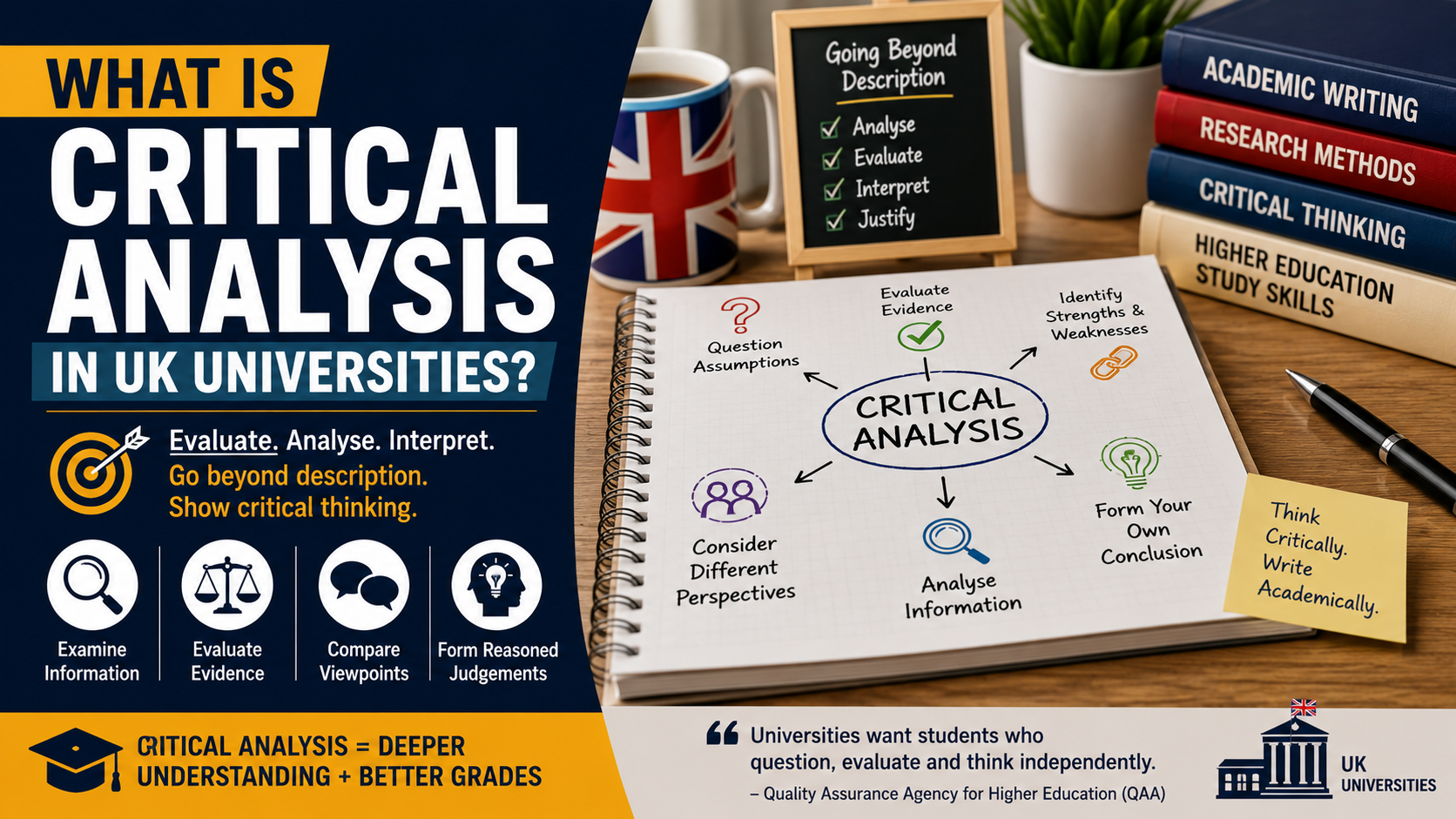
Critical analysis is the process of examining information carefully, evaluating evidence, questioning assumptions, comparing viewpoints, and forming reasoned judgements.
Rather than simply presenting information, students are expected to:
Analyse ideas
Evaluate evidence
Discuss strengths and weaknesses
Compare perspectives
Reach supported conclusions
Critical analysis shows that you understand the topic at a deeper level.
Why Is Critical Analysis Important in UK Universities?
UK higher education places strong emphasis on independent thinking.
Universities want students to:
Engage with research critically
Develop informed opinions
Evaluate evidence objectively
Demonstrate intellectual independence
Critical analysis helps students move beyond memorisation and demonstrate genuine academic understanding.
Because of this, critical analysis often carries significant weighting in marking rubrics.
Critical Analysis vs Description
Many students lose marks because they describe rather than analyse.
Understanding the difference is essential.
Description
Description explains what something is.
Example:
"Transformational leadership focuses on inspiring employees through motivation and vision."
This statement provides information but offers no evaluation.
Critical Analysis
Critical analysis evaluates the information.
Example:
"While transformational leadership is associated with higher employee motivation, some researchers argue that its effectiveness depends heavily on organisational culture and the leader's ability to maintain long-term engagement."
This example:
Discusses evidence
Acknowledges limitations
Presents alternative perspectives
This is critical analysis.
What Do Lecturers Expect?
When lecturers ask for critical analysis, they expect students to:
Examine evidence carefully
Compare academic viewpoints
Discuss limitations
Identify strengths and weaknesses
Evaluate competing arguments
Reach reasoned conclusions
They want students to explain not just what researchers say, but why it matters.
Key Characteristics of Critical Analysis
1. Questioning Information
Critical thinkers do not automatically accept every source.
Instead, they ask:
Is the evidence reliable?
Are there weaknesses?
Is the argument convincing?
Are there alternative explanations?
Questioning information demonstrates deeper engagement.
2. Comparing Viewpoints
Academic topics rarely have one correct answer.
Strong assignments compare:
Different theories
Research findings
Academic perspectives
Example:
"While Smith (2022) argues that remote work increases productivity, Jones (2023) suggests productivity gains vary significantly depending on management practices."
Comparing viewpoints demonstrates critical engagement.
3. Evaluating Evidence
Critical analysis requires students to assess evidence rather than simply present it.
Consider:
Sample size
Research methods
Reliability
Validity
Relevance
Not all evidence carries equal value.
4. Identifying Strengths and Weaknesses
Strong assignments acknowledge both advantages and limitations.
Example:
"The study provides valuable insights into employee engagement; however, its findings are limited by a relatively small sample size."
This demonstrates balanced evaluation.
5. Forming Independent Judgements
Critical analysis involves drawing your own conclusions based on evidence.
Rather than simply reporting research, students should explain:
Which arguments are strongest
Which evidence is most convincing
Why certain conclusions are justified
Independent judgement is highly valued in university assessment.
Examples of Critical Analysis
Example 1: Weak Response
"Social media affects mental health."
This statement is descriptive and unsupported.
Example 2: Strong Response
"Although social media has been linked to increased anxiety among young adults, some researchers argue that its effects depend on usage patterns, social support networks, and individual psychological factors."
This response:
Uses evidence
Recognises complexity
Presents multiple perspectives
This is critical analysis.
Common Words Used in Critical Analysis
Academic writing often uses language that signals evaluation.
Examples include:
However
Although
Nevertheless
Conversely
On the other hand
Despite
While
In contrast
These words help demonstrate analytical thinking.
How Critical Analysis Appears in Assignments
Critical analysis can be used throughout academic work.
Literature Reviews
Students evaluate:
Research quality
Methodologies
Academic debates
Essays
Students:
Compare theories
Evaluate evidence
Justify arguments
Reports
Students:
Assess findings
Discuss implications
Recommend actions
Case Studies
Students:
Analyse situations
Evaluate decisions
Apply theoretical frameworks
Common Mistakes Students Make
1. Summarising Instead of Analysing
Many students spend entire paragraphs explaining sources without evaluating them.
This limits marks.
2. Avoiding Criticism
Some students assume they must agree with academic sources.
However, critical analysis often requires questioning evidence and identifying limitations.
3. Presenting Only One Viewpoint
Assignments become stronger when multiple perspectives are discussed.
4. Making Unsupported Judgements
Conclusions should always be supported by evidence.
Personal opinions alone are not sufficient.
Techniques for Improving Critical Analysis
Use the PEEL Method
Point
Introduce the argument.
Evidence
Provide supporting research.
Explanation
Explain significance.
Link
Connect to the assignment question.
Ask Critical Questions
Whenever reading research, ask:
What is the author's argument?
What evidence supports it?
Are there limitations?
Is there conflicting evidence?
How convincing is the conclusion?
These questions encourage analytical thinking.
Read Widely
Students who consult multiple academic sources are more likely to identify:
Disagreements
Limitations
Alternative viewpoints
This naturally improves analysis.
Focus on "Why" and "How"
Descriptive writing often answers:
"What?"
Critical analysis answers:
Why?
How?
To what extent?
These questions encourage deeper discussion.
How Critical Analysis Affects Grades
Critical analysis is often one of the most heavily weighted assessment criteria.
Assignments that demonstrate:
Evaluation
Independent thinking
Evidence-based judgement
typically receive higher grades than assignments that rely primarily on description.
Many students move from a 2:2 to a 2:1—or from a 2:1 to a First-Class grade—simply by improving analytical depth.
Quick Critical Analysis Checklist
Before submitting your assignment, ask:
✔ Have I compared different viewpoints?
✔ Have I evaluated evidence?
✔ Have I discussed strengths and weaknesses?
✔ Have I identified limitations?
✔ Have I justified my conclusions?
✔ Have I gone beyond description?
If the answer is yes, your work is much more likely to demonstrate critical analysis.
Key Takeaways
Critical analysis involves evaluating information rather than simply describing it.
UK universities highly value independent thinking.
Students should compare viewpoints, assess evidence, and form reasoned judgements.
Critical analysis often carries significant weighting in marking rubrics.
Improving analytical writing can dramatically improve assignment grades.
Conclusion
Critical analysis is one of the most important skills students develop at university. It demonstrates intellectual maturity, independent thinking, and a deeper understanding of academic topics.
Rather than simply reporting information, students should focus on evaluating evidence, comparing perspectives, identifying limitations, and forming supported conclusions.
By practising these skills consistently, students can improve assignment quality, meet lecturer expectations, and achieve higher academic grades throughout their studies.
Frequently Asked Questions
Everything you need to know about our services