Common Reasons UK Students Lose Marks (And How to Avoid Them)
Introduction
Many UK university students are surprised when they receive assignment grades that are lower than expected. In many cases, the problem is not a lack of effort or intelligence. Instead, students lose marks because they overlook important assessment criteria that lecturers use when grading academic work.
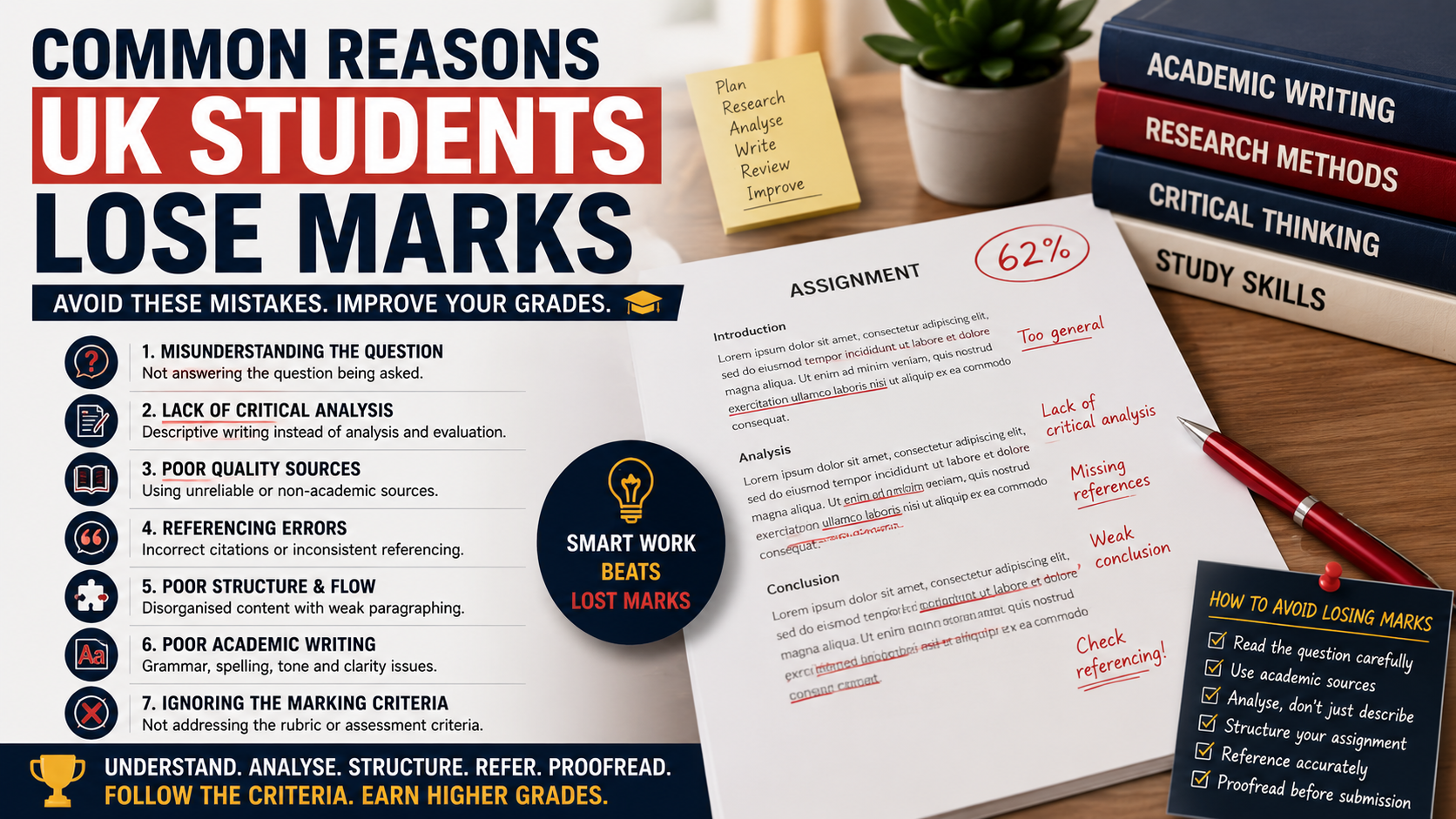
Small mistakes such as weak critical analysis, poor referencing, or misunderstanding the assignment brief can significantly reduce grades. The good news is that most of these issues are preventable.
Understanding the most common reasons students lose marks can help you improve your academic performance and avoid repeating the same mistakes in future assignments.
In this guide, we'll explore the most frequent grading issues and explain how to avoid them.
Why Students Lose Marks Despite Working Hard
Many students spend hours researching and writing assignments but still fail to achieve the grades they expect.
This often happens because university assignments are assessed using specific marking criteria rather than effort alone.
Lecturers typically evaluate:
Subject knowledge
Critical analysis
Research quality
Academic writing
Structure
Referencing
Originality
Even well-researched assignments can lose marks if they fail to meet these expectations.
1. Misunderstanding the Assignment Question
One of the most common reasons students lose marks is misunderstanding the assignment brief.
Students sometimes focus on the topic generally rather than answering the specific question being asked.
For example:
Question: Critically evaluate leadership styles in healthcare organisations.
Some students:
Describe leadership styles
Define leadership theories
Provide general information
However, they fail to critically evaluate those theories.
As a result, marks are lost.
How to Avoid It
Before writing:
Identify command words
Highlight key topics
Understand the context
Clarify expectations
Always ask:
"What exactly is the lecturer asking me to do?"
2. Writing Descriptively Instead of Analytically
Many assignments contain plenty of information but little analysis.
Description explains.
Analysis evaluates.
Lecturers expect students to:
Compare ideas
Evaluate evidence
Discuss strengths and weaknesses
Form reasoned judgements
Assignments that simply describe theories often receive lower grades.
Example
Weak:
"Transformational leadership motivates employees."
Stronger:
"While transformational leadership can improve employee motivation, some studies suggest its effectiveness depends on organisational culture and leadership implementation."
The second example demonstrates analysis.
3. Weak Critical Thinking
Critical thinking is heavily rewarded in UK universities.
Students lose marks when they:
Accept evidence without question
Repeat author opinions
Avoid evaluating research
Critical thinking involves:
Challenging assumptions
Identifying limitations
Comparing viewpoints
Drawing independent conclusions
Strong critical thinking often separates average assignments from high-scoring work.
4. Using Poor-Quality Sources
Not all sources are considered academically credible.
Students frequently lose marks because they rely heavily on:
Blogs
Wikipedia
Unverified websites
Opinion articles
Lecturers expect students to use:
Peer-reviewed journals
Academic books
Government reports
Professional publications
Source quality directly affects assignment credibility.
5. Insufficient Research
Some students stop researching after finding a few references.
This limits the depth of discussion.
Strong assignments demonstrate:
Broad reading
Current research
Multiple viewpoints
Limited research often results in:
Weak arguments
Repetitive discussion
Superficial analysis
6. Poor Assignment Structure
Even good ideas can lose marks if they are poorly organised.
Common structural issues include:
Weak introductions
Disorganised paragraphs
Poor transitions
Confusing conclusions
A strong assignment should follow a logical structure:
Introduction
Introduce the topic and argument.
Main Body
Present evidence and analysis.
Conclusion
Summarise findings and provide judgement.
Good structure improves readability and clarity.
7. Weak Paragraph Development
Students often lose marks because their paragraphs lack focus.
Strong paragraphs should:
Present one main idea
Include evidence
Explain significance
Link back to the question
The PEEL method can help:
Point
Evidence
Explanation
Link
This structure improves coherence.
8. Failing to Answer the Question Directly
Some assignments contain good information but fail to address the actual question.
Examiners want relevance.
Every section should contribute directly to answering the assignment brief.
Irrelevant discussion wastes words and reduces marks.
9. Referencing Errors
Referencing mistakes are extremely common.
Students often lose marks because they:
Miss citations
Use incorrect formatting
Create incomplete reference lists
Common styles include:
Harvard
APA
MLA
OSCOLA
Chicago
Accurate referencing demonstrates academic integrity.
10. Inconsistent Referencing
Even when students understand the referencing style, inconsistency causes problems.
Examples include:
Mixed citation formats
Missing page numbers
Incorrect punctuation
Consistency is essential.
11. Poor Academic Writing
Academic writing differs from everyday communication.
Students lose marks when they use:
Informal language
Slang
Emotional expressions
Overly casual tone
Academic writing should be:
Formal
Objective
Precise
Professional
Clear writing improves overall quality.
12. Grammar and Spelling Mistakes
Grammar mistakes do not always result in large mark deductions, but they can affect readability.
Common issues include:
Sentence fragments
Spelling errors
Punctuation mistakes
Awkward phrasing
Frequent errors create a negative impression.
How to Avoid It
Before submission:
Proofread carefully
Use grammar tools
Read aloud
Ask someone to review your work
Small corrections can improve presentation significantly.
13. Lack of Evidence
Strong academic arguments require evidence.
Students lose marks when they make claims without support.
Every major point should be backed by:
Research findings
Academic literature
Statistics
Expert opinion
Evidence strengthens credibility.
14. Weak Conclusions
Many students rush their conclusions.
Common mistakes include:
Repeating previous content
Introducing new information
Ending abruptly
Strong conclusions:
Summarise findings
Reinforce arguments
Provide final judgement
A good conclusion leaves a strong final impression.
15. Ignoring the Marking Rubric
One of the easiest ways to lose marks is ignoring the marking criteria.
Rubrics explain:
Assessment areas
Grade expectations
Weightings
Students who review the rubric before writing often perform better because they understand what lecturers are assessing.
How to Use the Rubric Effectively
Before submitting, ask:
✔ Have I addressed every assessment criterion?
✔ Have I demonstrated critical analysis?
✔ Have I used credible sources?
✔ Have I followed referencing guidelines?
✔ Have I answered the question directly?
This simple review can prevent avoidable mark losses.
Common Habits of High-Scoring Students
Students who consistently achieve strong grades often:
Read the assignment brief carefully
Start early
Use academic sources
Focus on critical analysis
Follow the marking rubric
Proofread thoroughly
These habits help reduce common mistakes.
Quick Assignment Checklist
Before submitting:
✔ Understand the question
✔ Follow the rubric
✔ Use quality sources
✔ Demonstrate analysis
✔ Structure clearly
✔ Reference accurately
✔ Proofread carefully
This checklist helps maximise marks.
Key Takeaways
Students often lose marks because of preventable mistakes.
Weak critical analysis is one of the most common issues.
Understanding the assignment brief is essential.
High-quality research strengthens arguments.
Accurate referencing matters.
Strong structure improves readability.
Following the marking rubric can significantly improve grades.
Conclusion
Most marks lost in university assignments are not caused by a lack of effort. Instead, they result from common academic mistakes that can often be avoided through better planning and awareness.
By understanding lecturer expectations, focusing on critical analysis, using strong academic sources, following assessment criteria, and proofreading carefully, students can improve assignment quality and achieve higher grades consistently.
Small improvements in these areas can make a significant difference to overall academic performance.
Frequently Asked Questions
Everything you need to know about our services


