Five Common Dissertation Situations and How Students Solved Them
Introduction
Every dissertation journey is different, yet many students encounter remarkably similar challenges. Some struggle to choose a research topic, while others fall behind on writing, receive difficult supervisor feedback, or panic as submission deadlines approach.
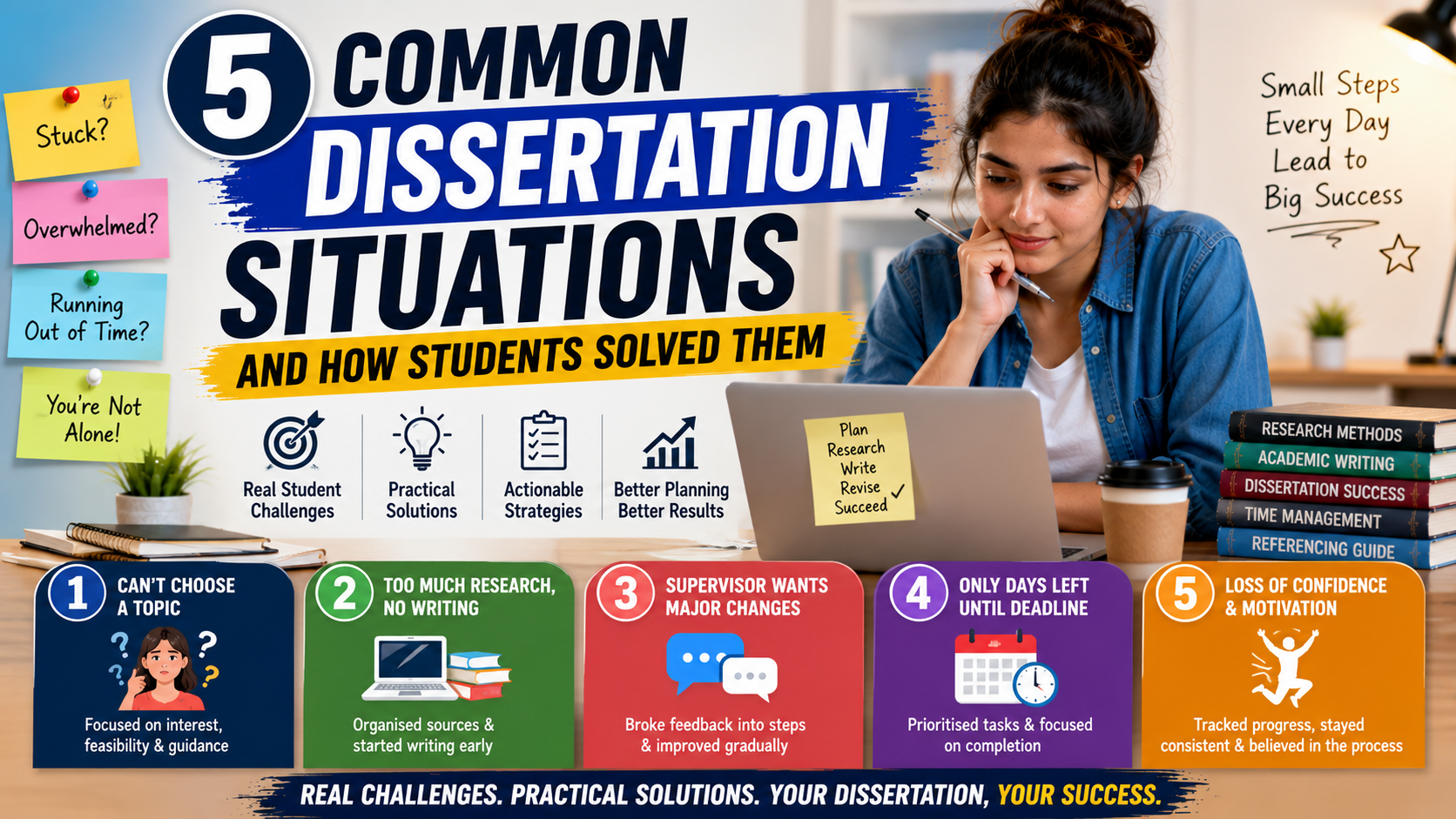
The encouraging news is that these situations are common—and they are often manageable with the right approach. Successful students are not necessarily those who avoid problems altogether, but those who identify issues early, adapt their strategies, and keep making steady progress.
This guide presents five fictional but realistic dissertation scenarios inspired by common student experiences. Each situation is followed by practical, ethical solutions that can help undergraduate, master's, and PhD students navigate their own dissertation journey more confidently.
Situation 1: "I Can't Choose a Dissertation Topic"
The Challenge
Emma spent two weeks switching between different research ideas.
Every topic seemed either:
Too broad
Too narrow
Too difficult
Already researched
Instead of making progress, she became trapped in endless decision-making.
What Changed?
Rather than searching for the "perfect" topic, Emma asked herself three questions:
Is the topic genuinely interesting?
Can I find enough academic literature?
Is the project realistic within my deadline?
After discussing her ideas with her supervisor, she selected one focused research question and stopped comparing alternatives.
The Lesson
A clear, manageable topic is usually more valuable than an ambitious idea that becomes impossible to complete.
Situation 2: "I've Done Lots of Research but Hardly Written Anything"
The Challenge
Daniel had downloaded more than 180 journal articles.
However:
His literature review was incomplete.
Notes were scattered across folders.
Writing had barely started.
Research had become a form of procrastination.
What Changed?
Daniel created thematic folders for his sources and began writing after reviewing each group of articles instead of waiting to finish all his reading.
He shifted his focus from collecting information to analysing it.
The Lesson
Research supports writing—it should not replace it.
Situation 3: "My Supervisor Wants Major Changes"
The Challenge
Sophia submitted her first dissertation chapter expecting minor corrections.
Instead, her supervisor suggested:
Stronger critical analysis
Better structure
Clearer arguments
Improved referencing
Initially, the feedback felt overwhelming.
What Changed?
Rather than rewriting everything immediately, Sophia grouped the comments into categories and addressed the biggest issues first.
Each revision made the dissertation stronger.
The Lesson
Supervisor feedback is part of the writing process, not a sign of failure.
Situation 4: "I Only Have Two Weeks Left"
The Challenge
James realised he had underestimated how long dissertation writing would take.
With only fourteen days remaining, he still needed to:
Finish two chapters
Edit existing work
Complete references
Format the document
Panic quickly set in.
What Changed?
Instead of trying to perfect every chapter, James focused on completing a full draft first.
He divided the remaining work into daily goals and reserved the final days for proofreading and formatting.
The Lesson
Progress becomes much easier when priorities are clear.
Situation 5: "I've Lost Confidence"
The Challenge
Priya began comparing her progress with classmates.
She worried that everyone else seemed:
More organised
More productive
Further ahead
This comparison reduced her motivation.
What Changed?
Priya stopped measuring her progress against others.
Instead, she tracked:
Weekly writing goals
Chapters completed
Supervisor feedback implemented
References organised
Watching her own progress restored confidence.
The Lesson
Your dissertation is unique.
Success should be measured against your own milestones—not someone else's.
What These Five Students Had in Common
Although their situations were different, each student eventually succeeded because they made similar changes.
They:
Accepted that challenges were normal.
Created realistic plans.
Focused on one problem at a time.
Asked for guidance when needed.
Worked consistently instead of waiting for motivation.
The solution wasn't working longer hours.
It was working more deliberately.
Practical Strategies for Any Dissertation Challenge
No matter where you are in your dissertation journey, these habits can help:
Plan Weekly
Break your project into manageable milestones rather than focusing only on the final deadline.
Write Before Editing
Complete your ideas first.
Refine the wording later.
Keep Your Research Organised
Store articles, notes, and references in clearly labelled folders.
Good organisation saves significant time later.
Review Feedback Promptly
Address supervisor comments while they are still fresh.
Small improvements accumulate quickly.
Protect Focused Study Time
Limit distractions during dedicated writing sessions.
Consistency is usually more effective than occasional marathon study days.
Maintain Academic Integrity
Regardless of the challenges you face, academic integrity should remain a priority.
Always:
Cite every source accurately.
Follow your university's guidance on the acceptable use of AI tools.
Clearly distinguish your own analysis from published research.
Review your institution's academic integrity policies before submission.
Ethical academic practice strengthens both the quality and credibility of your dissertation.
Quick Problem-Solution Guide
Situation | Practical Solution |
|---|---|
Can't choose a topic | Select a focused, researchable question with supervisor guidance. |
Too much research, little writing | Organise sources by theme and begin drafting. |
Difficult supervisor feedback | Prioritise major revisions and address comments systematically. |
Very little time remaining | Complete a full draft first, then edit and proofread. |
Loss of confidence | Track your own progress instead of comparing yourself with others. |
Final Thoughts
Every dissertation includes moments of uncertainty, unexpected setbacks, and difficult decisions. Whether you're struggling to choose a topic, feeling overwhelmed by supervisor feedback, racing against a deadline, or simply questioning your progress, remember that these experiences are shared by many students.
The fictional scenarios in this guide demonstrate an important truth: success rarely comes from avoiding challenges altogether. Instead, it comes from responding to them with realistic planning, consistent effort, organised research, and a willingness to adapt. By addressing one challenge at a time and maintaining good academic practices, you can navigate your dissertation journey with greater confidence and finish a project that reflects your hard work and learning.
Frequently Asked Questions
Everything you need to know about our services
Related Posts

The Biggest Time Wasters During Dissertation Writing

Can You Recover From a Poor Dissertation Draft?
