The Biggest Time Wasters During Dissertation Writing
Introduction
Writing a dissertation is one of the most demanding academic projects you'll complete at university. It requires months of planning, research, critical thinking, writing, editing, and revision. Yet despite having several months to finish, many students still find themselves racing against the deadline.
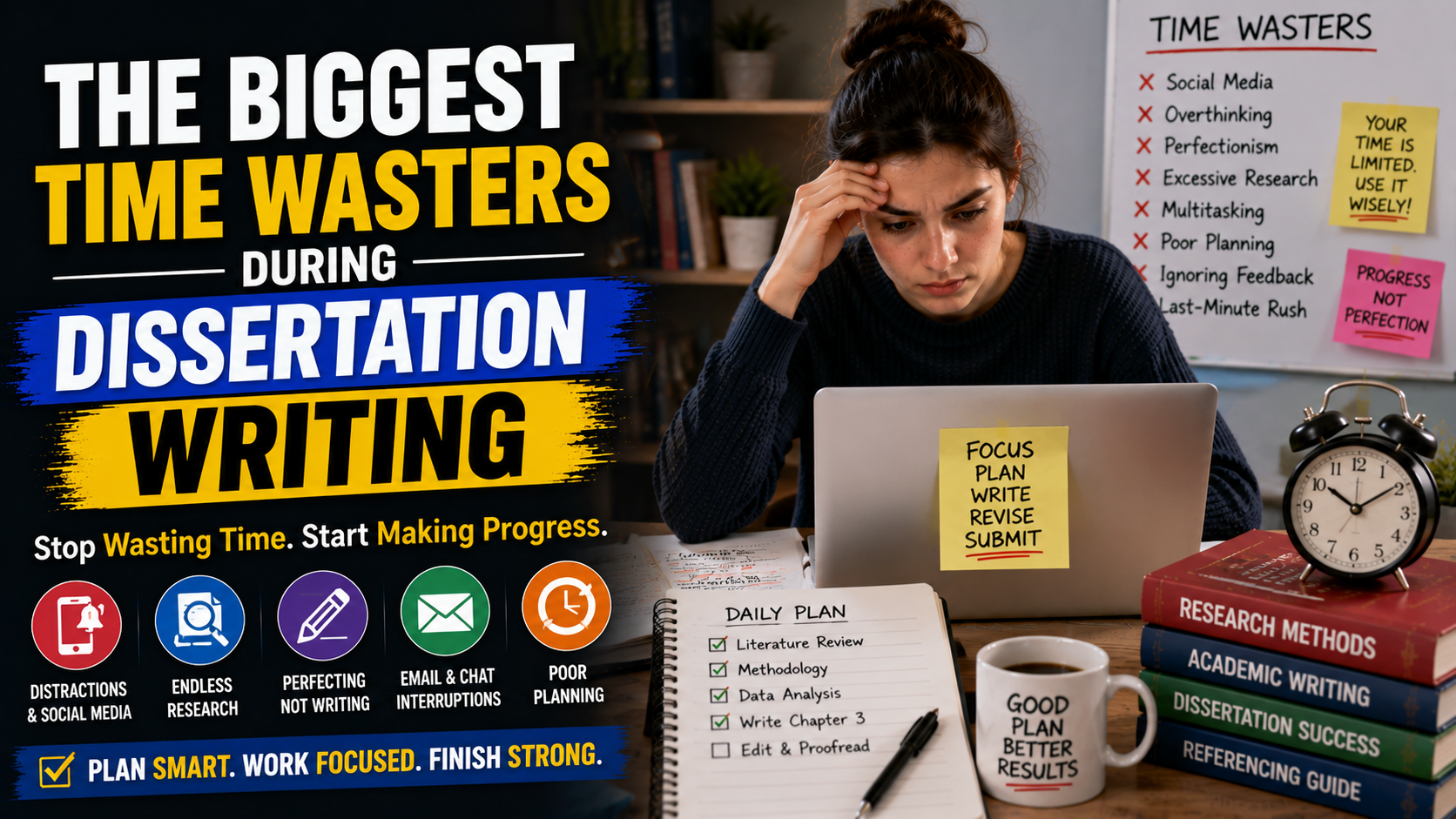
The reason is not always a lack of motivation. More often, it's the accumulation of small, seemingly harmless habits that consume valuable time without contributing much progress. Checking emails every few minutes, endlessly searching for the "perfect" source, rewriting the same paragraph repeatedly, or delaying difficult tasks can quietly reduce productivity.
Recognising these common time wasters is the first step towards managing your dissertation more effectively. By replacing inefficient habits with focused work strategies, you can make consistent progress, reduce stress, and improve the quality of your final submission.
This guide explores the biggest time wasters during dissertation writing and offers practical ways to avoid them.
Why Time Management Matters
Unlike regular coursework, dissertations are long-term projects with multiple stages, including:
Topic selection
Literature review
Research design
Data collection
Data analysis
Draft writing
Editing
Proofreading
Formatting
Final submission
Losing just a few hours each week can add up to several days or even weeks over the course of your project.
1. Waiting for the "Perfect Time" to Start
Many students delay starting because they believe they need:
More motivation
More free time
More inspiration
Better ideas
Unfortunately, perfect conditions rarely arrive.
Progress usually comes from starting, even if it's only for 30 minutes.
Better Approach
Schedule regular writing sessions instead of waiting until you feel inspired.
2. Endless Literature Searching
Research is essential, but many students continue searching for articles long after they have enough material.
Signs this is happening include:
Reading articles without taking notes
Downloading papers "just in case"
Constantly searching for one more perfect source
Eventually, research becomes a form of procrastination.
Better Approach
Set clear limits, such as reviewing a specific number of articles before beginning to write.
3. Editing While Writing
Stopping after every sentence to fix grammar or rewrite paragraphs dramatically slows progress.
The first draft should prioritise ideas rather than perfection.
Better Approach
Write first.
Edit later.
Separate writing sessions from editing sessions.
4. Multitasking
Many students attempt to:
Write
Check messages
Watch videos
Reply to emails
Browse social media
at the same time.
Research consistently shows that multitasking reduces concentration and increases the time required to complete complex tasks.
Better Approach
Work on one dissertation task at a time.
5. Constantly Changing Your Research Question
Refining your research question is normal.
Completely changing your topic several times is not.
Frequent changes often require:
New literature
New methodology
New analysis
New structure
This significantly increases workload.
Better Approach
Finalise your research question as early as possible with guidance from your supervisor.
6. Ignoring Supervisor Feedback
Some students postpone reviewing supervisor comments because they seem overwhelming.
Delaying feedback often creates more revision work later.
Better Approach
Review feedback soon after receiving it and prioritise major improvements first.
7. Spending Too Much Time Formatting Early
Formatting headings, adjusting margins, or perfecting the table of contents while chapters are still incomplete wastes valuable writing time.
Better Approach
Complete your content first, then perform detailed formatting during the final review.
8. Trying to Write Everything in One Sitting
Long writing marathons often result in:
Fatigue
Reduced concentration
More mistakes
Lower writing quality
Better Approach
Work in focused sessions with regular breaks.
Consistent daily progress is more sustainable than occasional all-night writing sessions.
9. Poor File Organisation
Searching for missing journal articles, datasets, or document versions wastes time.
Students often create folders like:
Final.docx
Final2.docx
Final_Final.docx
ReallyFinal.docx
This quickly becomes confusing.
Better Approach
Use organised folders and consistent file names.
10. Leaving Referencing Until the End
Trying to reconstruct every citation before submission is one of the biggest sources of last-minute stress.
Better Approach
Add citations as you write and maintain an updated reference list throughout the project.
11. Comparing Yourself With Other Students
Every dissertation is different.
Comparing:
Word counts
Progress
Supervisor meetings
Research methods
often creates unnecessary anxiety rather than productivity.
Better Approach
Focus on your own research plan and milestones.
12. Perfectionism
Many students spend hours improving a single paragraph instead of completing an entire chapter.
While quality matters, perfectionism often delays progress.
Better Approach
Aim for a complete first draft before refining individual sections.
13. Not Having a Weekly Plan
Without a plan, students often spend valuable time deciding what to do next.
Better Approach
Create weekly goals such as:
Read five journal articles
Finish methodology chapter
Analyse survey results
Edit one chapter
Update references
Knowing your next task improves productivity.
14. Ignoring Your Wellbeing
Poor sleep, inadequate breaks, and unhealthy routines reduce concentration and slow writing.
Productivity depends on both effective study habits and personal wellbeing.
Better Approach
Maintain:
Regular sleep
Healthy meals
Physical activity
Short breaks
Reasonable working hours
Build Better Dissertation Habits
Small daily habits often produce better results than occasional bursts of intense work.
Helpful habits include:
Writing consistently
Setting realistic goals
Tracking weekly progress
Backing up your work
Reviewing supervisor feedback promptly
Keeping references organised
Consistency usually beats intensity.
Protect Academic Integrity
Working efficiently should never compromise academic standards.
Remember to:
Cite all sources accurately.
Follow your university's guidance on the acceptable use of AI tools.
Distinguish your own ideas from published research.
Review your institution's academic integrity policies before submission.
Responsible academic practice remains essential throughout every stage of dissertation writing.
A Weekly Productivity Checklist
Habit | Benefit |
|---|---|
Plan weekly tasks | Reduces decision fatigue |
Write consistently | Maintains momentum |
Organise references | Saves time later |
Review supervisor feedback | Prevents repeated mistakes |
Proofread separately | Improves focus |
Back up your work | Prevents data loss |
Final Thoughts
Most dissertation delays are not caused by one major obstacle but by many small habits that quietly consume time and reduce productivity. By recognising common time wasters—such as procrastination, perfectionism, excessive research, multitasking, and poor planning—you can make better use of your time and maintain steady progress throughout your project.
A successful dissertation is rarely the result of working endlessly. It is more often the outcome of consistent effort, realistic planning, organised research, and regular revision. By focusing on what truly matters and eliminating unnecessary distractions, you'll be in a much stronger position to complete your dissertation on time and submit work you can be proud of.
Frequently Asked Questions
Everything you need to know about our services
Related Posts

What Happens When Your Dissertation Timeline Falls Apart

How Working Students Fall Behind on Their Dissertation
