Can You Recover From a Poor Dissertation Draft?
Introduction
Finishing your first dissertation draft is a significant achievement, but it can also be an emotional experience. After spending weeks or even months researching and writing, many students read through their work and feel disappointed. Perhaps the arguments seem unclear, the structure feels disorganised, or the analysis appears weaker than expected.
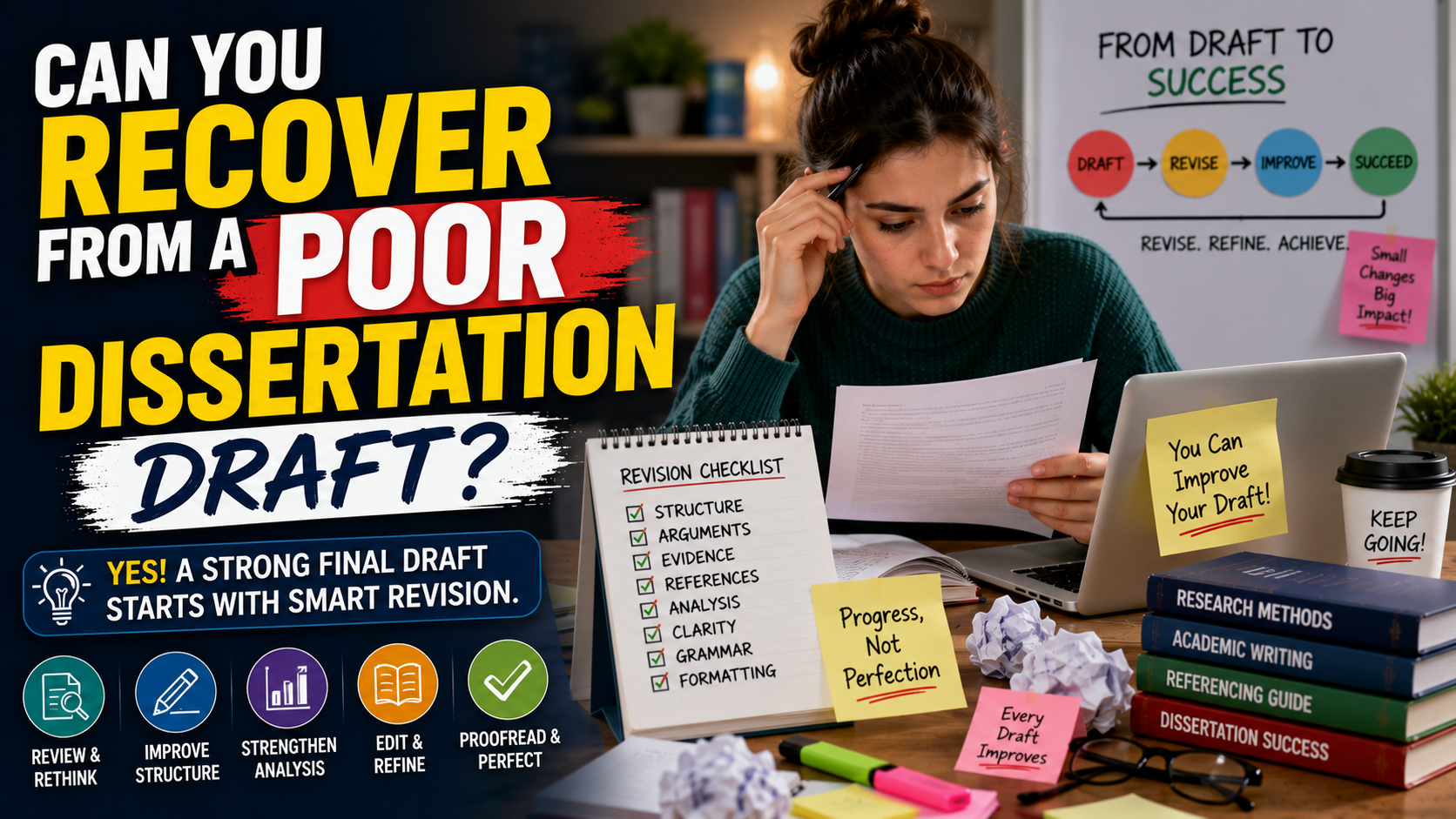
If this sounds familiar, you're not alone. Very few dissertations are submission-ready after the first draft. In fact, producing a rough draft is a normal part of the academic writing process. The purpose of a first draft is to capture your ideas, organise your research, and provide a foundation that can be refined through revision.
The encouraging news is that a poor first draft does not automatically lead to a poor final dissertation. With careful revision, constructive feedback, and a structured improvement plan, many students transform average drafts into well-organised, academically strong dissertations.
This guide explains why first drafts often fall short, how to identify areas for improvement, and the practical steps you can take to recover with confidence.
Why First Dissertation Drafts Often Feel Weak
Students frequently expect their first draft to be close to perfect. However, academic writing rarely works that way.
Common reasons a dissertation draft feels disappointing include:
Writing under time pressure
Limited critical analysis
Weak paragraph structure
Incomplete literature review
Unclear research questions
Inconsistent referencing
Grammar and language issues
Lack of confidence while writing
Remember that identifying weaknesses is an important step towards improving them.
Signs Your Dissertation Draft Needs More Work
A draft may require substantial revision if you notice:
Arguments that lack supporting evidence
Repetition between chapters
Weak transitions
Sections that drift away from the research question
Inconsistent academic tone
Missing citations
Unclear conclusions
Formatting inconsistencies
Most of these issues can be corrected during the revision stage.
Don't Panic After Reading Your Draft
Many students assume a poor draft means they have failed.
Instead, remember:
First drafts are designed to be revised.
Every revision improves clarity.
Academic writing develops through multiple versions.
Even experienced researchers rarely produce perfect first drafts.
Try to view your draft as a work in progress rather than a finished product.
Step 1: Take a Short Break
Before beginning revisions, step away from your dissertation for a day or two if your schedule allows.
Returning with fresh eyes often makes it easier to spot:
Repeated ideas
Weak arguments
Grammar errors
Structural problems
Distance improves objectivity.
Step 2: Review the Big Picture
Before correcting individual sentences, evaluate the dissertation as a whole.
Ask yourself:
Does the dissertation answer the research question?
Does every chapter have a clear purpose?
Is the structure logical?
Do chapters flow naturally?
Major structural improvements should come before detailed editing.
Step 3: Strengthen Your Literature Review
The literature review should do more than summarise previous studies.
Check whether you:
Compare different perspectives
Identify research gaps
Evaluate strengths and limitations
Connect literature to your research
Critical analysis is often more valuable than simply adding more sources.
Step 4: Improve Your Analysis
Many first drafts contain too much description.
Instead of only explaining what happened, ask:
Why are these findings important?
How do they compare with previous research?
What do they mean for your research question?
What are the implications?
Strong analysis demonstrates independent thinking.
Step 5: Improve Paragraph Structure
Effective academic paragraphs usually include:
A clear topic sentence
Supporting evidence
Critical discussion
A concluding or linking sentence
Well-structured paragraphs improve readability and coherence.
Step 6: Check Referencing
Review your dissertation carefully.
Ensure:
Every citation appears in the reference list.
Every reference is cited appropriately.
Citation style is consistent.
Quotations are clearly identified.
Accurate referencing supports academic credibility.
Step 7: Edit for Clarity
After structural improvements, focus on writing quality.
Look for:
Long sentences
Repetition
Informal language
Grammar mistakes
Typographical errors
Inconsistent terminology
Clear writing helps readers understand your arguments.
Step 8: Review Formatting
Before final submission, confirm that your dissertation follows your university's formatting requirements.
Check:
Page numbers
Headings
Tables
Figures
Margins
Line spacing
Table of contents
Appendices
Consistent formatting presents your work professionally.
Use Supervisor Feedback Effectively
Feedback is intended to improve your dissertation.
When reviewing comments:
Identify recurring issues.
Prioritise major improvements.
Ask questions if feedback is unclear.
Create a checklist based on recommendations.
Avoid trying to implement every minor suggestion before addressing larger structural concerns.
Protect Academic Integrity
During revision, continue following good academic practice.
Always:
Cite all sources accurately.
Distinguish your own ideas from published research.
Follow your university's guidance on the acceptable use of AI tools.
Review institutional academic integrity policies before submitting.
Improving your draft should never involve compromising academic standards.
Create a Revision Plan
Rather than editing randomly, work systematically.
For example:
Day | Task |
|---|---|
Day 1 | Review overall structure |
Day 2 | Improve literature review |
Day 3 | Strengthen analysis |
Day 4 | Edit methodology and findings |
Day 5 | Improve discussion chapter |
Day 6 | Check references |
Day 7 | Proofread and format |
Breaking revisions into smaller tasks makes the workload more manageable.
Common Mistakes During Revision
Avoid:
Rewriting everything from scratch
Ignoring supervisor feedback
Editing grammar before fixing structure
Adding unnecessary new sources
Leaving proofreading until submission day
Strategic revisions are usually more effective than complete rewrites.
Frequently Asked Questions (FAQs)
Final Thoughts
A poor first dissertation draft is not the end of your project—it's often the beginning of meaningful improvement. Nearly every successful dissertation evolves through careful revision, constructive feedback, and multiple rounds of editing.
Rather than judging your work too harshly, focus on identifying areas that need attention and improving them one step at a time. By strengthening your structure, enhancing your critical analysis, refining your writing, and maintaining academic integrity throughout the revision process, you can significantly improve the quality of your dissertation and approach submission with greater confidence.
Frequently Asked Questions
Everything you need to know about our services
Related Posts

What Happens If Your Dissertation Is Rejected?

How Working Students Fall Behind on Their Dissertation
