The Final Two Weeks Before Submission: What Really Matters
Introduction
After months of research, reading journal articles, meeting with supervisors, analysing data, and writing thousands of words, you've finally reached the last two weeks before your dissertation submission. While this period can feel overwhelming, it's also one of the most important stages of the entire project.
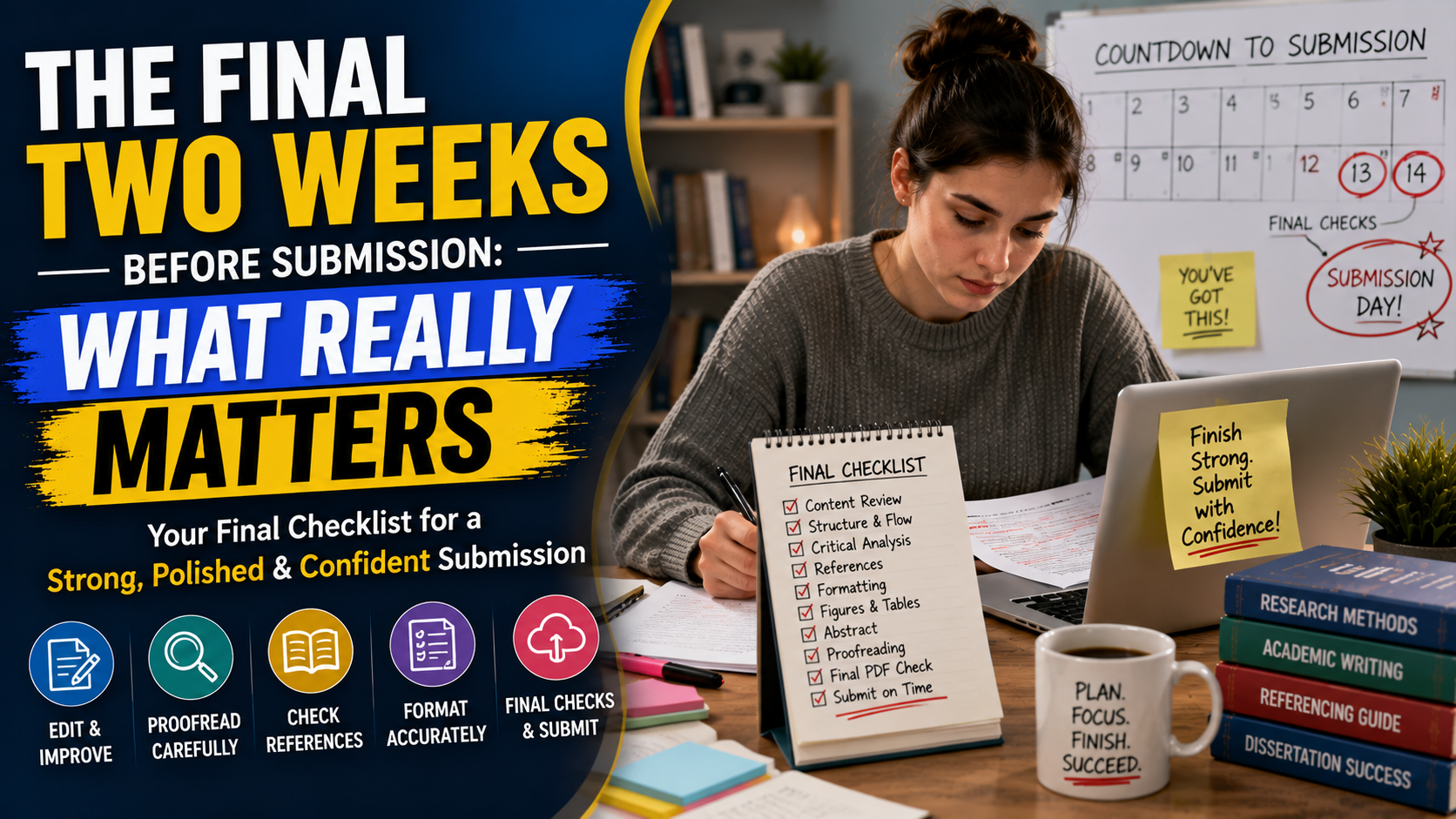
Many students believe these final days should be spent writing as much new content as possible. In reality, the last two weeks are often better used to refine, strengthen, and verify the work you've already completed. Careful editing, accurate referencing, formatting checks, and thoughtful revision can significantly improve the overall quality of your dissertation.
Rather than trying to achieve perfection, focus on presenting a well-organised, clearly argued, and academically sound dissertation that meets your university's submission requirements.
This guide explains what deserves your attention during the final two weeks before submission and how to use your remaining time effectively.
Shift Your Focus from Writing to Improving
If most of your dissertation draft is complete, your priority should gradually move away from producing new material.
Instead, concentrate on:
Strengthening arguments
Improving clarity
Correcting grammar
Checking references
Reviewing formatting
Confirming consistency
These tasks often have a greater impact than adding extra paragraphs at the last minute.
Week Two: Strengthen Your Dissertation
During the second-to-last week before submission, focus on improving the overall quality of your dissertation.
Review Each Chapter
Read every chapter individually.
Ask yourself:
Does this chapter answer its purpose?
Are the arguments logical?
Are paragraphs connected smoothly?
Is there unnecessary repetition?
Have key findings been explained clearly?
Reading each chapter separately makes it easier to identify weaknesses.
Improve Critical Analysis
Many dissertations lose marks because they describe research rather than analysing it.
Review whether you have:
Compared different viewpoints
Evaluated evidence
Explained why findings matter
Linked arguments back to your research questions
Critical thinking is often more valuable than additional content.
Check Structure
Ensure your dissertation flows logically.
Review:
Chapter order
Section headings
Introduction and conclusion
Transitions between chapters
A clear structure improves readability.
Week One: Focus on Accuracy
The final week should concentrate on polishing rather than rewriting.
Proofread Carefully
Proofreading involves much more than correcting spelling mistakes.
Check for:
Grammar
Punctuation
Typographical errors
Sentence clarity
Repeated words
Consistent terminology
Reading slowly often reveals mistakes you previously overlooked.
Review References
Accurate referencing is essential.
Confirm that:
Every citation appears in the reference list.
Every reference has an in-text citation where required.
Citation style is consistent.
Page numbers are included where appropriate.
Sources are formatted correctly.
Referencing errors are among the most common final-stage issues.
Check Formatting
University submission guidelines usually include formatting requirements.
Review:
Font style and size
Line spacing
Margins
Page numbering
Table numbering
Figure captions
Appendices
Table of contents
Small formatting issues are easier to correct before submission.
Verify Figures and Tables
If your dissertation contains charts, graphs, or tables:
Check that:
Every figure is numbered.
Captions are accurate.
Figures are referenced in the text.
Images remain clear after exporting to PDF.
Read Your Dissertation as a Reader
Rather than editing sentence by sentence, read the dissertation from beginning to end.
Ask yourself:
Does the argument make sense?
Would a reader understand each chapter?
Are there any confusing sections?
Is the conclusion supported by the evidence?
Viewing your dissertation from the reader's perspective often reveals overlooked issues.
Don't Ignore the Abstract
Many students leave the abstract until the very end.
Your abstract should briefly summarise:
Research problem
Objectives
Methodology
Main findings
Conclusions
Although short, the abstract deserves careful attention because it's often the first section readers see.
Confirm Submission Requirements
Before submitting, review your university's official guidance.
Check:
Submission deadline
Accepted file format
Naming conventions
Word count requirements
Declaration forms
Upload instructions
Requirements vary between institutions.
Protect Academic Integrity
During the final review, ensure your work reflects good academic practice.
Remember to:
Acknowledge all sources accurately.
Review paraphrased material carefully.
Follow your university's guidance on the appropriate use of AI tools.
Confirm that all quotations are correctly cited.
Check your institution's academic integrity requirements before submission.
Maintaining academic integrity is just as important during the final review as it is during the research stage.
Back Up Your Dissertation
Never rely on a single copy.
Keep backups:
On your computer
In cloud storage
On an external drive if available
Creating multiple backups helps protect your work from unexpected technical problems.
Look After Yourself
The final two weeks can be demanding.
Try to:
Get enough sleep
Stay hydrated
Take regular breaks
Eat balanced meals
Avoid working through the entire night
Maintaining your wellbeing often improves concentration and decision-making.
A Practical 14-Day Dissertation Checklist
Time Remaining | Priority |
|---|---|
Day 14–10 | Review chapter structure and arguments |
Day 9–7 | Improve analysis and strengthen discussion |
Day 6–5 | Proofread entire dissertation |
Day 4 | Review references and citations |
Day 3 | Check formatting, figures, and tables |
Day 2 | Read final PDF version and verify submission requirements |
Day 1 | Submit after completing final checks and saving backup copies |
Common Mistakes During the Final Two Weeks
Avoid:
Rewriting entire chapters unnecessarily
Adding large amounts of new research
Ignoring formatting requirements
Leaving references until the final evening
Skipping proofreading
Waiting until the deadline to upload your dissertation
Small, careful improvements are usually more valuable than major last-minute changes.
Final Thoughts
The final two weeks before dissertation submission are not about trying to transform your research into something entirely different. They are about refining the work you've already completed and ensuring it is presented as clearly, accurately, and professionally as possible.
By focusing on editing, proofreading, referencing, formatting, and carefully reviewing your university's submission requirements, you can approach your deadline with greater confidence. Consistent attention to detail during these final days often makes a meaningful difference to the overall quality of your dissertation and helps you submit your work knowing you've prepared it to the best of your ability.
Frequently Asked Questions
Everything you need to know about our services
Related Posts

The Cost of Starting Your Dissertation Too Late

Can You Realistically Finish a 15,000-Word Dissertation in One Month?
