Dissertation Formatting Help for Canadian Universities
Introduction
Formatting a dissertation can feel like a small task compared with conducting research, collecting data and writing hundreds of pages. However, formatting problems can create unnecessary delays during the final submission stage.
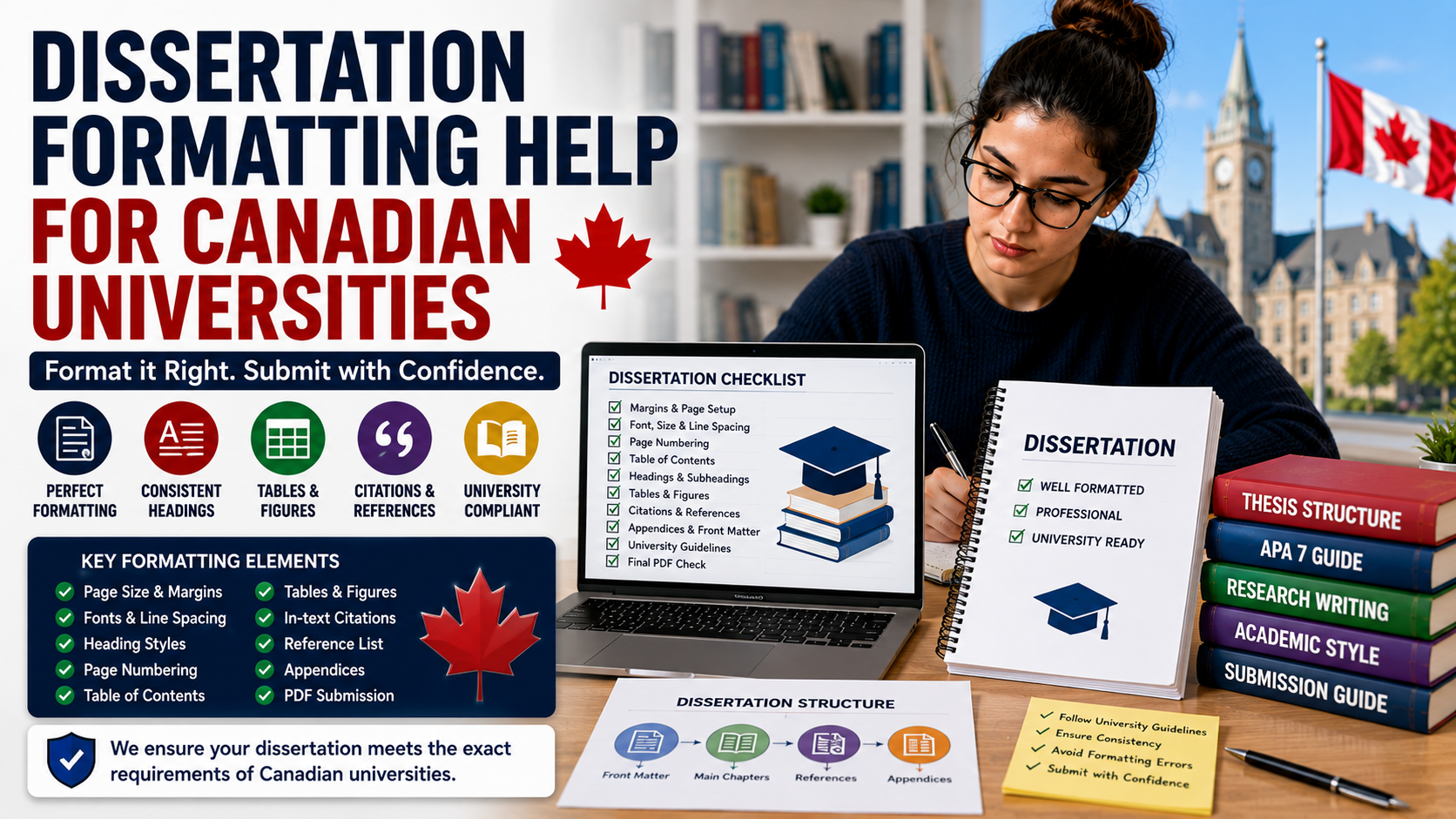
For Canadian Master's and PhD students, dissertation formatting may involve page layout, margins, headings, pagination, tables, figures, references, front matter, appendices, quotations, fonts and institutional submission requirements. The exact rules can vary between universities, faculties and graduate programs.
Dissertation formatting help for Canadian universities can assist students with reviewing and improving the presentation of an existing dissertation so that it follows the applicable institutional and academic requirements.
This guide explains what Canadian graduate students should check before submitting a dissertation and how professional formatting support can help.
What Is Dissertation Formatting?
Dissertation formatting is the process of applying the required visual, structural and technical presentation rules to a completed dissertation.
It can include:
Page size
Margins
Font
Line spacing
Paragraph formatting
Heading styles
Page numbers
Chapter numbering
Table of contents
Lists of tables and figures
Tables
Figures
Equations
Citations
Reference lists
Appendices
Front matter
Headers and footers
PDF preparation
File naming
Electronic submission requirements
Formatting is not simply about making a dissertation look attractive.
It is about making the document consistent, readable, professional and compliant with the relevant submission requirements.
Do Canadian Universities Have the Same Dissertation Formatting Rules?
No. Canadian universities do not have one universal dissertation formatting standard.
Requirements can differ according to:
University
Graduate school
Faculty
Department
Degree
Discipline
Thesis or dissertation format
Traditional versus manuscript-based dissertation
Electronic submission system
For example, the University of Toronto provides graduate thesis guidance and notes that specific requirements can vary by academic unit. McGill University provides detailed thesis-preparation requirements, while UBC provides thesis and dissertation preparation guidance through its graduate studies resources.
Therefore:
Your university and department's current formatting instructions should always take priority over a generic dissertation template.
Why Is Dissertation Formatting Important?
Formatting affects more than appearance.
A properly formatted dissertation helps readers:
Navigate chapters
Locate sections
Understand tables and figures
Find references
Identify supporting material
Follow the research argument
Read the document efficiently
Formatting also demonstrates attention to detail during the final stage of a major research project.
A dissertation with inconsistent headings, incorrect pagination or poorly presented tables can appear unfinished even when the underlying research is strong.
What Should a Canadian Dissertation Format Include?
A typical dissertation may contain:
Title page
Approval or examination information
Abstract
Acknowledgements
Table of contents
List of tables
List of figures
List of abbreviations
Main chapters
References
Appendices
However, not every dissertation requires every element.
The required front matter and order should be checked against the student's university and program requirements.
Dissertation Formatting Checklist for Canadian Students
Before submission, review:
Title page
Abstract
Table of contents
Chapter numbering
Heading hierarchy
Page margins
Font
Line spacing
Paragraph spacing
Page numbering
Tables
Figures
Captions
References
Citations
Appendices
Headers and footers
Cross-references
Hyperlinks
PDF conversion
File naming
Electronic submission requirements
What Are Common Dissertation Formatting Problems?
1. Inconsistent Heading Styles
A common problem is manually formatting every heading.
For example:
Chapter 1 uses 16-point bold
Chapter 2 uses 14-point bold
Chapter 3 uses a different font
Subheadings use inconsistent spacing
Using a consistent heading-style system makes the document easier to manage.
2. Incorrect Page Numbering
Dissertations often contain different sections requiring different pagination conventions.
For example, front matter and main chapters may require different numbering systems depending on institutional requirements.
Students should not assume that one pagination format applies universally.
3. Table of Contents Errors
A table of contents can become inaccurate after multiple revisions.
Common problems include:
Missing headings
Incorrect page numbers
Wrong heading levels
Extra headings
Inconsistent capitalization
Manually typed entries
An automatically generated table of contents is usually easier to update.
How Should Dissertation Headings Be Formatted?
A dissertation should use a clear hierarchy.
For example:
Chapter 3: Methodology
3.1 Research Design
3.1.1 Research Approach
3.1.2 Research Context
3.2 Participants
3.3 Data Collection
The exact numbering and heading style should follow your program requirements.
Avoid manually typing numbers into headings if your word-processing software can generate them automatically.
How to Format Tables in a Dissertation
Tables should be:
Numbered consistently
Clearly titled
Referred to in the text
Readable
Appropriately positioned
Consistent in style
For example:
Table 4.1
Participant Demographic Characteristics
The table should then be discussed in the surrounding text.
Avoid inserting a table without explaining why it matters.
How to Format Dissertation Figures
Figures may include:
Graphs
Charts
Conceptual models
Diagrams
Maps
Images
Research frameworks
Each figure should generally have:
Figure number
Descriptive caption
Appropriate placement
Clear text and labels
Consistent formatting
For example:
Figure 4.2. Conceptual model of the proposed relationship between X and Y.
Students should follow their required citation and attribution rules when figures originate from other sources.
How to Format Dissertation References
Reference formatting depends on the required academic style.
Common styles include:
APA
MLA
Chicago
Vancouver
IEEE
Harvard
Discipline-specific styles
Do not assume that APA 7 is automatically required simply because you are studying at a Canadian university.
Your department may specify another style.
Check:
Program requirements
Faculty guidelines
Supervisor instructions
Journal requirements if using a manuscript-based dissertation
APA 7 Dissertation Formatting
For students specifically required to use APA 7, check the applicable APA rules for:
Headings
Tables
Figures
References
In-text citations
Quotations
Numbers
Abbreviations
Statistical reporting
However, APA style and university dissertation formatting requirements are not necessarily identical.
A university may impose additional requirements for thesis submission.
Dissertation Formatting for a Manuscript-Based Thesis
Some graduate programs allow dissertations or theses to incorporate published or publication-ready manuscripts.
This can create additional formatting challenges.
Potential issues include:
Different formatting between manuscripts
Repeated introductions
Different reference styles
Journal-specific tables
Different heading systems
Copyright considerations
Formatting requirements for the overall thesis
Students should distinguish between journal formatting requirements and university thesis requirements.
The university's submission rules generally determine how the final thesis must be assembled.
How to Format Dissertation Appendices
Appendices contain supporting material that is useful but not essential to the main argument.
Examples include:
Interview guides
Questionnaires
Extended statistical tables
Supplementary analysis
Consent documentation where permitted
Additional figures
Research instruments
Supporting documents
Each appendix should be clearly identified.
For example:
Appendix A: Interview Guide
Appendix B: Additional Statistical Tables
Make sure every important appendix is referenced in the main dissertation.
How to Format a Dissertation Abstract
The abstract should follow your program's requirements.
Depending on the discipline, it may summarise:
Research problem
Research purpose
Methodology
Main findings
Conclusions
Contribution
Formatting requirements can include:
Word limit
Heading requirements
Paragraph structure
Keywords
Page placement
Do not exceed the specified abstract length.
How to Format the Title Page
The title page is one of the most institution-specific parts of a dissertation.
It may require:
Dissertation title
Student name
Degree
Department
University
Submission statement
Date
Supervisor information
Do not copy another student's title page without checking your current university template.
Small differences in required wording or information can matter during final submission.
Dissertation Formatting in Microsoft Word
Microsoft Word can be effective for dissertation formatting if styles and section breaks are used correctly.
Important Word features include:
Heading Styles
Multilevel Lists
Section Breaks
Automatic Table of Contents
Caption tools
Cross-references
Page-number fields
Navigation Pane
Track Changes
Automatic references
Document inspection
Avoid formatting the entire dissertation manually.
A style-based document is much easier to update when chapters are revised.
Dissertation Formatting in LaTeX
LaTeX can be useful for students working with:
Mathematical equations
Engineering
Computer Science
Physics
Large technical documents
Complex references
Numerous figures and tables
However, students should use the university's approved thesis template where one exists.
A visually impressive LaTeX document is not automatically compliant with institutional requirements.
How to Fix Dissertation Page Numbers
Page numbering problems often occur because students do not use section breaks correctly.
Before final submission, check:
First numbered page
Front-matter numbering
Chapter numbering
Page-number position
Blank pages
Landscape pages
Appendix numbering
Section breaks
If you are using Word, inspect the headers and footers in each section.
How to Format Landscape Tables
Large tables sometimes need landscape orientation.
A landscape page can create problems with:
Page numbering
Headers
Footers
Table captions
Section breaks
PDF conversion
Check the final PDF rather than assuming the Word document will display identically after conversion.
How to Make a Dissertation Table of Contents Automatically
An automated table of contents is preferable to manually typing page numbers.
A basic process is:
Apply heading styles.
Use consistent heading levels.
Insert the automatic table of contents.
Update it after major revisions.
Check page numbers.
Confirm that all chapters appear.
Check that appendices are included where required.
The same principle can apply to lists of tables and figures.
How to Check Dissertation Formatting Before Submission
Perform a final formatting audit.
Step 1: Check University Requirements
Download the latest thesis or dissertation guidelines from your institution.
Step 2: Check Front Matter
Verify the title page, abstract, acknowledgements and contents pages.
Step 3: Check Chapters
Review headings, numbering, spacing and page breaks.
Step 4: Check Tables and Figures
Make sure numbering, captions and references are consistent.
Step 5: Check References
Confirm that citations and reference entries follow the required style.
Step 6: Check Appendices
Ensure they are labelled and referenced correctly.
Step 7: Generate the Final PDF
Inspect the actual submission file.
Step 8: Check the Submission Portal
Confirm file format, size limits and other submission requirements.
Dissertation Formatting Help for Canadian Master's Students
Master's students often face formatting problems during the final stages because they are simultaneously:
Revising supervisor comments
Editing chapters
Updating references
Updating tables
Correcting figures
Preparing the abstract
Checking submission requirements
Formatting assistance may help students review an existing dissertation for:
Structural consistency
Heading styles
Page numbering
Tables and figures
Contents pages
References
Appendices
Final document presentation
Students should still verify the final document against their university's official requirements.
Dissertation Formatting Help for Canadian PhD Students
PhD dissertations can be particularly complex because they may contain:
Multiple research studies
Extensive literature reviews
Large datasets
Numerous figures
Complex tables
Multiple appendices
Manuscript-based chapters
Extensive reference lists
Formatting should therefore be approached systematically rather than as a final cosmetic exercise.
A professional formatting review can help identify inconsistencies across a long document.
Dissertation Formatting Help for International Students in Canada
International students may encounter additional challenges when institutional formatting rules differ from the conventions used in their previous education systems.
Common issues include:
Different title-page requirements
Different citation styles
Canadian university submission procedures
English academic conventions
Page-numbering requirements
Thesis templates
Electronic submission systems
University graduate studies offices and writing centres can be useful sources of clarification.
What Can Dissertation Formatting Services Help With?
Depending on the service, professional formatting support may include:
Document Structure
Heading hierarchy
Chapter numbering
Section breaks
Contents pages
Page Layout
Margins
Spacing
Page size
Headers and footers
Tables and Figures
Consistent captions
Numbering
Placement
Cross-references
References
Formatting consistency
Citation-reference matching
Reference-list presentation
Front Matter
Title page
Abstract
Acknowledgements
Lists of tables and figures
Appendices
Labels
Numbering
Cross-references
Consistent formatting
The exact service scope should be confirmed before ordering.
Dissertation Formatting vs Dissertation Editing
These services overlap but are not identical.
Formatting | Editing |
|---|---|
Page layout | Language |
Margins | Clarity |
Heading styles | Coherence |
Pagination | Argument flow |
Tables and figures | Academic tone |
Contents pages | Sentence structure |
References presentation | Repetition |
Appendices | Overall readability |
A student may need formatting, editing, proofreading or a combination of these services.
How to Choose Dissertation Formatting Help in Canada
If you are considering professional formatting support, check the following.
1. Does the Provider Understand University Requirements?
A formatter should work from your university's current guidelines rather than applying a generic template.
2. Can They Work With Your Existing Document?
Ask whether the service formats your existing dissertation rather than replacing your university-approved structure.
3. Can They Handle Long Documents?
PhD dissertations can contain hundreds of pages, tables and figures.
4. Can They Work With Word or LaTeX?
Choose support compatible with your document format.
5. Do They Check Tables and Figures?
Formatting should include more than margins and fonts.
6. Is Proofreading Included?
Clarify whether language editing is separate from formatting.
7. How Is Confidential Research Handled?
Dissertations may contain unpublished research and sensitive participant information.
8. Do They Guarantee Approval?
Avoid providers promising dissertation approval, specific grades or supervisor acceptance.
No legitimate formatting service can guarantee academic outcomes.
Academic Integrity and Dissertation Formatting Help
Formatting assistance is different from outsourcing the intellectual work of a dissertation.
Students should remain responsible for:
Research design
Data collection
Data analysis
Findings
Interpretation
Academic arguments
Conclusions
Final submission
Before using external formatting or editing support, check your institution's current academic-integrity requirements.
If generative AI tools are used during formatting or editing, students should also review applicable institutional policies.
Common Dissertation Formatting Mistakes
Manual Page Numbers
Manually typed page numbers can become incorrect after revisions.
Inconsistent Fonts
Different chapters may accidentally use different fonts or sizes.
Broken Heading Hierarchy
Heading levels may not match the table of contents.
Tables Running Off the Page
Large tables can become unreadable or get cut off during PDF conversion.
Missing Figure Captions
Figures should follow the applicable institutional or disciplinary conventions.
Incorrect Appendix Labels
Appendices should be clearly labelled and referenced.
Unlinked Contents Pages
A manually typed table of contents can quickly become outdated.
Incorrect Section Breaks
Section breaks can cause unexpected page numbering and header problems.
Formatting Only the Word File
The final PDF may look different from the editable document.
Ignoring Institutional Templates
A generic online dissertation template may conflict with university requirements.
Final Dissertation Formatting Checklist
Before submitting your dissertation, check:
Current university formatting guidelines have been reviewed.
Department-specific requirements have been checked.
Title page follows the approved format.
Abstract meets the required word limit.
Headings are consistent.
Chapter numbering is correct.
Margins meet requirements.
Font is consistent.
Line spacing is correct.
Page numbering is correct.
Table of contents is updated.
List of tables is updated.
List of figures is updated.
Tables are numbered consistently.
Figures are numbered consistently.
Captions are consistent.
References follow the required style.
Citations correspond to references.
Appendices are labelled correctly.
Cross-references work correctly.
Headers and footers are consistent.
Landscape pages are formatted correctly.
No blank or unintended pages remain.
The final PDF has been inspected.
File naming follows submission requirements.
Electronic submission requirements have been checked.
Academic-integrity requirements have been reviewed.
Final Takeaway
Dissertation formatting is an important part of preparing a professional final submission.
For Canadian Master's and PhD students, the most important principle is simple:
Follow your own university and department requirements rather than relying on a generic dissertation template.
A final formatting review should cover more than fonts and margins. It should examine the complete document—from the title page and abstract through chapters, headings, tables, figures, references and appendices to the final PDF.
If you choose professional dissertation formatting help in Canada, look for support that improves consistency, readability and institutional compliance while preserving your original research, academic arguments and intellectual contribution.
Frequently Asked Questions
Everything you need to know about our services
Related Posts

Thesis Structure and Formatting Help for NZ Postgraduate Students

Dissertation Reference List Formatting Help in New Zealand
