Dissertation Formatting Services in Singapore
Introduction
Writing a dissertation is only one part of completing a postgraduate research project.
Once the research, analysis and writing are finished, there is another important stage before submission:
Formatting the dissertation correctly.
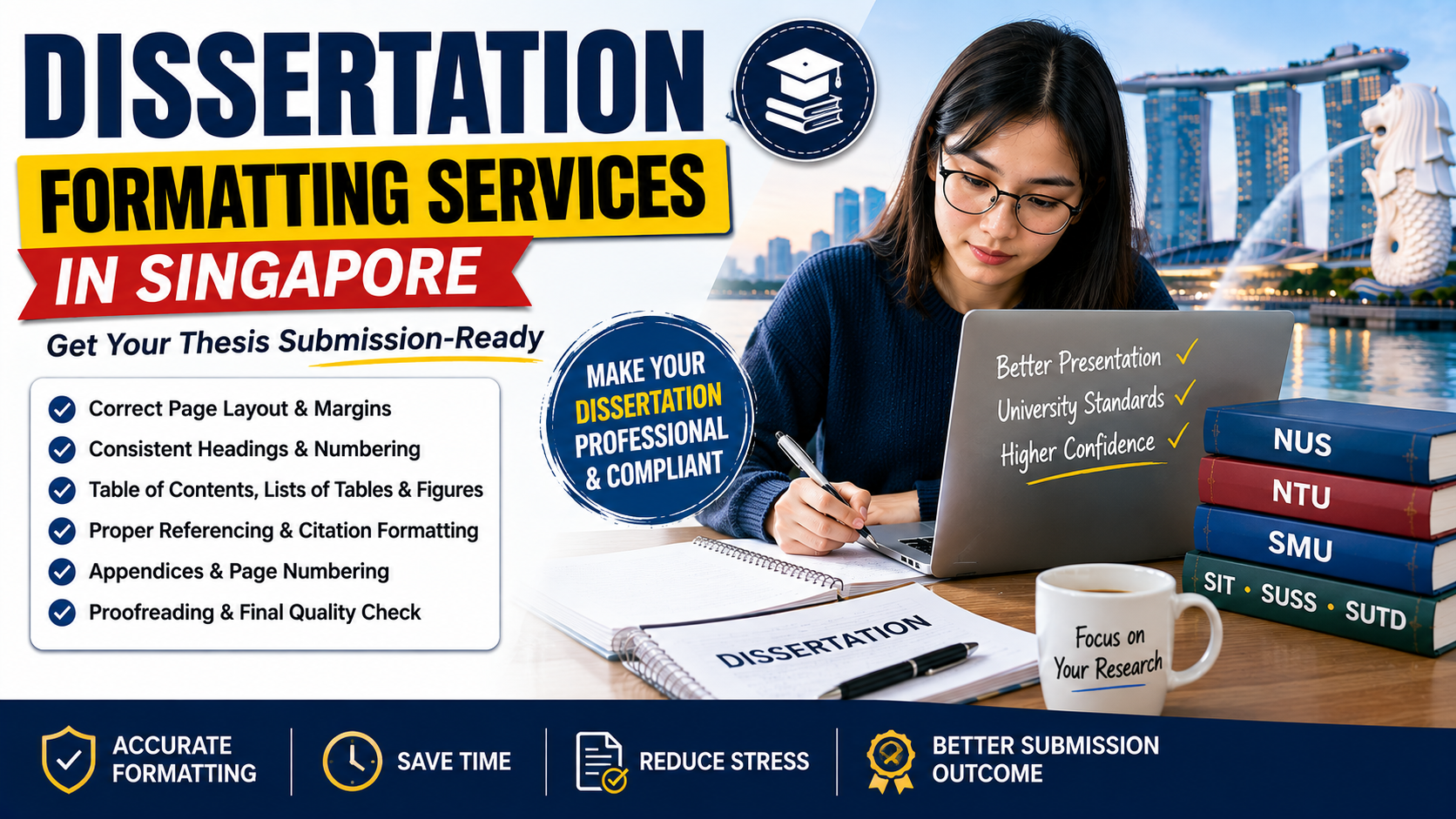
A dissertation can contain strong research and still look unprofessional if headings are inconsistent, page numbers are incorrect, tables are poorly positioned, references are not formatted consistently or the contents page does not match the document.
For students in Singapore, dissertation formatting can become especially stressful when submission guidelines contain detailed requirements concerning:
Page layout
Margins
Fonts
Headings
Chapter numbering
Tables
Figures
Citations
References
Page numbering
Appendices
Front matter
Contents pages
Lists of tables and figures
This is where professional dissertation formatting services in Singapore can help students turn an already-written dissertation into a clean, consistent and submission-ready document.
The important distinction is that formatting support should improve the presentation of your existing academic work rather than replace your research or writing.
What Is Dissertation Formatting?
Dissertation formatting is the process of organising and presenting a completed dissertation according to the required academic and institutional specifications.
It can involve reviewing the entire document to ensure consistency across:
Chapters
Headings
Subheadings
Paragraphs
Tables
Figures
References
Page numbers
Contents
Appendices
Formatting is more than making a dissertation "look nice."
A professionally formatted dissertation should make the research easier to navigate and demonstrate attention to academic presentation requirements.
Why Is Dissertation Formatting Important?
Imagine spending months conducting research, collecting data and writing your dissertation, only to discover shortly before submission that:
Your table of contents is incorrect.
Chapter headings use different styles.
Some pages have the wrong numbering.
Figures are not labelled consistently.
References use inconsistent formatting.
Tables extend beyond the margins.
Your appendices are not organised properly.
Page breaks have created large blank spaces.
These problems can make final submission unnecessarily stressful.
Formatting also affects readability.
A well-structured dissertation allows the reader to move easily between:
Chapter → Section → Evidence → Table/Figure → Reference → Appendix
Professional presentation does not compensate for weak research, but it can make strong research much easier to evaluate.
What Does a Dissertation Formatting Service Include?
The exact scope depends on the service provider and your requirements.
A comprehensive dissertation formatting review can include several areas.
1. Page Layout
The document can be reviewed for consistency in:
Margins
Page size
Paragraph spacing
Line spacing
Alignment
Indentation
Page breaks
If your university provides specific formatting instructions, those should take priority.
2. Dissertation Cover Page
The title page may need specific information such as:
Dissertation title
Student name
Student identification details where required
Programme
Department or school
University
Degree
Submission date
Supervisor information where required
The exact requirements vary by institution and programme.
Students should therefore provide the relevant university template or guidelines when requesting formatting support.
3. Consistent Fonts
A dissertation can become visually inconsistent when different sections use different fonts or sizes.
For example:
Chapter 1
may use one heading style while:
Chapter 2
uses another.
Similarly, tables may contain smaller fonts while references use inconsistent sizing.
A formatting review can identify these inconsistencies and apply a consistent style based on your required guidelines.
4. Heading and Subheading Formatting
Long dissertations usually contain multiple levels of headings.
For example:
Chapter 1: Introduction
1.1 Background
1.2 Research Problem
1.3 Research Objectives
1.4 Research Questions
If headings are formatted manually rather than through proper document styles, the table of contents can become difficult to maintain.
Using consistent heading styles makes it easier to:
Navigate the dissertation
Generate a table of contents
Update page numbers
Maintain consistency
Apply formatting across chapters
5. Table of Contents Formatting
The table of contents should accurately reflect the structure of the dissertation.
A formatting review can check:
Chapter titles
Section titles
Subsection titles
Page numbers
Heading hierarchy
Alignment
Leader dots
Numbering
One common problem is a contents page that does not match the final dissertation because chapters were edited after the contents page was created.
Always update the table of contents after major revisions.
6. List of Tables
If your dissertation contains multiple tables, you may need a dedicated list of tables.
For example:
Table 1.1: Participant Demographics
Table 2.1: Descriptive Statistics
Table 3.1: Regression Results
The numbering and titles should be consistent throughout the document.
7. List of Figures
The same applies to figures.
Figures may include:
Charts
Graphs
Conceptual frameworks
Diagrams
Models
Maps
Research frameworks
A formatting review can help ensure that figure titles and numbering are consistent.
8. Chapter Numbering
Dissertations often contain multiple chapters, so numbering must remain consistent.
For example:
Introduction
Literature Review
Methodology
Results
Discussion
Conclusion
Subsections may then follow a hierarchy such as:
3.1 Research Design
3.2 Research Philosophy
3.3 Research Approach
3.4 Data Collection
The numbering system should remain consistent throughout the dissertation.
9. Page Numbering
Page numbering is one of the most common formatting problems in long dissertations.
Front matter may use one numbering system while the main dissertation uses another, depending on the university's requirements.
For example, a dissertation may contain:
Title page
Declaration
Abstract
Acknowledgements
Table of contents
List of tables
List of figures
Main chapters
References
Appendices
Each section may require different page-numbering rules.
Microsoft Word section breaks can be particularly useful for managing these layouts.
10. Abstract Formatting
The abstract should be presented according to the required academic format.
Depending on the programme, it may summarise:
Research problem
Research objective
Methodology
Key findings
Conclusion
Recommendations
Formatting support can ensure that the abstract is positioned and presented consistently with the rest of the dissertation.
The content itself should remain the student's own academic work.
11. Acknowledgements Page
If your dissertation includes an acknowledgements section, formatting can cover:
Heading style
Paragraph spacing
Alignment
Page positioning
Consistency with other front matter
This section is generally brief, but it should still fit the overall document structure.
12. Tables and Figures Formatting
Tables and figures can create significant formatting problems in dissertations.
Common issues include:
Tables running beyond page margins
Inconsistent font sizes
Incorrect numbering
Captions separated from tables
Figures appearing before they are discussed
Poor page breaks
Unclear labels
Low-resolution graphics
A formatting review can help make these elements more readable.
13. Statistical Tables
Students writing quantitative dissertations often include output from tools such as:
SPSS
R
Stata
Excel
Python
MATLAB
Raw statistical output is not always suitable for direct inclusion in a dissertation.
Formatting support can help organise the presentation of tables, provided that the underlying analysis and interpretation remain the student's responsibility.
The goal is to present results clearly rather than simply inserting pages of software output.
14. Qualitative Research Formatting
Qualitative dissertations may contain:
Interview excerpts
Coding tables
Themes
Participant quotations
Conceptual diagrams
NVivo outputs
These materials need consistent formatting so that readers can understand how the evidence relates to the research findings.
For example:
Participant 4 described the transition as "challenging but manageable."
The quotation format, participant labels and surrounding discussion should remain consistent.
15. Referencing and Bibliography Formatting
A dissertation formatting service may also review the visual and structural consistency of the reference list.
Depending on your required referencing style, this may involve checking:
Alphabetical order
Hanging indentation
Spacing
Italics
Capitalisation
DOI presentation
URL formatting
Consistency between citations and references
However, students should distinguish formatting from source verification.
Formatting a reference does not mean the source has been independently verified.
Students remain responsible for using genuine and appropriate academic sources.
16. APA, Harvard, Vancouver and Other Styles
Different disciplines use different referencing systems.
Common styles include:
APA
Harvard
Vancouver
IEEE
Chicago
OSCOLA
MLA
A dissertation formatting service should not automatically change your referencing style.
The required style should come from your university, school, supervisor or dissertation guidelines.
17. Appendices Formatting
Appendices can contain supporting material such as:
Questionnaires
Interview questions
Interview transcripts
Additional statistical tables
Consent documentation
Supporting calculations
Supplementary figures
Research instruments
Each appendix should be clearly labelled.
For example:
Appendix A: Questionnaire
Appendix B: Interview Guide
Appendix C: Additional Statistical Results
The appendix should also be referenced appropriately from the main dissertation.
18. Cross-Referencing
Long dissertations often contain internal references.
For example:
"See Table 4.2."
"Further details are provided in Appendix B."
"As discussed in Chapter 2..."
These references need to remain accurate after revisions.
Changing the position of a table or chapter can make manually typed references incorrect.
Using Word's cross-reference features can reduce this problem.
19. Dissertation Formatting for Singapore Universities
There is no single formatting template that automatically applies to every Singapore university dissertation.
Requirements can vary across:
NUS
NTU
SMU
SIT
SUSS
SUTD
Other institutions
They can also differ between schools and programmes within the same university.
Therefore, students should provide their specific:
Dissertation guidelines
Thesis template
Faculty instructions
Supervisor instructions
Submission checklist
when requesting professional formatting support.
This prevents a formatter from applying generic rules that may conflict with your programme requirements.
20. NUS Dissertation Formatting
NUS students should consult the requirements applicable to their specific programme and graduate school.
Do not assume that a formatting template found online is automatically suitable for your dissertation.
If your programme provides a template, use that as the primary reference.
A professional formatter can work from the supplied requirements to help organise:
Front matter
Chapters
Headings
Figures
Tables
References
Appendices
Page numbering
21. NTU Dissertation Formatting
NTU students should similarly follow the requirements applicable to their programme and school.
This can be especially important for research degrees because dissertations may have specific requirements concerning structure, presentation and submission.
If your supervisor has provided formatting instructions, include those instructions when requesting assistance.
22. SMU Dissertation Formatting
SMU students should follow the formatting and submission requirements relevant to their programme.
Where programme-specific instructions exist, those should take priority over generic online dissertation templates.
23. Dissertation Formatting Before Submission
The best time to format your dissertation is not necessarily the night before submission.
Formatting a 15,000–30,000-word dissertation can involve hundreds of small details.
If you wait until the final hours, you may discover problems such as:
Incorrect page numbers
Broken contents pages
Missing figure captions
Inconsistent headings
References extending beyond margins
Appendix numbering problems
Large blank pages
Incorrect section breaks
Ideally, start the final formatting review before your submission deadline.
24. What Is the Difference Between Formatting and Proofreading?
These services are related but different.
Formatting
Formatting focuses primarily on presentation and document structure.
Examples:
Headings
Margins
Page numbers
Tables
Figures
Contents pages
References layout
Appendices
Proofreading
Proofreading focuses primarily on errors in the written document.
Examples:
Spelling
Grammar
Punctuation
Typographical errors
Inconsistent terminology
Sentence-level issues
A student may need one or both services.
25. What Is the Difference Between Formatting and Editing?
Editing can go deeper than proofreading.
Academic editing may review:
Clarity
Structure
Argument flow
Academic language
Paragraph organisation
Repetition
Transitions
Formatting is more concerned with how the document is presented.
If your dissertation is already written but needs to look professional and comply with formatting requirements, formatting may be the appropriate service.
26. How Much Does Dissertation Formatting Cost in Singapore?
Pricing varies depending on:
Word count
Number of chapters
Number of tables
Number of figures
Complexity of formatting
Reference style
Urgency
University requirements
Whether proofreading is included
Whether extensive document restructuring is required
A short dissertation requiring basic formatting will generally require less work than a large thesis containing hundreds of references, complex tables and multiple appendices.
For this reason, reputable providers may request the dissertation and formatting guidelines before providing a final quote.
27. How Long Does Dissertation Formatting Take?
Turnaround depends on the size and complexity of the dissertation.
A document with:
10,000 words
Simple formatting
Few tables
Standard references
may require significantly less time than a 40,000-word thesis containing:
Multiple chapters
Complex tables
Statistical outputs
Numerous figures
Extensive appendices
Complicated page numbering
If your submission deadline is approaching, provide the exact deadline when requesting a quotation.
28. What Should You Send to a Formatting Service?
To receive an accurate quote, provide:
Your dissertation
Preferably the latest complete version.
University guidelines
Upload the official formatting requirements where available.
Template
If your university provides a Word template, include it.
Deadline
State your actual submission deadline.
Required referencing style
For example:
APA 7
Harvard
IEEE
Vancouver
Specific concerns
Tell the formatter if you particularly need help with:
Table of contents
Page numbering
Tables
Figures
Appendices
References
Chapter formatting
This makes it easier to determine the actual scope of work.
29. Why Students Choose Professional Dissertation Formatting Help
Formatting a dissertation manually can be frustrating, especially when you are already dealing with:
Supervisor revisions
Data analysis
Referencing
Proofreading
Submission deadlines
Professional formatting support can save time by organising the document systematically.
It can be particularly useful when:
Your dissertation is already written.
You have complicated tables and figures.
Your document contains many chapters.
Your university has detailed formatting requirements.
You are struggling with Word styles and section breaks.
You need a final presentation review.
30. Dissertation Formatting Checklist
Before submitting, check the following.
Document Setup
☐ Correct page size
☐ Correct margins
☐ Correct font
☐ Correct line spacing
☐ Correct paragraph spacing
Front Matter
☐ Title page completed
☐ Declaration included if required
☐ Abstract included
☐ Acknowledgements included if required
☐ Table of contents updated
☐ List of tables updated
☐ List of figures updated
Chapters
☐ All chapters use consistent heading styles
☐ Chapter numbering is correct
☐ Section numbering is consistent
☐ Page breaks are appropriate
☐ No unexpected blank pages
Tables and Figures
☐ All tables are numbered
☐ All figures are numbered
☐ Captions are consistent
☐ Tables fit within margins
☐ Figures are readable
☐ Tables and figures are referenced in the text
References
☐ Required referencing style followed
☐ References are consistently formatted
☐ Citations match the reference list
☐ Hanging indentation is consistent
Appendices
☐ Appendices are labelled
☐ Appendices appear in the correct order
☐ Main text refers to relevant appendices
Final Review
☐ Page numbers are correct
☐ Contents page has been updated
☐ Headers and footers are consistent
☐ File opens correctly
☐ Final PDF has been checked
☐ University submission requirements have been followed
Should You Convert Your Dissertation to PDF?
If your university requires PDF submission, convert the final document according to the required submission instructions.
Before uploading the PDF, check it carefully.
Do not assume that the PDF automatically looks identical to the Word document.
Check:
Page breaks
Tables
Figures
Fonts
Page numbers
Headers
Footers
Hyperlinks
References
Appendices
Open the final PDF from beginning to end before submission.
Common Dissertation Formatting Mistakes
Here are some of the most common problems students encounter.
Inconsistent Heading Styles
Different chapters use different fonts, sizes or spacing.
Incorrect Page Numbers
Front matter and main chapters are numbered incorrectly.
Broken Table of Contents
The contents page does not reflect the final document.
Poor Table Placement
Tables run beyond the page margins or split awkwardly.
Inconsistent Figure Captions
Different figures use different caption formats.
Reference Formatting Problems
Entries are not formatted consistently.
Unnecessary Blank Pages
Incorrect page breaks create empty pages.
Manual Numbering
Headings and figures are manually numbered, causing errors after revisions.
Inconsistent Spacing
Different sections contain different paragraph spacing.
Appendix Errors
Appendices are not labelled or referenced correctly.
Can Dissertation Formatting Improve Your Grade?
Formatting alone cannot guarantee a higher grade.
Academic marks should primarily reflect the quality of your:
Research
Analysis
Argument
Methodology
Evidence
Discussion
Conclusions
However, professional formatting can improve readability and presentation.
A clear, organised document allows supervisors and examiners to navigate your work more easily.
The goal should therefore be:
Strong research + strong academic writing + accurate formatting + compliance with submission requirements.
Professional Dissertation Formatting Services in Singapore
If your dissertation is complete but the document still requires substantial formatting work, professional support can make the final stage easier.
AssignmentCart provides dissertation formatting and academic editing support for students who need help preparing their existing work for submission.
Depending on your requirements, support can include:
Dissertation formatting
Thesis formatting
Chapter formatting
Table of contents creation
List of tables
List of figures
Page-number formatting
Heading-style consistency
Table formatting
Figure formatting
Appendix organisation
Reference-list formatting
Academic proofreading
Dissertation chapter editing
You can provide your dissertation, university formatting guidelines and deadline to receive a tailored quotation.
Important: Students should always confirm that the type of external support they request is permitted by their university and programme.
Final Thoughts
A dissertation represents months of research and academic work.
The final document should therefore be presented with the same level of care.
Before submitting your dissertation in Singapore, make sure you have checked:
University formatting requirements
Page layout
Heading styles
Chapter numbering
Table of contents
Page numbers
Tables
Figures
References
Appendices
Final PDF
If you are struggling with formatting, professional dissertation formatting support can help organise your existing work and reduce the administrative burden before submission.
The key is to use the official requirements for your specific programme rather than relying on a generic dissertation template.
Your research deserves a final document that is clear, consistent and ready for submission.
Frequently Asked Questions
Everything you need to know about our services


