Dissertation Chapter Editing Services
Introduction
A dissertation is rarely improved through a single final proofreading session.
Each chapter has a different academic purpose, and each needs to meet different expectations. Your introduction needs to establish a clear research direction, your literature review needs critical engagement, your methodology needs justification, and your discussion needs to explain what your findings mean.
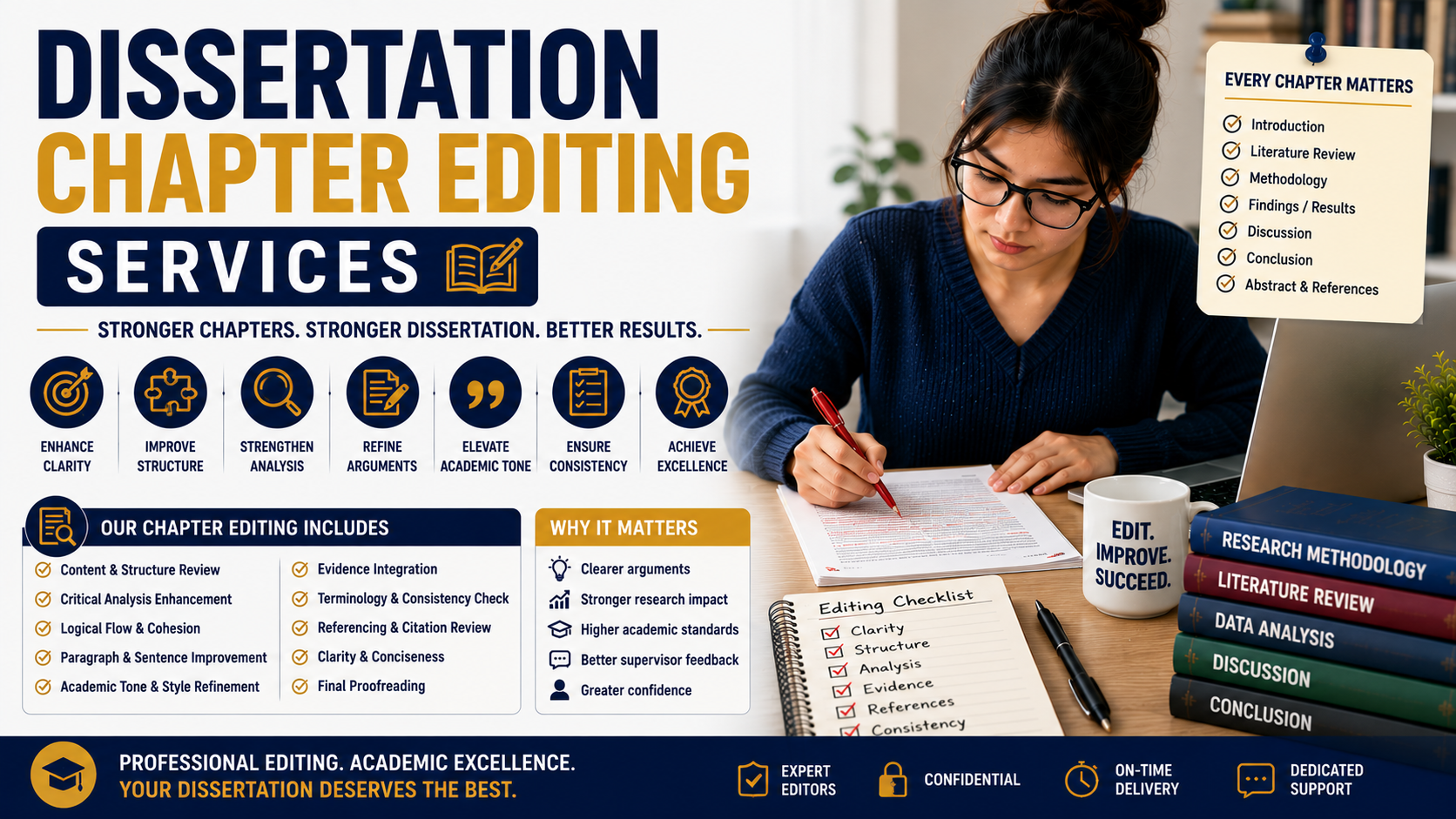
This is why dissertation chapter editing can be more useful than simply checking grammar at the end.
Chapter-level editing focuses on the academic quality, structure, clarity, argument, evidence, and consistency of individual sections while ensuring that they continue to work together as one coherent dissertation.
Whether you need help improving a literature review, restructuring a methodology chapter, strengthening a discussion, or proofreading your final conclusion, chapter editing can help identify issues before final submission.
What Is Dissertation Chapter Editing?
Dissertation chapter editing involves reviewing an existing chapter and improving its:
Academic clarity
Logical structure
Argument development
Critical analysis
Paragraph organisation
Evidence integration
Academic tone
Transitions
Consistency
Referencing presentation
Grammar and sentence structure
Editing is different from writing a dissertation from scratch.
The purpose is to improve the student's existing academic work while preserving their research, ideas, evidence, and intended argument.
Depending on your requirements, chapter editing may focus on language and presentation or provide broader structural and academic feedback.
Why Edit Your Dissertation Chapter Separately?
Editing an entire dissertation at once can make it difficult to identify recurring problems.
Chapter-level editing allows you to focus on the specific purpose of each section.
For example:
Chapter | Main Editing Focus |
|---|---|
Introduction | Research focus and objectives |
Literature Review | Synthesis and critical analysis |
Methodology | Clarity and methodological justification |
Findings | Organisation and presentation |
Discussion | Interpretation and literature integration |
Conclusion | Answering the research question |
This approach can make the revision process more systematic.
Dissertation Introduction Chapter Editing
The introduction establishes the foundation of your dissertation.
A chapter editor may review whether it clearly presents:
Research background
Research problem
Research question
Research objectives
Research rationale
Research significance
Scope of the study
Key terminology
Dissertation structure
One of the most important checks is alignment.
Your introduction should establish a research direction that remains consistent throughout the dissertation.
Common Introduction Chapter Problems
Students frequently receive feedback such as:
"Research question is too broad."
"Objectives need clarification."
"The rationale needs development."
"Research gap is unclear."
"Significance of the study needs strengthening."
"Introduction is too descriptive."
Editing can help identify where the introduction needs restructuring or clarification.
Literature Review Chapter Editing
The literature review is one of the most important chapters to edit carefully.
A strong literature review should not simply describe what different researchers have said.
It should demonstrate:
Knowledge of the field
Understanding of major theories
Comparison of academic perspectives
Evaluation of evidence
Identification of disagreements
Recognition of limitations
Development of a research gap
This is where critical analysis becomes particularly important.
Editing a Descriptive Literature Review
A common supervisor comment is:
"The literature review is too descriptive."
This means the chapter may contain plenty of information but insufficient evaluation.
For example:
Smith (2022) found that leadership improves employee motivation. Jones (2023) also found that leadership affects motivation.
An editor may suggest developing the discussion by considering:
Why the studies reached similar conclusions
Whether they used similar methods
Whether their samples were comparable
Whether their theoretical perspectives differed
What limitations affected their findings
How the evidence relates to your research
The objective is not simply to add more words.
It is to make the discussion more analytical.
Literature Review Structure Editing
A literature review can often be improved by organising it around:
Theoretical Themes
Different theories and conceptual perspectives.
Research Themes
Major topics emerging from existing studies.
Academic Debates
Areas where researchers disagree.
Methodological Issues
Differences in research approaches and limitations.
Research Gap
What existing research has not adequately addressed.
This can create a clearer academic narrative.
Dissertation Methodology Chapter Editing
The methodology chapter explains how your research was conducted.
Editing may focus on:
Research philosophy
Research approach
Research design
Sampling
Data collection
Data analysis
Research instruments
Reliability
Validity
Trustworthiness
Ethical considerations
Methodological limitations
The chapter should not simply state what you did.
It should explain why the selected approach was appropriate for your research question.
Improving Methodological Justification
A weak statement might say:
A quantitative research approach was selected.
A stronger methodology explains:
Why quantitative research was appropriate
How it relates to the research objectives
Why alternative approaches were not selected
How the research design supports the study
What limitations arise from the selected approach
Chapter editing can help identify areas where methodological decisions are described but not adequately justified.
Dissertation Findings Chapter Editing
The findings chapter should present your research results clearly and logically.
Depending on the research design, editing may examine:
Organisation of findings
Tables
Figures
Statistical results
Themes
Participant quotations
Links to research objectives
Consistency of terminology
The findings should remain focused on what your research discovered.
Interpretation that belongs in the discussion should not unnecessarily dominate the findings chapter.
Quantitative Findings Editing
For quantitative dissertations, chapter editing may check whether:
Variables are clearly defined
Statistical results are presented consistently
Tables match the written explanation
Figures are labelled correctly
Statistical terminology is used accurately
Findings relate to the research objectives
The presentation should allow the reader to understand the results without unnecessary confusion.
Qualitative Findings Editing
For qualitative dissertations, editing may focus on:
Theme structure
Coding explanation
Participant quotations
Evidence supporting themes
Connections between themes
Research objectives
Themes should represent meaningful patterns in the data rather than simply being broad categories.
Dissertation Discussion Chapter Editing
The discussion chapter is where many dissertations require substantial editing.
The findings tell the reader what you discovered.
The discussion explains what those findings mean.
A strong discussion can:
Compare findings with previous research
Explain similarities
Explain differences
Connect findings to theory
Address unexpected results
Discuss implications
Consider limitations
Explain the contribution of the study
Strengthening Critical Discussion
For each major finding, ask:
What did the research find?
What does existing literature say?
Does the finding support previous research?
Does it contradict previous research?
Why might the results differ?
What does this mean for the research question?
What are the theoretical or practical implications?
This transforms a simple description of results into a more analytical discussion.
Dissertation Conclusion Chapter Editing
The conclusion should bring the dissertation together.
Editing can assess whether the conclusion:
Answers the research question
Summarises the main findings
Reflects the research objectives
Explains the contribution
Discusses limitations
Provides appropriate recommendations
Suggests future research
A common problem is introducing new arguments in the conclusion.
Your conclusion should primarily synthesise what has already been established in the dissertation.
Dissertation Abstract Editing
Although the abstract is short, it is one of the most important sections to edit.
A strong abstract generally communicates:
Research background or problem
Research aim
Methodology
Main findings
Key conclusion
Contribution or implications
The abstract should accurately reflect the final dissertation.
For this reason, it is often best to edit the abstract after the other chapters have been finalised.
Dissertation Chapter Editing for Academic Style
Academic editing is not simply about replacing words with complicated alternatives.
Effective academic writing should be:
Clear
Precise
Concise
Evidence-based
Logical
Consistent
Appropriate for the discipline
Editing can remove unnecessary repetition and improve sentence construction without making the writing unnecessarily complicated.
Improving Paragraph Structure
A well-developed academic paragraph often contains:
Main Point → Evidence → Explanation → Critical Analysis → Link
If a paragraph contains several unrelated ideas, it may need to be divided.
If a paragraph makes a major claim without evidence, supporting literature may be required.
If a paragraph contains evidence without interpretation, the analysis may need strengthening.
Improving Transitions Between Paragraphs
A dissertation should read as a connected argument rather than a collection of independent paragraphs.
Transitions can help establish relationships such as:
Addition
Contrast
Cause and effect
Comparison
Development
Qualification
Conclusion
Good transitions help the reader understand why the next point follows from the previous one.
Dissertation Chapter Editing and Referencing
Chapter editing can also identify referencing inconsistencies.
Check for:
Missing citations
Incorrect citation formats
Inconsistent author names
Incorrect publication years
Missing reference-list entries
References that are no longer relevant
Formatting inconsistencies
The exact referencing style should follow your university's requirements.
Common styles include:
Harvard
APA
MLA
Chicago
OSCOLA
IEEE
Vancouver
Dissertation Chapter Editing for Consistency
One of the biggest problems created by extensive dissertation revisions is inconsistency.
For example, your introduction may refer to three objectives while your findings discuss four.
Your methodology may describe one sample size while your findings report another.
Your conclusion may use different terminology from the literature review.
A chapter-level review should therefore be followed by a whole-dissertation consistency check.
Editing Chapters After Supervisor Feedback
Supervisor feedback often provides specific instructions such as:
Add more critical analysis
Improve chapter structure
Clarify the methodology
Strengthen the research gap
Explain this finding
Add recent literature
Improve the discussion
Rewrite the conclusion
Instead of treating each comment as an isolated correction, identify the underlying problem.
For example, multiple comments about description, weak comparison, and limited interpretation may indicate that your dissertation needs stronger critical engagement.
Dissertation Chapter Editing Before Final Submission
If you have already completed several rounds of supervisor feedback, final chapter editing can provide a useful quality-control stage.
A final review can examine:
Academic Content
Is the argument clear and appropriately supported?
Structure
Does each chapter fulfil its purpose?
Consistency
Do the research question, objectives, methods, findings, and conclusion align?
Language
Is the academic writing clear and precise?
Referencing
Are citations and references consistent?
Presentation
Does the document follow the required formatting guidelines?
Dissertation Editing vs Dissertation Proofreading
These services are related but different.
Dissertation Editing
Editing can focus on:
Structure
Argument
Clarity
Critical analysis
Paragraph organisation
Academic tone
Logical flow
Evidence integration
Dissertation Proofreading
Proofreading generally focuses on:
Grammar
Spelling
Punctuation
Typographical errors
Formatting inconsistencies
Minor language issues
If your supervisor has requested major revisions, editing should usually happen before final proofreading.
How Professional Dissertation Chapter Editing Can Help
A fresh review of your dissertation chapter can make it easier to identify problems you may no longer notice yourself.
Support may help identify:
Weak arguments
Repetition
Unclear paragraphs
Poor transitions
Descriptive writing
Unsupported claims
Inconsistent terminology
Referencing problems
Formatting issues
The goal is to improve your existing academic work rather than replace your research or ideas.
Which Dissertation Chapter Should You Edit First?
There is no universal order, but a useful approach is:
Research question and objectives
Introduction
Literature review
Methodology
Findings
Discussion
Conclusion
Abstract
References
Final proofreading
The exact order may change depending on your supervisor's feedback.
If the methodology has major problems, for example, it may need to be addressed before editing later chapters.
Dissertation Chapter Editing Checklist
Before final submission, review each chapter.
Introduction
✔ Clear research problem
✔ Focused research question
✔ Aligned research objectives
✔ Clear rationale
✔ Research significance
Literature Review
✔ Relevant academic sources
✔ Critical analysis
✔ Comparison of perspectives
✔ Clear themes
✔ Research gap
Methodology
✔ Appropriate research approach
✔ Clear research design
✔ Sampling explained
✔ Data collection explained
✔ Analysis method explained
✔ Ethical considerations
✔ Limitations
Findings
✔ Clear organisation
✔ Accurate presentation
✔ Tables and figures checked
✔ Findings linked to objectives
Discussion
✔ Findings interpreted
✔ Literature integrated
✔ Contrasting evidence considered
✔ Theoretical implications discussed
✔ Practical implications discussed
Conclusion
✔ Research question answered
✔ Main findings synthesised
✔ Contribution explained
✔ Limitations acknowledged
✔ Recommendations supported
Final Presentation
✔ Referencing checked
✔ Formatting checked
✔ Contents page updated
✔ Page numbers checked
✔ Tables and figures labelled
✔ Grammar and spelling checked
✔ University requirements followed
How AssignmentCart Can Help With Dissertation Chapter Editing
AssignmentCart provides ethical academic support for students who want to improve their own dissertation chapters.
Support can include:
Dissertation chapter editing
Literature review editing
Methodology editing
Findings presentation review
Discussion chapter editing
Conclusion editing
Academic language improvement
Critical analysis feedback
Structural review
Referencing checks
Dissertation proofreading
Final formatting review
The focus is on improving the student's existing academic work and helping them present their research more clearly.
Why Choose Chapter-Level Dissertation Editing?
Editing one chapter at a time can be useful when:
Your supervisor has commented on a specific chapter
You have a tight revision deadline
One section needs substantial improvement
You want feedback before moving to the next chapter
You have already completed most of your dissertation
You need a final review of selected sections
You do not necessarily need to edit the entire dissertation at once.
Chapter-level support allows you to focus your time and budget on the areas that require the most attention.
Ethical Academic Support
Dissertation editing should support your academic development rather than replace your work.
Ethical editing can help with:
Language
Structure
Clarity
Academic presentation
Critical analysis feedback
Referencing
Formatting
Proofreading
Students remain responsible for their research, data, arguments, interpretations, and final submission.
Always follow your university's academic integrity policies.
Final Thoughts
Every dissertation chapter has a different role.
A strong introduction establishes the research direction. A strong literature review demonstrates critical engagement. A clear methodology explains and justifies the research process. The findings present the evidence, while the discussion interprets it. Finally, the conclusion brings the research together and answers the central question.
This is why dissertation chapter editing services can be valuable when you need more than a basic grammar check.
Whether you need to strengthen critical analysis in a literature review, clarify methodological decisions, improve the presentation of findings, develop your discussion, or polish your conclusion, targeted chapter editing can help you identify weaknesses before final submission.
The most effective editing does not simply make a dissertation sound more academic.
It makes the research clearer, more coherent, better structured, better supported, and easier for the reader to understand.
If you need help reviewing your dissertation chapters after supervisor feedback or before final submission, professional editing and proofreading support can provide an additional quality-control stage while keeping your own research and academic decisions at the centre of the dissertation.
Frequently Asked Questions
Everything you need to know about our services
Related Posts

Dissertation Editing Services for NUS Master's Students

Dissertation Editing Services Before Final Submission in Ireland
