How Small Editing Errors Affect Final Grades
Introduction
After months of researching, analysing data, and writing thousands of words, many students believe their dissertation is complete once the final chapter is written. However, one important stage is often underestimated: editing.
Small editing mistakes may appear minor when viewed individually. A spelling error, inconsistent heading, misplaced citation, or formatting issue might seem harmless. Yet when these errors appear repeatedly throughout a dissertation, they can reduce readability, interrupt the flow of arguments, and weaken the overall impression of academic quality.
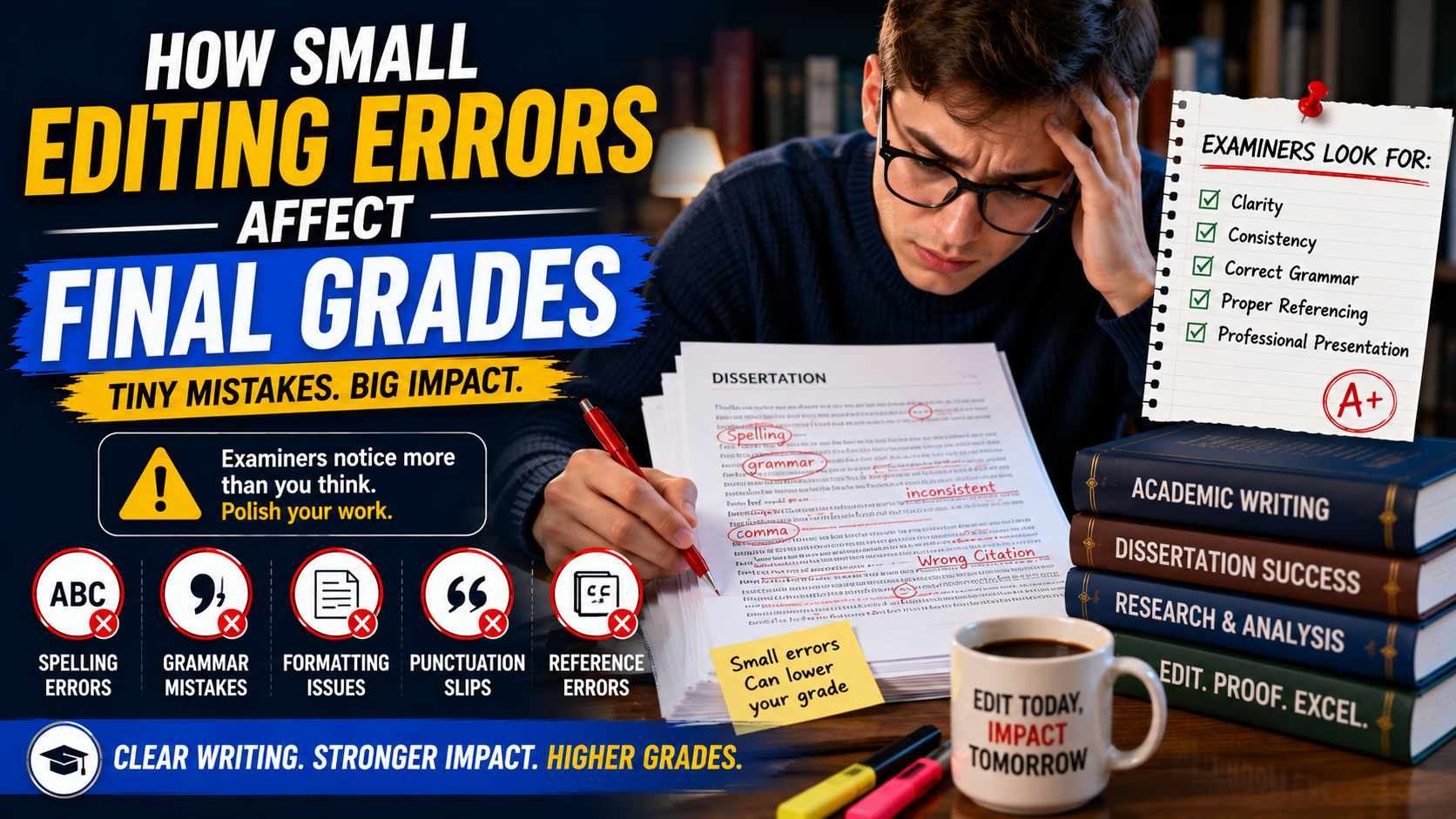
Although universities primarily assess the quality of research and critical analysis, examiners also expect dissertations to demonstrate professionalism, accuracy, and attention to detail. Careful editing helps ensure that your ideas are communicated clearly and effectively.
This guide explains how seemingly small editing errors can influence your final grade and how to minimise them before submission.
Why Editing Matters
Editing is much more than correcting spelling mistakes.
A thorough editing process improves:
Clarity
Academic tone
Logical flow
Grammar
Sentence structure
Consistency
Referencing
Formatting
Readability
Strong editing allows your research to receive the attention it deserves rather than distracting examiners with avoidable mistakes.
What Examiners Notice
Dissertation examiners often read many dissertations within a short period.
They quickly notice recurring issues such as:
Inconsistent formatting
Grammar errors
Awkward sentences
Missing references
Poor organisation
Repetitive language
Incorrect terminology
Frequent errors can make an otherwise strong dissertation appear less polished.
Common Editing Errors That Affect Grades
1. Grammar Mistakes
Grammar errors can interrupt the reader's understanding.
Examples include:
Incorrect verb tenses
Subject-verb disagreement
Misplaced modifiers
Sentence fragments
Run-on sentences
Clear grammar improves academic credibility.
2. Spelling Errors
Even modern spell-checkers miss certain mistakes.
For example:
"Form" instead of "from"
"Principle" instead of "principal"
"Affect" instead of "effect"
Manual proofreading remains essential.
3. Inconsistent Formatting
Formatting inconsistencies create an unprofessional appearance.
Common examples include:
Different heading styles
Uneven spacing
Mixed fonts
Inconsistent margins
Incorrect page numbering
Consistency improves readability.
4. Referencing Errors
Incorrect referencing is one of the most common editing problems.
Check carefully for:
Missing citations
Incorrect author names
Incomplete bibliography entries
Wrong publication dates
Inconsistent citation style
Accurate referencing strengthens academic integrity.
5. Repetitive Language
Repeating the same words or phrases throughout the dissertation weakens writing quality.
Editing helps improve vocabulary while maintaining precision.
6. Long, Complex Sentences
Long sentences often become confusing.
During editing:
Break lengthy sentences into shorter ones.
Remove unnecessary words.
Improve transitions.
Clarify meaning.
Simple, precise writing is usually easier to understand.
7. Weak Paragraph Structure
Each paragraph should contain:
One clear idea.
Supporting evidence.
Critical analysis.
A logical transition to the next point.
Editing helps strengthen paragraph flow.
8. Inconsistent Terminology
Using different terms for the same concept may confuse readers.
For example:
If your dissertation uses "online learning," avoid switching to "digital education" or "virtual instruction" unless you explain the distinction.
Maintain consistency throughout.
9. Poor Figure and Table Presentation
Ensure that:
Every figure is numbered.
Every table has a title.
All figures are referenced within the text.
Labels remain consistent.
Visual elements should support your discussion.
10. Typographical Errors
Small typing mistakes may seem insignificant, but frequent typographical errors can distract examiners from your arguments.
Careful proofreading helps identify these issues.
How Editing Improves Academic Quality
Good editing strengthens:
Clarity of arguments
Logical organisation
Academic tone
Reader engagement
Overall professionalism
Rather than changing your ideas, editing ensures they are communicated effectively.
Editing vs Proofreading
Many students use these terms interchangeably, but they serve different purposes.
Editing | Proofreading |
|---|---|
Improves clarity | Corrects final errors |
Strengthens sentence structure | Checks spelling |
Improves organisation | Corrects grammar |
Enhances readability | Verifies formatting |
Refines academic style | Removes typographical mistakes |
Both stages are important before submission.
Practical Editing Checklist
Before submitting your dissertation, ask yourself:
✅ Are chapter headings consistent?
✅ Is grammar correct throughout?
✅ Have I removed repetitive language?
✅ Are references complete and accurate?
✅ Do paragraphs flow logically?
✅ Are figures and tables correctly labelled?
✅ Is formatting consistent?
✅ Have I checked page numbers and contents?
Completing this checklist reduces avoidable mistakes.
Why Students Miss Editing Errors
After working on the same dissertation for weeks or months, your brain naturally begins to overlook familiar mistakes.
This is why students often miss:
Repeated words
Missing punctuation
Incorrect citations
Awkward phrasing
Formatting inconsistencies
Taking a short break before proofreading or reading the dissertation aloud can make errors easier to identify.
Tips for Better Editing
Edit in Multiple Stages
Avoid trying to fix everything at once.
Instead, review separately for:
Structure
Clarity
Grammar
References
Formatting
Read Slowly
Reading more slowly increases the likelihood of spotting small mistakes.
Print the Dissertation
Some students notice more errors on paper than on a screen.
Read Aloud
Reading aloud highlights awkward wording and missing words.
Check References Separately
Review every citation against your bibliography to ensure consistency.
Maintaining Academic Integrity
Editing and proofreading improve presentation without changing the originality of your research.
Many universities allow guidance on:
Grammar
Formatting
Referencing
Academic writing
Structure
Presentation
Students remain responsible for all original research, interpretation, analysis, and conclusions. Any assistance should comply with institutional academic integrity policies.
Final Thoughts
Small editing mistakes rarely determine a dissertation grade on their own. However, when numerous errors appear throughout a dissertation, they can reduce readability, weaken professionalism, and make it more difficult for examiners to focus on your strongest ideas.
A carefully edited dissertation demonstrates attention to detail, clear communication, and academic maturity. Investing time in editing allows your research, analysis, and arguments to be presented as effectively as possible.
Before submitting your dissertation, remember that polishing the final version is not simply a cosmetic exercise—it is an important step in communicating your work with clarity and confidence.
Frequently Asked Questions
Everything you need to know about our services


