What Distinction-Level Dissertations Do Differently
Introduction
Every year, thousands of students submit dissertations that are well researched, properly referenced, and carefully formatted. Yet only a small percentage receive distinction-level grades. The difference is rarely about writing more pages or using more references. Instead, it comes down to how effectively students demonstrate independent thinking, critical analysis, originality, and academic judgement.
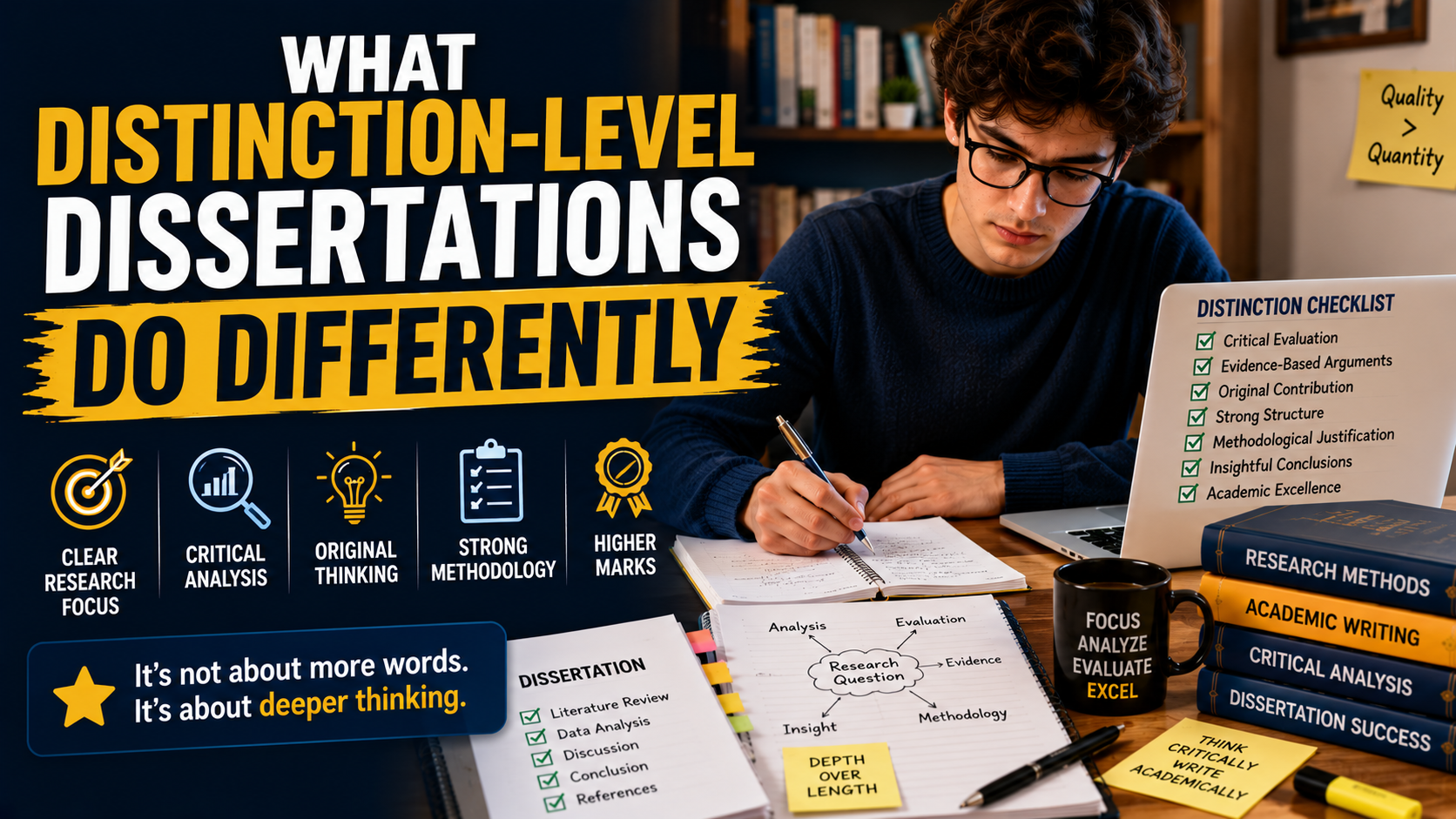
A distinction dissertation does more than answer the research question. It contributes meaningful insights, evaluates evidence critically, and presents a coherent argument supported by high-quality research. Understanding these characteristics can help you strengthen your own dissertation before submission.
In this guide, we explore what distinction-level dissertations consistently do differently and how you can apply these principles to improve your academic work.
What Is a Distinction-Level Dissertation?
Although grading criteria vary across universities and degree programmes, a distinction dissertation generally exceeds the minimum assessment requirements. It demonstrates:
Strong critical analysis
Original thinking
Excellent research quality
Clear academic writing
Logical organisation
Well-justified methodology
Evidence-based conclusions
Accurate referencing
Consistent academic presentation
Rather than simply meeting expectations, distinction-level work consistently exceeds them.
1. They Answer the Research Question Clearly
Every chapter supports the central research question.
Students sometimes include interesting information that does not contribute directly to their objectives. Distinction dissertations avoid unnecessary discussion and remain focused throughout.
Ask yourself:
Does every section contribute to answering my research question?
Is any information repetitive or irrelevant?
Does every chapter build logically toward the conclusion?
Maintaining focus strengthens coherence and improves readability.
2. They Prioritise Critical Analysis Over Description
One of the biggest differences between average and distinction dissertations is the depth of critical analysis.
Instead of simply explaining what previous researchers found, distinction-level dissertations evaluate:
Research strengths
Methodological limitations
Conflicting viewpoints
Reliability of evidence
Practical implications
They explain why evidence matters rather than simply describing it.
3. They Demonstrate Independent Thinking
Originality does not necessarily require discovering something entirely new.
Instead, distinction-level dissertations often:
Identify gaps in previous research.
Offer thoughtful interpretations.
Challenge assumptions respectfully.
Connect ideas in new ways.
Present balanced conclusions.
Independent thinking shows academic maturity.
4. They Use High-Quality Sources
The quality of evidence matters more than the quantity of references.
High-scoring dissertations typically rely on:
Peer-reviewed journal articles
Academic books
Government publications
Official statistics
Reputable research organisations
Strong evidence improves the credibility of your arguments.
5. They Justify Every Methodological Decision
Rather than simply describing their research methods, distinction dissertations explain why those methods were appropriate.
For example:
Why was qualitative research chosen?
Why was a particular sampling strategy used?
Why were certain analytical techniques selected?
Clear justification demonstrates a strong understanding of research design.
6. They Maintain Strong Connections Between Chapters
Each chapter should naturally lead to the next.
A distinction dissertation demonstrates clear links between:
Introduction
Literature review
Methodology
Findings
Discussion
Conclusion
This creates a logical narrative that is easy for examiners to follow.
7. They Present Balanced Arguments
Academic writing rarely presents issues as entirely right or wrong.
Instead, distinction dissertations:
Consider alternative viewpoints.
Evaluate competing evidence.
Acknowledge uncertainty.
Discuss limitations.
Support conclusions with evidence.
Balanced arguments increase academic credibility.
8. They Discuss Limitations Honestly
No research project is perfect.
Rather than ignoring limitations, high-quality dissertations explain:
Sample limitations
Data limitations
Methodological constraints
Potential bias
Opportunities for future research
Recognising limitations demonstrates academic integrity and critical reflection.
9. They Write Clearly and Precisely
Complex vocabulary does not necessarily improve academic writing.
Distinction dissertations focus on:
Clear sentences
Logical paragraphs
Accurate terminology
Concise explanations
Professional tone
Good writing makes strong ideas easier to understand.
10. They Follow the Assessment Criteria
Successful students review the marking rubric throughout the writing process—not just before submission.
They regularly check whether they have demonstrated:
Critical analysis
Originality
Research quality
Organisation
Methodological justification
Evidence-based conclusions
This helps ensure the dissertation aligns with examiner expectations.
Common Mistakes That Prevent Distinction Grades
Many otherwise strong dissertations lose marks because they:
Describe rather than analyse.
Repeat information across chapters.
Ignore conflicting evidence.
Present weak discussions.
Lack originality.
Fail to justify methodological choices.
Use inconsistent referencing.
Leave proofreading until the last minute.
Avoiding these mistakes can improve the overall quality of your dissertation.
Distinction vs Good Dissertation
Good Dissertation | Distinction-Level Dissertation |
|---|---|
Explains research | Critically evaluates research |
Meets requirements | Exceeds expectations |
Clear structure | Highly coherent structure |
Uses relevant sources | Evaluates source quality |
Summarises evidence | Synthesises and critiques evidence |
Logical conclusions | Insightful, evidence-based conclusions |
Good writing | Sophisticated academic communication |
Practical Checklist Before Submission
Before submitting, ask yourself:
✅ Does every chapter answer the research question?
✅ Have I evaluated evidence rather than simply summarising it?
✅ Are my conclusions supported by my findings?
✅ Have I explained why my methodology was appropriate?
✅ Have I acknowledged research limitations?
✅ Have I reviewed the marking criteria?
✅ Is my referencing completely consistent?
✅ Have I completed proofreading after all revisions?
Small improvements across multiple chapters often have a greater impact than rewriting one section completely.
The Value of Constructive Feedback
After spending months working on the same dissertation, it can be difficult to identify weaknesses objectively.
Constructive feedback may highlight:
Weak arguments
Unclear explanations
Structural inconsistencies
Referencing errors
Areas requiring stronger critical analysis
Opportunities to improve coherence
Seeking feedback early provides more time to implement meaningful improvements.
Maintaining Academic Integrity
Many universities allow students to receive guidance on:
Academic writing
Structure
Referencing
Formatting
Grammar
Presentation
Students remain responsible for producing their own original research, analysis, interpretations, and conclusions. Any assistance should comply with institutional academic integrity policies.
Final Thoughts
Distinction-level dissertations are rarely defined by a single outstanding chapter or an exceptionally high word count. Instead, they consistently demonstrate critical thinking, independent judgement, strong research design, logical organisation, and evidence-based arguments throughout the entire document.
By focusing on analytical depth rather than descriptive writing, justifying your methodological decisions, engaging critically with academic literature, and aligning your work with the assessment criteria, you can significantly strengthen your dissertation before submission.
Remember that achieving a distinction is not about perfection. It is about consistently demonstrating the qualities that university examiners value most: clarity, originality, critical analysis, and academic integrity.
Frequently Asked Questions
Everything you need to know about our services


