Why Early Support Can Save Weeks of Rewriting
Introduction
Writing a dissertation is rarely a straightforward process. It involves developing a research question, reviewing academic literature, designing a methodology, analysing evidence, and presenting your findings in a logical and well-structured manner. Because each stage builds on the previous one, small mistakes made early in the process can become much larger problems later.
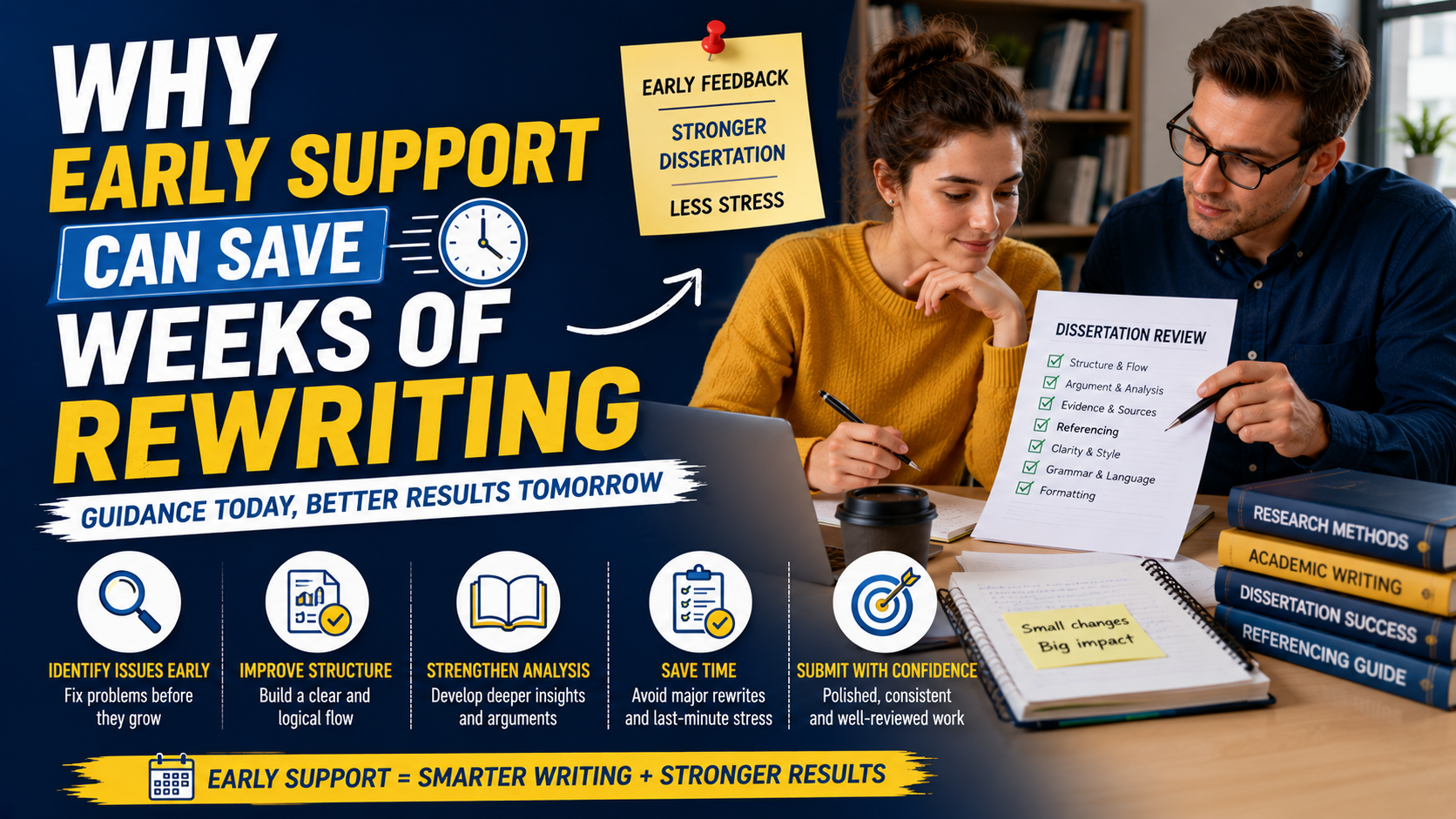
Many students discover this only after completing their first full draft. They realise that chapters need major restructuring, arguments require stronger evidence, or references contain inconsistencies. These issues often lead to extensive rewriting that could have been reduced—or even avoided—through earlier guidance.
Seeking appropriate academic support early in the dissertation process is not about avoiding independent work. Instead, it helps you identify potential weaknesses while there is still time to improve them, making the revision process more efficient and less stressful.
Why Students End Up Rewriting Large Sections
Rewriting is a normal part of academic writing, but excessive rewriting usually happens when underlying problems remain unnoticed for too long.
Common reasons include:
An unclear research question
Weak dissertation structure
Limited critical analysis
Inconsistent arguments
Incomplete literature review
Incorrect referencing
Poor time management
Misunderstanding assessment criteria
Finding these issues after writing thousands of words often means revisiting multiple chapters rather than making small revisions.
What Does Early Support Mean?
Early support refers to obtaining constructive guidance before your dissertation reaches its final stages.
This may include:
Supervisor meetings
University academic writing centres
Library research support
Peer feedback
Referencing guidance
Academic proofreading and editing (where permitted)
Independent reviews that focus on clarity, structure, grammar, and presentation
The objective is to strengthen your own work—not replace it.
The Best Time to Seek Support
Although every dissertation follows a different timeline, there are several stages where feedback can have the greatest impact.
During Topic Selection
Early discussions can help ensure that your research question is:
Clearly defined
Researchable
Appropriate for the module
Neither too broad nor too narrow
A strong foundation often reduces significant revisions later.
During the Literature Review
Feedback at this stage may reveal:
Missing key sources
Limited critical evaluation
Weak thematic organisation
Gaps in current research
Correcting these issues early can improve every chapter that follows.
After Completing Your First Draft
A full draft allows reviewers to assess:
Overall structure
Logical flow
Chapter consistency
Argument development
Referencing
Academic writing style
Major improvements are usually easier before final proofreading begins.
Benefits of Early Support
Better Time Management
Addressing problems gradually is often more manageable than rewriting multiple chapters close to the submission deadline.
Stronger Academic Structure
Early guidance helps ensure that each chapter contributes clearly to your overall research objectives.
Improved Critical Analysis
Constructive feedback can encourage deeper evaluation of evidence rather than simple description.
More Consistent Referencing
Checking citations throughout the writing process reduces the likelihood of widespread referencing errors later.
Reduced Stress
Knowing that your dissertation has been reviewed at key stages can increase confidence during the final weeks before submission.
Common Signs You Should Seek Support
You may benefit from additional guidance if:
You keep rewriting the same paragraphs.
Your arguments feel repetitive.
You are unsure whether your research question has been answered.
Your supervisor's comments seem difficult to interpret.
You struggle with academic writing in English.
You feel overwhelmed by the size of the project.
You have little time remaining before submission.
Recognising these signs early often makes revisions more manageable.
What Early Support Cannot Do
It is important to understand the limits of legitimate academic assistance.
Ethical support should not:
Write your dissertation
Conduct your research
Fabricate results
Produce original analysis on your behalf
Guarantee grades or degree classifications
Instead, appropriate support improves communication, presentation, organisation, and clarity while preserving your authorship.
A Practical Revision Timeline
Dissertation Stage | Recommended Support |
|---|---|
Topic Selection | Supervisor discussion |
Proposal | Research planning feedback |
Literature Review | Academic writing guidance |
Methodology | Supervisor consultation |
First Full Draft | Comprehensive dissertation review |
Revised Draft | Proofreading and formatting check |
Final Week | Submission checklist |
Building feedback into your schedule helps reduce the need for extensive rewriting.
Self-Review vs Early Feedback
Self-Review | Early Feedback |
|---|---|
Checks factual accuracy | Provides an independent perspective |
Familiar with the research | Identifies overlooked issues |
Useful for refining ideas | Improves clarity and organisation |
Limited objectivity | Highlights structural weaknesses |
Combining both approaches often leads to stronger academic writing.
How to Make the Most of Early Feedback
When receiving feedback:
Read all comments before making changes.
Group similar suggestions together.
Prioritise structural improvements.
Revise arguments using supporting evidence.
Update references consistently.
Complete grammar and formatting corrections last.
A structured revision process is generally more effective than making isolated changes throughout the document.
Maintaining Academic Integrity
Universities generally permit students to receive guidance on:
Structure
Clarity
Grammar
Referencing
Formatting
Academic writing style
However, students remain responsible for their original research, analysis, conclusions, and final submission. Always ensure any support complies with your university's academic integrity policies.
Final Thoughts
Extensive rewriting often results from identifying problems too late in the dissertation process. Seeking appropriate support early can help uncover structural weaknesses, improve clarity, strengthen critical analysis, and reduce the amount of revision needed before submission.
Rather than viewing feedback as something to seek only after completing your dissertation, consider making it part of your writing process from the beginning. Early planning, regular reviews, and ethical academic guidance can save valuable time while helping you produce a stronger and more coherent dissertation.
Frequently Asked Questions
Everything you need to know about our services


