What Should You Do After Receiving Poor Feedback?
Introduction
Receiving disappointing dissertation feedback can be difficult. After spending weeks—or even months—researching, writing, and editing, reading comments that highlight weaknesses may leave you feeling frustrated, disappointed, or unsure of what to do next.
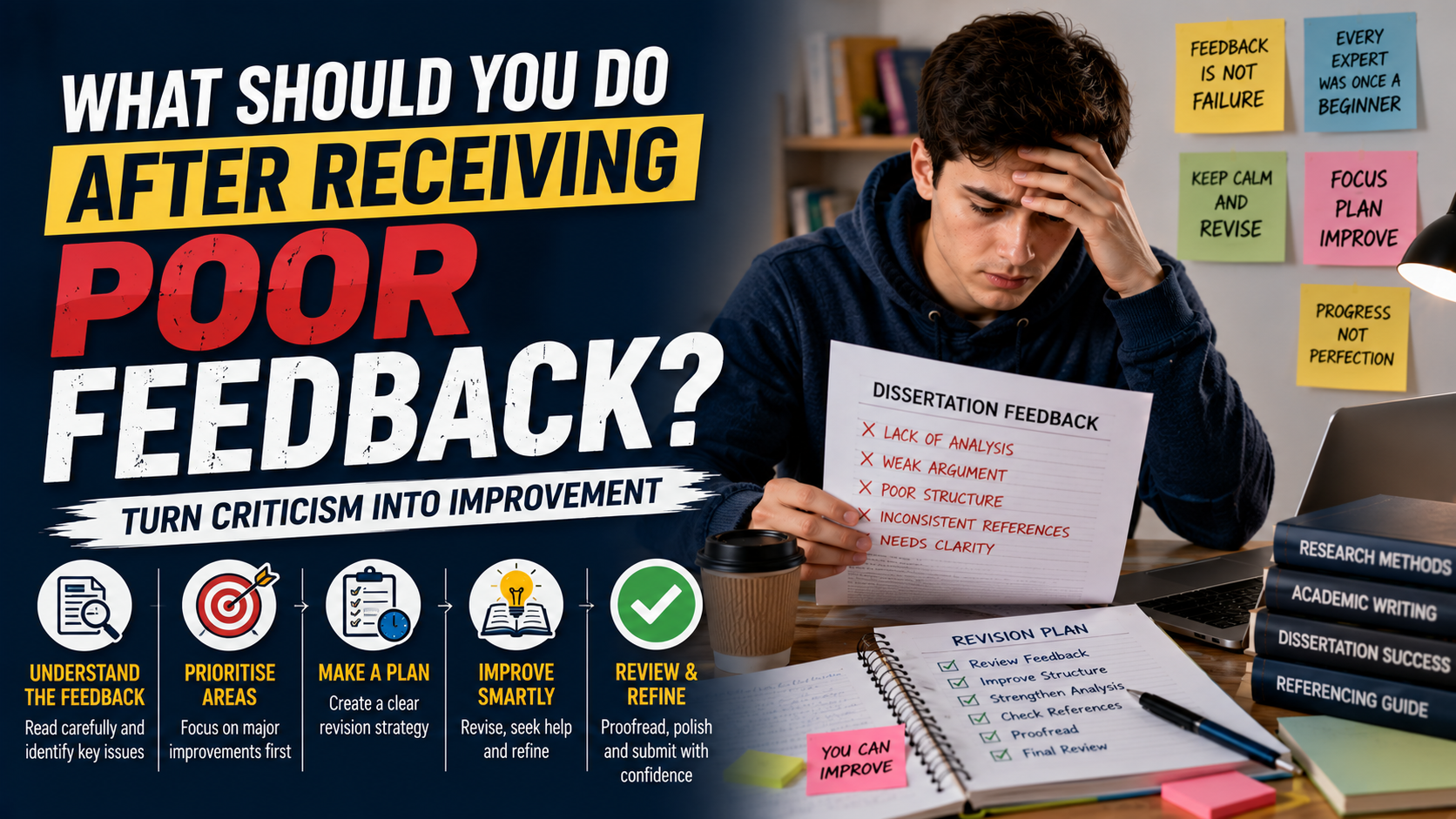
However, poor feedback does not necessarily mean your dissertation cannot achieve a good outcome. In many cases, feedback is intended to help students identify areas for improvement before final submission or resubmission.
The key is not to panic or make rushed changes. Instead, take a structured approach to understanding the feedback, prioritising revisions, and strengthening your dissertation while maintaining your own original work.
This guide explains how to respond constructively after receiving poor dissertation feedback and how to use it as an opportunity to improve.
Why Dissertation Feedback Matters
Feedback is an important part of the academic process.
Its purpose is to:
Identify strengths and weaknesses
Improve academic writing
Strengthen critical analysis
Clarify arguments
Improve research presentation
Help students meet assessment criteria
Although criticism can be difficult to read, constructive feedback often provides a clear roadmap for revision.
Don't React Immediately
Your first reaction may be emotional.
Common responses include:
Frustration
Embarrassment
Disappointment
Anxiety
Self-doubt
Rather than immediately rewriting large sections, allow yourself some time to process the comments objectively.
Once emotions settle, you'll be better prepared to evaluate the feedback carefully.
Read Every Comment Carefully
Avoid focusing only on the mark.
Instead, review every comment and identify:
Repeated issues
Major concerns
Minor corrections
Positive observations
Suggested improvements
Looking for patterns helps you understand which issues deserve the highest priority.
Separate Major and Minor Issues
Not all comments carry the same weight.
High-Priority Issues
Examples include:
Weak research question
Insufficient critical analysis
Poor chapter structure
Missing evidence
Inaccurate referencing
Weak conclusions
These issues usually require careful revision.
Lower-Priority Issues
These may include:
Grammar mistakes
Typographical errors
Formatting inconsistencies
Minor wording improvements
These can often be corrected during the final editing stage.
Compare Feedback With the Assessment Criteria
Many students focus only on written comments.
Instead, compare the feedback against:
Learning outcomes
Marking rubric
Dissertation handbook
Assessment criteria
This helps you understand why certain comments were made and which improvements are most likely to strengthen your work.
Ask Questions if Anything Is Unclear
If feedback contains comments that you do not fully understand, consider discussing them with:
Your dissertation supervisor
Academic skills advisers
University writing centre
Module leader (where appropriate)
Clarifying expectations early helps avoid unnecessary revisions.
Create a Revision Plan
Rather than changing everything at once, organise revisions into manageable stages.
Priority | Revision Task |
|---|---|
High | Address research and structural issues |
High | Improve critical analysis |
High | Strengthen arguments with evidence |
Medium | Correct referencing |
Medium | Improve clarity |
Medium | Refine transitions |
Low | Grammar and punctuation |
Low | Formatting consistency |
Working systematically reduces stress and helps ensure important issues are not overlooked.
Avoid Common Mistakes
Students sometimes respond to poor feedback by:
Rewriting everything unnecessarily
Ignoring supervisor comments
Making changes without understanding the issue
Leaving revisions until the final days
Focusing only on grammar instead of content
A balanced, evidence-based approach is generally more effective.
How Independent Feedback Can Help
After multiple rounds of editing, it can become difficult to evaluate your own work objectively.
A fresh reviewer may identify:
Logical gaps
Weak transitions
Unclear arguments
Referencing inconsistencies
Grammar issues
Formatting errors
Constructive feedback should support your revision process while ensuring that your dissertation remains your own original work.
Build Confidence Through Small Improvements
Not every improvement needs to be dramatic.
Small changes can collectively strengthen your dissertation, including:
Clearer topic sentences
Better transitions
More accurate citations
Improved paragraph flow
Stronger conclusions
Consistent formatting
Incremental improvements often produce a more polished final document.
When Time Is Limited
If your submission deadline is approaching, prioritise:
Structural issues
Research accuracy
Referencing
Clarity
Grammar
Formatting
Avoid spending hours perfecting individual sentences before larger issues have been addressed.
Maintain Academic Integrity
Feedback should help you improve your own work—not replace it.
Many universities allow support with:
Grammar
Proofreading
Structure
Referencing
Clarity
Presentation
Students remain responsible for the originality, research, analysis, and final submission of their dissertation.
Always ensure any assistance complies with your institution's academic integrity policies.
A Practical Post-Feedback Checklist
Before submitting your revised dissertation:
✅ Read every feedback comment.
✅ Prioritise major revisions first.
✅ Check your assessment criteria.
✅ Improve structure and logical flow.
✅ Verify all citations and references.
✅ Proofread grammar and spelling.
✅ Check formatting requirements.
✅ Save multiple backup copies.
Final Thoughts
Poor dissertation feedback can feel discouraging, but it often provides valuable guidance for improving your work. Rather than viewing criticism as a setback, treat it as an opportunity to strengthen your arguments, improve clarity, and present your research more effectively.
A structured revision plan, careful attention to feedback, and sufficient time for editing can significantly improve the quality of your dissertation. Where appropriate, ethical academic guidance can provide an additional perspective while ensuring your dissertation remains entirely your own work.
Frequently Asked Questions
Everything you need to know about our services
Related Posts

Is It Too Late to Improve Your Dissertation?

Should You Continue Fixing Your Dissertation Alone?
