Common Dissertation Mistakes Singapore Students Make
Introduction
Writing a dissertation is one of the most demanding academic projects university students complete.
Whether you are completing a bachelor's dissertation, master's thesis, MBA research project, or another substantial research assignment in Singapore, small mistakes can affect the overall quality of your work.
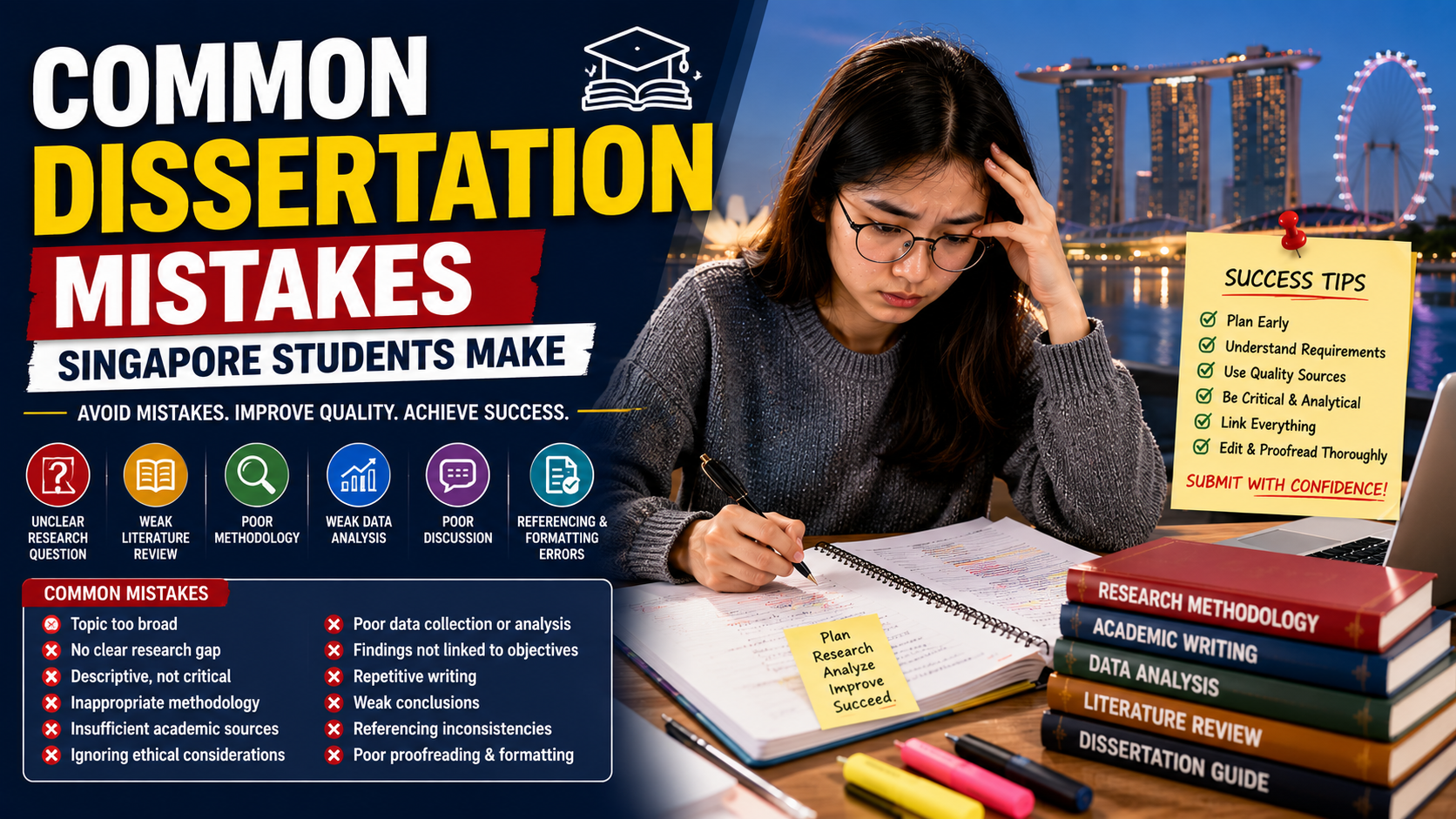
Some problems are relatively easy to fix, such as formatting or referencing errors.
Others can have a much bigger impact, including an unclear research question, weak methodology, insufficient critical analysis, poor data interpretation, or a discussion chapter that does not answer the research objectives.
The good news is that most dissertation mistakes can be identified before submission.
This guide explains the most common dissertation mistakes Singapore students make, how to avoid them, and when professional dissertation editing or proofreading can provide an additional quality check.
1. Choosing a Research Topic That Is Too Broad
One of the earliest dissertation mistakes happens before the actual writing begins.
Students sometimes choose a topic that sounds interesting but is too broad to investigate effectively within the available time, word count, and resources.
For example:
"The Impact of Artificial Intelligence on Business."
This could involve hundreds of possible industries, technologies, countries, organisational functions, and research questions.
A more focused topic might examine a specific relationship, population, industry, or geographical context.
How to avoid this mistake
Ask:
What exactly am I investigating?
Who or what is the research about?
Where is the research taking place?
What specific relationship or problem am I examining?
Can I realistically investigate this within my deadline?
A narrower topic is often easier to research deeply.
2. Writing a Weak Research Question
Your research question is the foundation of the dissertation.
If the question is unclear, almost every later chapter can become difficult.
A weak question may be:
Too broad
Too descriptive
Difficult to measure
Impossible to answer with available data
Unrelated to the methodology
Unrelated to the research objectives
A strong research question should provide a clear direction for the research.
Before finalising it, check whether your proposed methodology and data can realistically answer the question.
3. Having Research Objectives That Don't Match the Question
Your research question and objectives should work together.
A common mistake is creating objectives that sound academically impressive but do not directly contribute to answering the research question.
For example:
Research Question:
How does remote working influence employee engagement among Singapore SMEs?
Possible objectives could examine:
Current remote-working practices.
Employee engagement levels.
The relationship between remote working and engagement.
Factors influencing that relationship.
Each objective should contribute to answering the central question.
4. Writing a Descriptive Literature Review
This is one of the most common dissertation weaknesses.
A descriptive literature review tells the reader what different researchers have said.
For example:
Smith (2023) studied employee motivation. Jones (2022) examined employee engagement. Tan (2024) investigated workplace flexibility.
The problem is that listing studies does not automatically demonstrate critical academic engagement.
A stronger literature review asks:
Do the researchers agree?
Why do their findings differ?
What methodologies did they use?
What limitations exist?
Which theories explain the findings?
What remains unknown?
How does the literature relate to your research?
Your literature review should build an argument, not simply become a catalogue of sources.
5. Failing to Establish a Clear Research Gap
A dissertation needs a reason for conducting the research.
Students sometimes write:
"There is limited research on this topic."
This is usually too vague.
A stronger research gap identifies a specific limitation in existing research.
For example:
A particular population has not been studied sufficiently.
Existing studies focus on another geographical context.
Previous research uses a different methodology.
Existing findings are contradictory.
A recent development has created a new research problem.
Existing research has not examined a specific relationship.
The research gap should logically lead toward your research question.
6. Using Too Many Sources Without Evaluating Them
Having a long reference list does not automatically make a dissertation academically strong.
Students sometimes add large numbers of citations without explaining their relevance.
Instead, focus on:
Relevance
Quality
Recency where appropriate
Academic credibility
Methodological strength
Relationship to your research question
A smaller collection of highly relevant academic sources can be more useful than a large collection of loosely related references.
7. Relying Too Heavily on Websites
Online sources can sometimes be useful, but a dissertation normally requires substantial engagement with appropriate academic literature.
Avoid building your literature review primarily around:
Random websites
Blogs
Unverified articles
Commercial pages
Wikipedia as a primary academic source
Search-engine summaries
Use appropriate scholarly literature and authoritative sources relevant to your discipline.
8. Not Understanding the Methodology
Another common mistake is treating the methodology chapter as a description of what was done.
A stronger methodology explains why particular research choices were made.
Depending on your research design, you may need to discuss:
Research philosophy
Research approach
Research design
Sampling
Data collection
Data analysis
Ethical considerations
Reliability
Validity
Trustworthiness
Research limitations
Your choices should be connected to the research question.
9. Choosing a Method Because It Looks Advanced
Students sometimes assume that more complicated research methods automatically produce better dissertations.
They do not.
A sophisticated statistical technique is not useful if it does not match your research question or dataset.
Likewise, conducting interviews does not automatically make a qualitative study strong.
The appropriate methodology depends on what you are trying to investigate.
Ask:
"Why is this method appropriate for answering my research question?"
If you cannot clearly explain the answer, revisit your methodology.
10. Using an Inappropriate Sample
Sampling problems can affect the credibility of your findings.
Consider:
Who is your target population?
Why were participants selected?
How were they recruited?
Is the sample size appropriate?
Are there inclusion or exclusion criteria?
Could selection bias exist?
Can your findings reasonably be generalised?
Do not claim that findings represent an entire population if your sample does not support that conclusion.
11. Ignoring Research Ethics
Ethics should not be treated as a formality.
If your dissertation involves human participants, consider issues such as:
Informed consent
Confidentiality
Anonymity
Data protection
Voluntary participation
Potential harm
Secure data storage
Withdrawal rights
Follow the ethical requirements of your university and research project.
12. Collecting Data Before Finalising the Research Design
Changing your research question after collecting substantial data can create significant problems.
Your research design should be sufficiently developed before data collection begins.
Make sure you understand:
What data you need
Why you need it
How you will collect it
How you will analyse it
How it relates to the research objectives
If you are uncertain about these issues, discuss them with your supervisor before proceeding.
13. Presenting Findings Without Explaining Them
A findings chapter should present your research results clearly.
However, students sometimes provide tables, percentages, quotations, or statistical outputs without explaining what they show.
For example:
"Table 4.2 shows that 68% of participants reported increased job satisfaction."
The reader may need more context.
What does this finding mean?
How does it relate to your research objective?
Are there differences between groups?
Does it support or challenge previous research?
The appropriate level of interpretation depends on your dissertation structure and whether findings and discussion are presented separately.
14. Confusing Findings With Discussion
Another common mistake is failing to distinguish between reporting results and interpreting their significance.
The findings chapter may focus primarily on:
What did the research find?
The discussion may focus more heavily on:
What do these findings mean, and how do they relate to existing research?
The exact structure depends on your programme requirements, so follow your dissertation guidelines.
15. Weak Data Analysis
Data analysis should directly contribute to answering your research question.
For quantitative research, review:
Variable definitions
Statistical techniques
Assumptions
Results
Significance
Effect interpretation
Tables and figures
For qualitative research, review:
Coding
Themes
Evidence
Interpretation
Relationships between themes
Links to research objectives
Avoid using analysis methods simply because they appear sophisticated.
16. Making Claims That Your Data Cannot Support
This is a serious academic mistake.
Suppose your study identifies a relationship between two variables.
That does not automatically prove causation.
Similarly, a small sample may not justify broad claims about an entire population.
Use appropriately cautious language.
For example:
"The findings suggest..."
"The results indicate..."
"Within the sample..."
"The evidence may imply..."
"These findings should be interpreted in light of..."
Your conclusions should reflect the actual strength of your evidence.
17. Writing a Discussion That Simply Repeats the Findings
A discussion should do more than repeat your results.
It should interpret them.
Consider:
Why did you obtain these findings?
Do they agree with previous research?
If not, why might they differ?
What theoretical explanation is possible?
What are the practical implications?
What limitations affect interpretation?
This is where much of the dissertation's critical thinking becomes visible.
18. Not Connecting the Discussion to the Literature Review
Your literature review and discussion should not feel like two unrelated chapters.
The literature review establishes what is already known.
The discussion explains how your findings relate to that existing knowledge.
A useful question is:
"How does my research contribute to, support, challenge, or extend what previous researchers have found?"
19. Writing a Weak Conclusion
A conclusion should answer the research question.
It should normally bring together:
Main findings
Research objectives
Research question
Contribution
Limitations
Recommendations
Future research where appropriate
Avoid simply repeating sentences from the discussion.
Your conclusion should demonstrate what the research ultimately tells the reader.
20. Making Recommendations Without Evidence
Recommendations should be based on your findings.
A weak recommendation might say:
"Companies should improve employee engagement."
A stronger recommendation explains:
Who should act
What should change
Why it matters
How it could be implemented
What evidence supports the recommendation
Avoid recommendations that are unrelated to your findings.
21. Ignoring Dissertation Limitations
Every research project has limitations.
These might relate to:
Sample size
Research design
Time constraints
Data availability
Geographic scope
Measurement
Sampling
Researcher bias
Acknowledging limitations does not automatically weaken your dissertation.
In many cases, demonstrating that you understand the limitations of your research shows academic maturity.
22. Trying to Hide Weak Results
Not every research project produces the result you expected.
Students sometimes become concerned when their findings do not support their original assumptions.
Do not manipulate the research to create a preferred outcome.
Instead:
Report the findings accurately.
Explain what they mean.
Compare them with previous research.
Consider possible explanations.
Discuss the limitations.
Explain the implications.
Unexpected results can sometimes produce valuable academic discussion.
23. Poor Chapter Structure
A dissertation should have a clear logical progression.
A common structure might involve:
Introduction
Literature Review
Methodology
Findings/Results
Discussion
Conclusion
The exact structure varies by discipline and programme.
Each chapter should have a clear purpose and contribute to the overall research argument.
24. Writing Chapters in Isolation
Another common mistake is treating each chapter as an independent assignment.
Your dissertation should feel like one connected research project.
For example:
Introduction
defines the problem.
↓
Literature Review
establishes existing knowledge and the research gap.
↓
Methodology
explains how the research addresses the gap.
↓
Findings
presents what the research discovered.
↓
Discussion
interprets the findings in relation to existing knowledge.
↓
Conclusion
answers the research question and explains the contribution.
If these connections are weak, the dissertation can feel fragmented.
25. Poor Academic Writing
Strong research can lose impact if it is difficult to read.
Common problems include:
Very long sentences
Repetition
Informal language
Unclear claims
Poor paragraph structure
Excessive jargon
Inconsistent terminology
Grammar mistakes
Weak transitions
Academic writing should prioritise clarity and precision.
26. Writing to Reach the Word Count
Trying to reach a required word count by adding unnecessary sentences can weaken a dissertation.
Avoid:
Repeating the same point
Overexplaining basic concepts
Adding irrelevant literature
Using unnecessary quotations
Writing lengthy background sections
Every paragraph should contribute something useful.
27. Poor Time Management
Dissertations often take longer than expected.
Students may underestimate the time required for:
Literature searching
Reading
Data collection
Data analysis
Supervisor feedback
Revisions
Referencing
Proofreading
Formatting
Do not leave the final editing stage until the night before submission.
28. Ignoring Supervisor Feedback
Supervisor feedback is one of the most useful sources of dissertation guidance.
Students sometimes read comments but do not systematically implement them.
Keep a feedback document.
For every significant comment, record:
What the supervisor identified
Which chapter it affects
What needs to change
Whether the change has been completed
This makes the revision process much more organised.
29. Making Major Changes Without Discussing Them
If supervisor feedback suggests a fundamental change to:
Research question
Methodology
Sample
Data analysis
Theoretical framework
do not make major methodological changes without understanding the consequences.
Discuss significant changes with your supervisor or relevant academic staff where appropriate.
30. Leaving Referencing Until the End
Referencing can become extremely difficult when completed as a last-minute task.
Maintain your references throughout the research process.
Check:
In-text citations
Reference list
Author details
Dates
Titles
Journal information
DOI or URL requirements
Required referencing style
Also check that every significant citation corresponds to a reference-list entry.
31. Inconsistent Referencing Style
Mixing APA, Harvard, MLA, IEEE, or other styles can create unnecessary problems.
Follow the referencing system specified by your programme.
Do not assume that the style used by a classmate or another university applies to your dissertation.
32. Poor Formatting
Formatting may seem minor, but dissertations often have specific requirements.
Check:
Font
Spacing
Margins
Page numbers
Heading hierarchy
Table formatting
Figure captions
Contents page
Appendices
Referencing
Cover page
Always follow the official dissertation guidelines provided by your university.
33. Forgetting the Appendices
Students sometimes include important supporting information but fail to reference it properly in the main dissertation.
Depending on your research, appendices might include:
Questionnaires
Interview guides
Additional tables
Participant information
Consent documentation
Supplementary analysis
Only include material that is appropriate and permitted under your programme's requirements.
34. Failing to Proofread the Final Document
A dissertation can contain good research but still look unfinished because of avoidable errors.
Before submission, check:
Grammar
Spelling
Punctuation
Formatting
Headings
Page numbers
Tables
Figures
Citations
References
Contents page
Cross-references
Do not rely entirely on automated grammar tools.
A human review can identify problems that software may overlook.
35. Treating AI as a Substitute for Research
AI tools can be useful for certain academic tasks, but students should not assume that generated content is automatically accurate or academically acceptable.
Potential problems include:
Incorrect information
Fabricated references
Misinterpreted research
Generic arguments
Unsupported claims
Inappropriate paraphrasing
If your university permits AI assistance, use it according to the applicable academic integrity rules.
Always verify information against reliable academic sources.
36. Ignoring Your University's AI Policy
Universities and programmes can have different expectations regarding generative AI.
Before using AI for dissertation work, check:
Academic integrity guidance
Programme-specific requirements
Assessment instructions
Disclosure requirements
Permitted AI uses
If your university prohibits a particular use of AI, do not assume that using an AI tool secretly is acceptable.
37. Failing to Keep Research Data Organised
Dissertation research can involve large amounts of information.
Keep organised copies of:
Academic sources
Notes
Datasets
Coding files
Interview transcripts
Analysis outputs
Consent documentation
Draft chapters
Supervisor feedback
Use sensible file names and backups.
Losing research data close to the deadline can create unnecessary problems.
38. Not Keeping Different Draft Versions
Avoid repeatedly overwriting your only dissertation file.
Use versions such as:
Dissertation_v1
Dissertation_v2
Dissertation_Feedback
Dissertation_Revised
Dissertation_Final
Dissertation_Final_Proofread
This provides a safety net if you need to recover earlier material.
39. Waiting Until the Last Minute for Dissertation Editing
Editing is not simply correcting spelling.
A proper editing process can identify:
Weak arguments
Repetition
Poor transitions
Structural inconsistencies
Unclear paragraphs
Academic language problems
Referencing inconsistencies
Leave enough time between substantive revisions and final proofreading.
40. Submitting Without a Final Dissertation Audit
One of the simplest ways to avoid dissertation mistakes is to conduct a final audit.
Ask:
Research
☐ Is my research question clear?
☐ Do my objectives align with it?
☐ Is my research gap established?
Literature
☐ Is the literature relevant?
☐ Have I demonstrated critical analysis?
☐ Have I compared different perspectives?
Methodology
☐ Are my methods justified?
☐ Is sampling explained?
☐ Are ethical issues addressed?
Findings
☐ Are results presented clearly?
☐ Do they answer the research objectives?
Discussion
☐ Are findings interpreted?
☐ Are they compared with existing research?
☐ Are limitations considered?
Conclusion
☐ Does it answer the research question?
☐ Are recommendations supported by evidence?
Presentation
☐ Is referencing consistent?
☐ Is formatting correct?
☐ Has the document been proofread?
Which Dissertation Mistakes Are Most Serious?
Not every mistake has the same impact.
Generally, problems with the research question, methodology, data analysis, critical analysis, and alignment between chapters can be more significant than minor formatting errors.
A useful priority system is:
Priority | Examples |
|---|---|
Critical | Research question, methodology, data integrity, major analytical problems |
High | Literature review, critical analysis, discussion, findings interpretation |
Medium | Structure, argument flow, referencing |
Final-stage | Grammar, spelling, formatting, proofreading |
Address substantive academic problems before cosmetic issues.
How Dissertation Editing Services Can Help Singapore Students
If you have completed your dissertation but are concerned about quality, professional editing can provide an additional review before submission.
Depending on the service, support may include:
Dissertation structure review
Chapter editing
Literature review feedback
Methodology review
Critical analysis feedback
Discussion chapter review
Academic language editing
Referencing checks
Dissertation proofreading
Formatting review
This can be particularly useful when you have already received supervisor feedback and want to check whether the suggested changes have been implemented effectively.
Students should always ensure that any external academic support complies with their university's academic integrity requirements.
AssignmentCart Dissertation Support
AssignmentCart provides ethical academic support for students who want to improve their own dissertation before submission.
Support can include:
Dissertation editing
Dissertation proofreading
Chapter review
Literature review feedback
Methodology review
Critical analysis feedback
Supervisor-feedback implementation review
Referencing checks
Formatting assistance
Final quality checks
The purpose is to help students improve the clarity and quality of their existing academic work.
Students remain responsible for their research, data, analysis, arguments, and final submission.
Final Dissertation Mistake Checklist
Before submitting your dissertation, ask yourself:
Research Question
☐ Is my research question focused?
☐ Can my methodology answer it?
☐ Do my objectives align with it?
Literature Review
☐ Have I established a research gap?
☐ Am I analysing rather than simply describing sources?
☐ Have I included relevant academic literature?
Methodology
☐ Have I justified my research choices?
☐ Is the sampling appropriate?
☐ Are ethical considerations addressed?
Findings
☐ Are my findings presented clearly?
☐ Are tables and figures accurate?
☐ Do the findings relate to my objectives?
Discussion
☐ Have I interpreted the results?
☐ Have I compared them with previous research?
☐ Have I addressed unexpected findings?
Conclusion
☐ Does the conclusion answer the research question?
☐ Are recommendations supported?
☐ Have limitations been acknowledged?
Presentation
☐ Is my referencing consistent?
☐ Is the formatting correct?
☐ Are all required sections included?
☐ Has the dissertation been professionally proofread?
Final Thoughts
Dissertation mistakes are often easier to prevent than to repair after submission.
The most important approach is to review your dissertation as a complete research project rather than as a collection of separate chapters.
Your research question should guide your objectives.
Your objectives should guide your methodology.
Your methodology should produce evidence that answers the objectives.
Your findings should be interpreted in the discussion.
And your conclusion should ultimately answer the research question.
For Singapore students, university-specific dissertation requirements can vary considerably, so always follow the official guidance provided by your programme.
If you are close to submission and concerned about weaknesses in your dissertation, an additional editing, proofreading, or academic quality review can help identify problems that you may have overlooked after spending months working on the same document.
The goal is not simply to make your dissertation longer or more complicated.
The goal is to make it clearer, better supported, logically structured, critically analytical, and aligned with your research question and assessment requirements.
Frequently Asked Questions
Everything you need to know about our services


