Dissertation Reference List Formatting Help in New Zealand
Introduction
A dissertation reference list may appear to be a simple collection of sources, but formatting it correctly can become surprisingly time-consuming.
Master's and PhD students can work with hundreds of journal articles, books, reports, websites, theses and other academic sources. Each source needs to be recorded accurately and presented according to the referencing style required by the student's university, faculty or discipline.
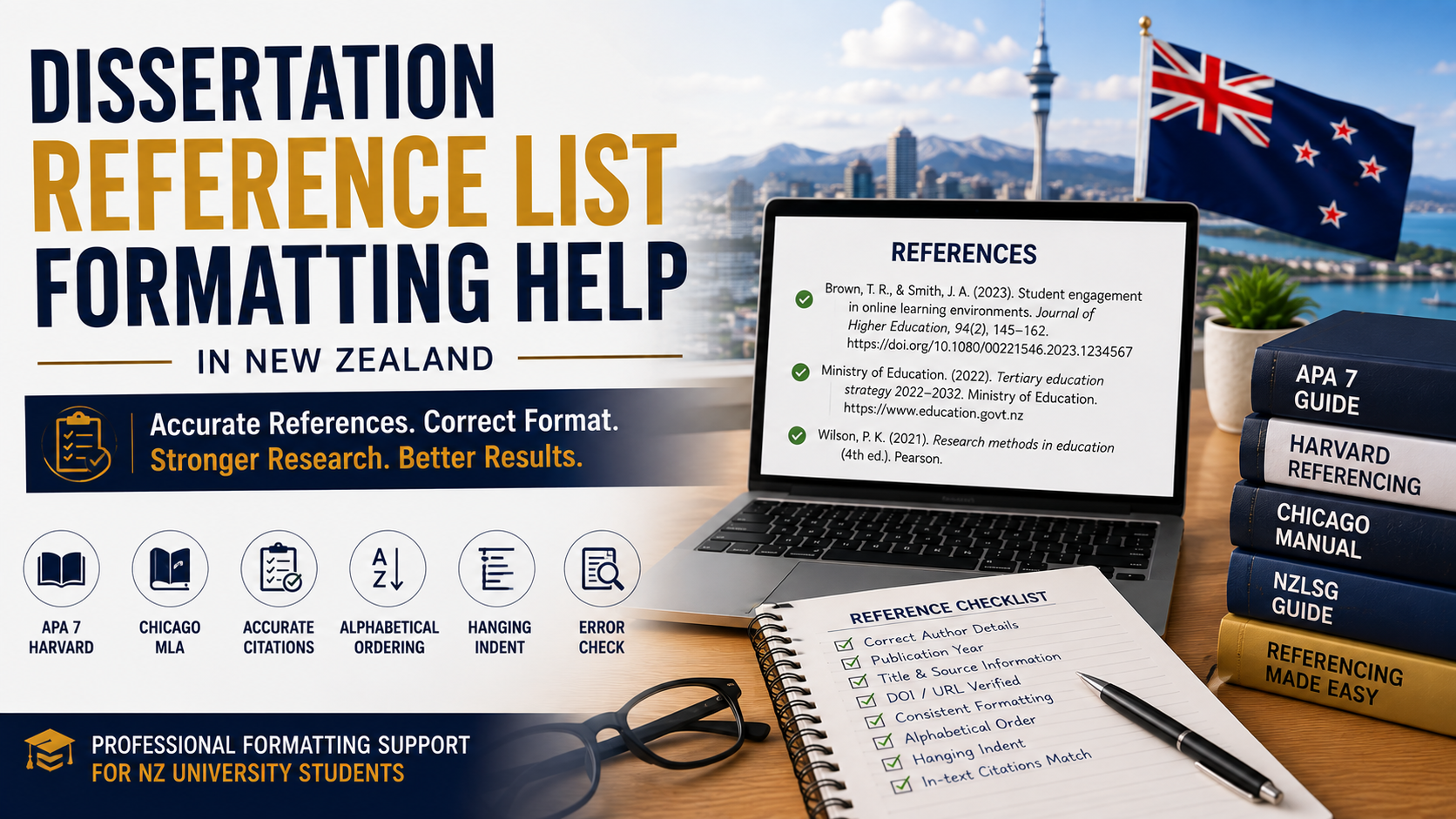
Dissertation reference list formatting help in New Zealand can assist students with organising, checking and formatting an existing reference list for consistency, accuracy and compliance with the required referencing style.
The University of Canterbury explains that referencing styles vary by discipline and that students should follow the style recommended by their lecturer or programme. It also recommends reference-management software such as EndNote or Zotero for large projects.
The University of Auckland similarly notes that research projects should use a standard referencing system, such as APA or Chicago, and maintain a logical and consistent approach throughout the thesis.
What Is a Dissertation Reference List?
A dissertation reference list is the list of sources cited or referenced in the dissertation.
Depending on the referencing system, it may contain information such as:
Author name
Publication year
Title
Journal or book information
Publisher
Volume and issue
Page range
DOI
URL
Edition
Report number
Thesis information
The exact information and formatting depend on the referencing style.
A reference list is different from a general reading list. In APA 7, for example, the reference list contains the sources cited in the work, subject to the style's specific rules. The University of Canterbury's current guidance states that an APA reference list should be provided on a new page after the text for the sources quoted or paraphrased in the document.
Why Is Reference List Formatting Important?
A correctly formatted reference list helps readers identify and locate the sources used in the dissertation.
It also demonstrates attention to academic conventions.
Poor reference formatting can result in problems such as:
Missing information
Incorrect author names
Inconsistent dates
Incorrect titles
Broken DOI links
Incorrect URLs
Inconsistent punctuation
Incorrect alphabetical ordering
Missing references
References that do not appear in the text
In-text citations that are missing from the reference list
Mixing different referencing styles
Referencing also forms part of academic integrity. Victoria University of Wellington explains that academic writing should clearly distinguish a student's own ideas from material taken from other sources through appropriate quotation, paraphrasing and citation.
Which Referencing Style Should New Zealand Students Use?
There is no single referencing style used by every New Zealand university.
Common styles include:
APA 7
MLA
Chicago
Harvard
Vancouver
IEEE
ACS
NZLSG
The University of Auckland provides resources covering APA, MLA, Chicago, ACS, NZLSG and Vancouver styles.
Victoria University of Wellington also identifies APA, MLA, Chicago, Harvard, NZLSG and IEEE among styles used across different disciplines.
The correct style therefore depends on the student's:
University
Faculty
Department
Programme
Subject
Supervisor
Dissertation guidelines
Students should never assume that APA 7 is automatically required simply because it is common.
APA 7 Reference List Formatting
APA 7 is widely used across many disciplines and is currently used at the University of Canterbury.
Some general APA 7 reference-list requirements include:
Start the reference list on a new page.
Use the heading References.
Centre and bold the heading.
Arrange entries alphabetically by the surname of the first author.
Use a hanging indent for each reference.
Maintain the document's required line spacing.
Ensure references correspond with the citations in the text.
The University of Canterbury's current APA guidance specifies a 0.5-inch (1.27 cm) hanging indent and alphabetical ordering by first author's surname.
Example of an APA 7 Journal Article
A general journal article structure is:
Author, A. A. (Year). Title of article. Title of Journal, volume(issue), pages. https://doi.org/xxxxx
For example:
Smith, J. A., & Brown, T. R. (2025). Student engagement in postgraduate online learning. Journal of Higher Education Research, 18(2), 45–61. https://doi.org/10.xxxx/xxxxx
The actual details must come from the source being cited.
Never create a DOI, author, page number or publication detail simply to make a reference appear complete.
Example of an APA 7 Book Reference
A typical book reference follows this structure:
Author, A. A. (Year). Title of book. Publisher.
APA 7 does not generally include the publisher's location.
The University of Canterbury's current APA 7 guidance specifically identifies omission of publisher location as one of the changes from APA 6.
Example of an APA 7 Website Reference
A general webpage reference may follow:
Author or Organisation. (Year, Month Day). Title of webpage. Site Name. URL
The precise format depends on the information available and the type of webpage.
For organisational authors, the organisation may function as the author.
The University of Canterbury provides separate APA guidance for webpages, reports, government publications and other source types.
How to Format a Thesis or Dissertation in APA 7
Theses and dissertations have their own APA 7 reference format.
For an online thesis, a general structure is:
Author, A. A. (Year). Title of thesis [Master's thesis/Doctoral dissertation, University Name]. Repository Name. DOI or URL
The University of Canterbury's APA 7 guidance specifically provides formats for theses available through repositories and for unpublished theses.
This is particularly relevant for postgraduate students who cite previous Master's dissertations or doctoral theses in their literature review.
Reference List Formatting for Government Reports
New Zealand dissertations frequently use government publications, particularly in areas such as:
Public health
Education
Social policy
Economics
Environmental studies
Business
Public administration
Nursing
Psychology
A government report may use an organisation as the author.
For example:
Ministry of Health. (Year). Title of report. Publisher or URL.
The University of Canterbury's APA 7 guidance provides specific rules for agency authors and government publications.
Students should check whether the agency is the author, publisher or both rather than automatically entering the same organisation twice.
Reference List Formatting for Journal Articles
Journal articles are among the most frequently cited sources in dissertations.
A complete journal reference may require:
Author(s)
Publication year
Article title
Journal title
Volume
Issue
Page range
DOI, where applicable
Common problems include:
Missing DOI
Students may have a DOI available but leave it out.
Incorrect journal title
The journal title should follow the conventions of the applicable referencing style.
Incorrect volume and issue
Volume and issue information should be checked against the original publication.
Incorrect page range
The page numbers should correspond to the actual article.
Database URLs
Students sometimes copy a long URL from a university library database instead of using the DOI or a publicly accessible URL where the style calls for one.
APA 7 guidance at the University of Canterbury specifically addresses DOI and URL treatment.
Reference List Formatting for Online Sources
Online sources can create additional formatting problems because webpages may contain:
Individual authors
Organisations
Publication dates
Updated dates
No date
Website names
Permanent URLs
Changing content
Before adding a webpage to a dissertation reference list, identify:
Who created the content?
When was it published or updated?
What is the title?
What is the website?
Is there a stable URL?
Does the required referencing style require a retrieval date?
Do not automatically use the date you accessed the webpage as its publication date.
Alphabetical Ordering of References
For APA 7, reference entries are generally arranged alphabetically by the surname of the first author.
The University of Canterbury's current guidance explicitly requires alphabetical ordering by the surname of the first author.
For example:
Adams, J. (2024)...
Brown, L. (2022)...
Chen, R. (2025)...
Wilson, P. (2023)...
If an organisation is the author, the organisation's name is considered for ordering.
Students should also pay attention to multiple works by the same author.
Multiple Works by the Same Author
Referencing styles can have specific rules for multiple works by the same author.
Under the current APA 7 guidance used by the University of Canterbury, works by the same author are arranged by publication year, with the earliest first. Special rules apply to entries without dates and forthcoming works.
For example:
Smith, J. (2021)...
Smith, J. (2023)...
Smith, J. (2025)...
Do not manually invent alphabetical suffixes such as "2023a" and "2023b" unless the applicable style requires them.
Hanging Indent in a Dissertation Reference List
A hanging indent means that the first line of a reference begins at the left margin while subsequent lines are indented.
For example:
Smith, J. A. (2025). Research methods in higher education. Academic Press.
https://doi.org/xxxxx
In APA 7, the standard hanging indent is 0.5 inches or 1.27 cm.
In Microsoft Word, students can apply this using the paragraph indentation settings.
The University of Canterbury provides instructions for applying a hanging indent in Word on both Windows and Mac.
Checking In-Text Citations Against the Reference List
One of the most important final checks is ensuring that the citations and references correspond.
Students should ask:
Does every in-text citation have a corresponding reference-list entry?
And:
Does every reference-list entry appear in the dissertation as an in-text citation?
There can be style-specific exceptions, so students should follow the rules of their chosen referencing system.
For APA 7, the reference list is closely connected to the citations used throughout the document.
The University of Canterbury explicitly describes the APA reference list as containing sources quoted or paraphrased in the text.
Common Reference List Formatting Mistakes
1. Mixing Referencing Styles
A dissertation might contain APA-style journal references alongside Harvard-style book references.
This creates inconsistency.
Choose the required style and apply it throughout the dissertation.
2. Missing References
A citation may appear in the dissertation but have no corresponding reference entry.
This is particularly common when students add or remove sources during revisions.
3. Extra References
The opposite problem can also occur.
A source may appear in the reference list but never be cited in the dissertation.
Check whether the applicable style permits such entries before removing them.
4. Incorrect Author Names
Common problems include:
Wrong initials
Missing authors
Incorrect author order
Incorrect organisation names
Misspelled surnames
Author information should be checked against the original source.
5. Incorrect Publication Dates
Students sometimes use the date they accessed an online article instead of its publication date.
These dates serve different purposes.
6. Incorrect Capitalisation
Titles are formatted differently depending on the referencing style.
Do not apply APA capitalisation rules to a Chicago or MLA reference list.
7. Missing DOI
Where a DOI is available and required by the chosen style, it should be included in the appropriate format.
8. Incorrect URLs
Avoid copying unnecessary tracking parameters or unstable database URLs when the referencing style requires a DOI or publicly accessible URL instead.
9. Incorrect Hanging Indents
A reference list can contain correct citation information but still have inconsistent formatting.
Check the paragraph settings across the entire list.
10. Inconsistent Spacing
Reference lists should follow the formatting requirements of the selected referencing style and the dissertation's institutional guidelines.
Reference List Formatting for Master's Dissertations
Master's dissertations can contain dozens or hundreds of sources.
The final reference list should be checked for:
Correct style
Alphabetical order
Author information
Dates
Titles
Journal information
DOI and URL formatting
Hanging indents
Citation-reference matching
Consistent spacing
The larger the dissertation becomes, the more difficult it is to identify these issues manually.
This is one reason universities recommend reference-management tools for larger research projects.
The University of Canterbury recommends tools such as EndNote or Zotero for large projects.
Reference List Formatting for PhD Theses
PhD theses can involve substantially larger reference libraries.
A doctoral researcher may work with:
Hundreds of journal articles
Books
Conference papers
Government publications
Datasets
Reports
Theses
Standards
Websites
Legal materials
Archival sources
A reference-management system can help organise this material, but students should still manually check the final output.
Reference managers can contain incorrect metadata, duplicate records or formatting problems.
Automated formatting is therefore not a substitute for final human verification.
Using EndNote or Zotero
Reference-management software can be extremely useful for dissertations.
Common tools include:
EndNote
Useful for storing references, organising research libraries and generating citations and bibliographies.
Zotero
Useful for collecting, organising and citing research sources.
Other reference managers
Students may also use other systems depending on their university or discipline.
The University of Auckland provides resources for reference-management tools and specifically offers information about RefWorks and reference-management options.
The University of Canterbury recommends EndNote or Zotero for large projects.
However, students should always verify automatically generated references.
Reference List Formatting for International Students in New Zealand
International students may encounter additional difficulties because New Zealand universities use different referencing systems depending on the subject.
A student may previously have used one style at another university and then discover that their New Zealand programme requires something different.
For example:
Psychology may use APA.
Law may use NZLSG or another legal citation system.
Engineering may use IEEE or another technical style.
Humanities may use Chicago or MLA.
Health disciplines may use APA or Vancouver depending on the programme.
Victoria University of Wellington explicitly advises students to check the style required by their subject or supervisor because different disciplines use different referencing styles.
Dissertation Reference List Editing vs Proofreading
Reference-list support can involve different levels of work.
Reference Formatting
Focuses on applying the required style consistently.
This may include:
Alphabetical ordering
Hanging indents
Punctuation
Capitalisation
DOI formatting
URL formatting
Author formatting
Reference Checking
Focuses on verifying:
Author names
Publication dates
Titles
Journal details
Volume and issue
Page numbers
DOI
URLs
Dissertation Proofreading
A broader proofreading process can also check the relationship between:
In-text citations
Reference list
Headings
Tables
Figures
Appendices
Formatting
The appropriate level of support depends on the student's needs and university rules.
Academic Integrity and Reference List Help
Reference formatting assistance should not involve inventing sources.
A responsible service should never:
Create fake references
Invent DOI numbers
Fabricate page numbers
Invent publication dates
Add sources that were never consulted
Manipulate citations to misrepresent research
Create false evidence
Students remain responsible for the accuracy and integrity of their references.
Victoria University of Wellington explains that academic integrity requires students to distinguish their own work from material belonging to others through appropriate citation and acknowledgement.
Reference formatting should therefore be about accurately presenting genuine sources, not creating references simply to make a dissertation appear more scholarly.
Secondary Sources and Reference Lists
Sometimes students find a statement in one source that refers to another original source.
This creates a secondary-source situation.
For APA 7, the University of Canterbury advises that when the primary source has not actually been read, the reference list should contain the secondary source that the student did read, while the in-text citation identifies the original work as cited in the secondary source. It also recommends using secondary sources sparingly when the original source is available.
This is important because students should not pretend to have read a source they have not actually consulted.
Reference List Formatting Checklist
Before submitting your dissertation, complete the following check.
Referencing Style
Have I confirmed the required style?
Am I using the current edition?
Is the same style applied consistently?
Reference Details
Are author names correct?
Are publication dates correct?
Are titles accurate?
Are journal details correct?
Are DOI links correct?
Are URLs accurate?
Organisation
Are references arranged correctly?
Are multiple works by the same author handled correctly?
Are organisational authors formatted correctly?
Formatting
Is the reference-list heading correct?
Are hanging indents applied?
Is spacing consistent?
Is punctuation consistent?
Is capitalisation correct?
Citation Matching
Does every relevant in-text citation have a reference?
Are unnecessary or uncited entries identified?
Have references been checked after the final round of dissertation revisions?
Academic Integrity
Are all references genuine?
Have I actually consulted the sources I cite?
Have I avoided fabricated references?
Have I followed my university's academic-integrity requirements?
Final Thoughts
A dissertation reference list is more than a collection of sources added at the end of a thesis.
It provides a record of the research that supports the student's academic argument.
For New Zealand students, the most important principle is to follow the referencing style required by the relevant programme and apply it consistently.
The University of Auckland provides resources for multiple referencing systems, while Victoria University of Wellington emphasises that referencing requirements vary between disciplines. The University of Canterbury's current APA 7 guidance provides detailed rules for reference-list structure, ordering and formatting.
For large dissertations, tools such as EndNote and Zotero can make reference management considerably easier, but students should still perform a final manual review.
Professional reference-list formatting or proofreading can help identify inconsistencies in an existing bibliography, but the sources themselves must be genuine and accurately represent the research the student has consulted.
Before submitting a Master's dissertation or PhD thesis, check the final reference list against the latest university, faculty and programme requirements.
Accurate sources + correct referencing style + consistent formatting + citation matching = a stronger and more reliable dissertation reference list.
Frequently Asked Questions
Everything you need to know about our services
Related Posts

Dissertation Literature Review Editing Service for NZ Students

Dissertation Chapter 1 Writing Help in New Zealand
