Dissertation Literature Review Editing Service for NZ Students
Introduction
A literature review is one of the most important parts of a dissertation. It demonstrates a student's understanding of existing research, identifies relevant theories and debates, evaluates previous findings and establishes the research gap that the dissertation intends to address.
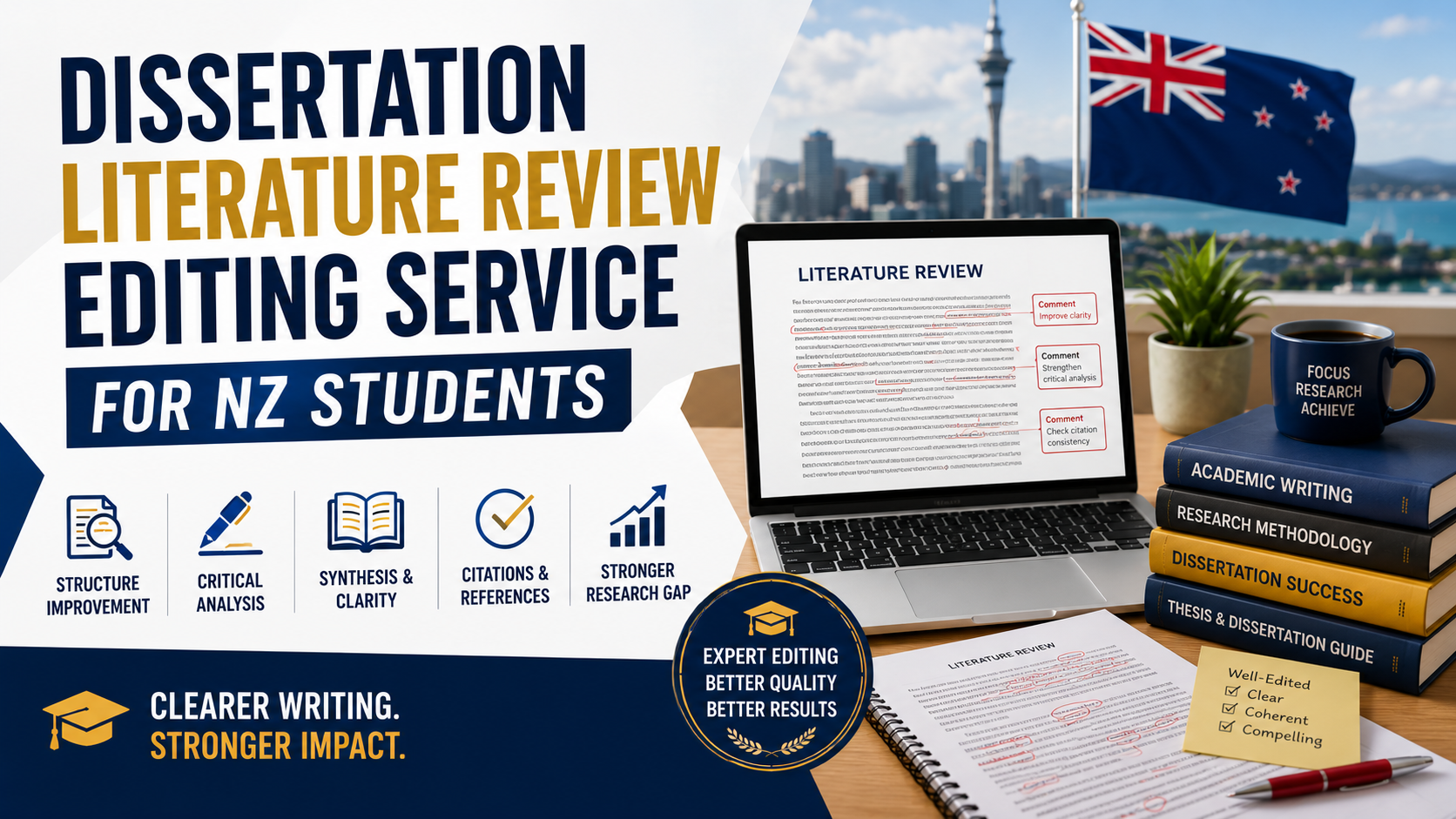
For students in New Zealand, writing an effective literature review can be challenging because it requires more than collecting and summarising academic sources. A strong literature review needs critical analysis, logical organisation, synthesis of evidence and a clear connection to the research problem.
A dissertation literature review editing service for NZ students can help improve an existing literature review by identifying problems with structure, academic expression, coherence, citation consistency, repetition and critical analysis while preserving the student's original research and academic contribution.
The exact dissertation structure and requirements can vary between universities, faculties and disciplines. Students should therefore use their university's current guidelines and supervisor feedback when preparing and revising their literature review.
What Is a Dissertation Literature Review?
A dissertation literature review is a structured and critical examination of existing academic research related to a particular research problem.
It may examine:
Peer-reviewed journal articles
Academic books
Conference papers
Research reports
Government publications
Industry sources
Relevant theoretical frameworks
Previous empirical studies
The purpose is not simply to describe what other researchers have written.
Instead, the literature review should demonstrate how existing research relates to the student's research problem and explain where gaps, disagreements, limitations or opportunities for further investigation exist.
A strong literature review typically moves from:
Existing Research → Critical Evaluation → Synthesis → Research Gap → Current Study
Why Is Literature Review Editing Important?
Students can spend weeks or months collecting sources and writing their literature review. After repeated revisions, however, it can become difficult to identify weaknesses in their own writing.
Common problems include:
Repetition
Weak paragraph transitions
Excessive description
Limited critical analysis
Poor source integration
Inconsistent terminology
Unclear research themes
Weak connections between studies
Citation inconsistencies
Poor organisation
An unclear research gap
Editing provides an opportunity to review the chapter from a reader's perspective.
The goal is not simply to correct grammar.
A well-edited literature review should make the relationship between sources, themes, arguments and the research problem easier to understand.
What Does a Literature Review Editing Service Include?
The exact scope varies by provider, but dissertation literature review editing can include several areas.
1. Structure and Organisation
An editor can review whether the literature review follows a logical structure.
For example, a review might be organised according to:
Themes
Concepts
Theories
Chronology
Methodological approaches
Research populations
Geographical contexts
The best structure depends on the research topic and discipline.
2. Academic Language Editing
Academic writing needs to communicate complex ideas clearly.
Editing may identify:
Grammar errors
Awkward sentences
Spelling mistakes
Punctuation problems
Unclear wording
Unnecessary repetition
Informal expressions
Inconsistent terminology
For international students studying in New Zealand, language editing can be particularly useful when English is not their first language.
The objective should be to improve clarity while preserving the student's academic voice.
3. Improving Critical Analysis
One of the most common weaknesses in literature reviews is excessive description.
Descriptive writing
A descriptive literature review might say:
Smith (2023) examined employee motivation. Jones (2024) investigated workplace engagement. Brown (2024) studied employee retention.
This tells the reader what individual studies investigated.
However, it does not necessarily explain how the studies relate to one another.
More critical writing
A stronger discussion could compare the studies:
Recent studies associate employee motivation with workplace engagement and retention, although researchers differ in their interpretation of the factors that produce sustained employee commitment.
The second approach begins to synthesise the literature.
Editing can help students identify places where a paragraph needs stronger comparison, evaluation or synthesis.
4. Source Integration
A literature review should not read like a collection of disconnected summaries.
Sources should be integrated into the student's argument.
Instead of repeatedly using:
Author A says...
Author B says...
Author C says...
students can organise research around themes and compare evidence.
For example:
Theme: Employee Motivation
Several studies associate intrinsic motivation with employee engagement. However, research differs regarding the relative influence of organisational culture and financial incentives. While one group of studies emphasises workplace autonomy, other researchers identify compensation and career progression as important predictors.
This structure allows multiple sources to contribute to a single academic discussion.
5. Identifying Repetition
Long literature reviews often contain repeated ideas.
A student may discuss the same concept:
In the introduction
Under one theme
Under another theme
In the research-gap section
An editing review can identify unnecessary repetition and help improve the overall flow.
Removing repetition can also make a dissertation more concise without reducing its academic value.
6. Citation and Reference Consistency
Literature review editing can include checking citation consistency according to the required referencing style.
Depending on the university and discipline, students may use styles such as:
APA
Chicago
Harvard
MLA
OSCOLA
Vancouver
The editor should follow the student's required style rather than assuming that one referencing system applies to every New Zealand university or programme.
Students should also independently verify that cited sources actually support the claims made in the dissertation.
7. Research Gap Development
The research gap is often one of the most important parts of a literature review.
A literature review should help answer:
What is already known?
What remains uncertain?
Where do researchers disagree?
What populations or contexts have received limited attention?
What methodological limitations exist?
What does the current study investigate?
A good editing process can help ensure that the literature review builds logically toward the research gap.
However, editors should not invent research gaps or unsupported claims.
The gap needs to emerge from the student's own research and evidence.
Literature Review Editing for NZ University Students
Students in New Zealand may study at universities including:
University of Auckland
University of Otago
Victoria University of Wellington
University of Canterbury
Massey University
University of Waikato
Lincoln University
Auckland University of Technology
Each institution may have different requirements depending on the qualification, faculty and discipline.
Students should therefore check their programme-specific requirements before finalising a literature review.
For example, university guidance can differ regarding thesis structure, formatting, referencing and research-component presentation.
A generic online template should not automatically be treated as a university requirement.
Literature Review Editing for International Students in New Zealand
International students may face additional challenges when preparing a dissertation literature review.
These can include:
Academic English
Understanding how to express complex arguments in formal academic English can take time.
Critical Writing
Students may be more familiar with descriptive writing and need support understanding critical analysis and synthesis.
Referencing
Different countries and previous institutions may use different referencing conventions.
Academic Expectations
Expectations surrounding argument development, source evaluation and evidence-based writing may differ between education systems.
Large Volumes of Literature
A dissertation can require students to manage a substantial number of academic sources.
Editing and academic guidance can help students understand how to organise these sources more effectively.
Literature Review Editing vs Literature Review Writing
These services should not be confused.
Literature Review Editing
Editing works with an existing draft and may involve:
Grammar correction
Clarity improvement
Structural suggestions
Academic-language editing
Paragraph flow
Repetition reduction
Citation consistency
Terminology consistency
Critical-analysis feedback
Literature Review Writing
Writing involves producing new academic content.
Students should understand their university's rules regarding external assistance before using any third-party writing service.
A responsible academic support service should avoid replacing the student's research, analysis or intellectual contribution.
What Makes a Strong Dissertation Literature Review?
A strong literature review generally demonstrates five characteristics.
1. Relevance
The sources directly relate to the research problem.
2. Currency
Recent research is considered where appropriate, while foundational studies are retained when they remain important.
3. Critical Analysis
The review evaluates rather than merely describes previous research.
4. Synthesis
Multiple sources are connected to develop themes and arguments.
5. Research Alignment
The literature review leads logically toward the research gap and current study.
Common Literature Review Problems
Problem 1: Too Much Description
The student summarises every source individually.
Better approach
Group sources around themes and compare their findings.
Problem 2: No Clear Structure
The literature review jumps between unrelated topics.
Better approach
Create a thematic structure based on the research questions or major concepts.
Problem 3: Weak Critical Analysis
The chapter reports what researchers said without evaluating the evidence.
Better approach
Compare methodologies, findings, populations, theoretical perspectives and limitations.
Problem 4: Unclear Research Gap
The chapter contains extensive literature but never explains what remains unresolved.
Better approach
Use the reviewed literature to demonstrate the specific gap addressed by the research.
Problem 5: Outdated Sources
The review relies heavily on old research despite substantial recent developments.
Better approach
Include relevant recent literature while retaining seminal sources where they remain important.
Problem 6: Poor Citation Consistency
Citations and references contain formatting inconsistencies.
Better approach
Apply the required referencing style consistently and verify the source information.
How a Literature Review Editing Service Can Help
A professional editing review can examine the chapter at several levels.
Language Level
Grammar
Spelling
Punctuation
Academic expression
Paragraph Level
Topic sentences
Logical progression
Transitions
Repetition
Section Level
Thematic organisation
Balance between sections
Source integration
Critical discussion
Dissertation Level
Connection to research questions
Research-gap development
Consistency with Chapter 1
Alignment with methodology
This multi-level review can make the literature review more coherent and easier to follow.
Literature Review Editing Checklist
Before submitting your literature review, check:
Sources
Are the sources relevant?
Are important recent studies included?
Are foundational sources retained where necessary?
Are claims supported by appropriate evidence?
Critical Analysis
Do you compare studies?
Do you discuss disagreements?
Do you evaluate methodologies?
Do you identify limitations?
Do you synthesise findings?
Structure
Are sections logically organised?
Are themes clearly identified?
Does each section contribute to the research problem?
Research Gap
Is the gap clearly established?
Is it supported by the reviewed literature?
Does it connect to the research questions?
Writing
Is the academic language clear?
Are paragraphs logically connected?
Is unnecessary repetition removed?
Is terminology consistent?
Referencing
Are citations consistent?
Does every required citation appear in the reference list?
Are references formatted according to the required style?
Have source details been independently verified?
How to Choose a Dissertation Literature Review Editing Service
Students comparing editing providers should consider several factors.
Academic Experience
Look for editors who understand postgraduate academic writing and research conventions.
Subject Knowledge
A literature review about nursing, finance, engineering or computer science may require different terminology and conventions.
Editing Scope
Check whether the service covers only grammar or also provides structural and coherence feedback.
Referencing Support
Confirm whether citation and reference consistency are included.
Confidentiality
Understand how documents are stored, processed and handled.
Turnaround Time
Check whether the expected delivery time fits your dissertation deadline.
Revision Policy
Understand whether the provider offers clarification or follow-up support.
Academic Integrity
Choose support that respects university rules and keeps the student's research and intellectual contribution at the centre of the dissertation.
Preparing Your Literature Review for Editing
Before sending a draft for review, prepare:
Your current literature review
Research proposal
Research questions
Research objectives
Supervisor feedback
University or faculty guidelines
Required referencing style
Submission deadline
Providing this information allows the editor to understand the context of the chapter rather than reviewing the document in isolation.
What Should You Expect From Literature Review Editing?
A useful editing service should not simply return a document with hundreds of grammar corrections.
Good editing should help you understand:
Why a section is unclear
Where an argument needs stronger evidence
Where sources should be compared
Which paragraphs repeat information
Where transitions are weak
Whether themes are logically organised
Whether the research gap is clearly established
Whether the chapter connects with the research questions
The purpose is to make the student's own academic work clearer and more coherent.
Dissertation Literature Review Editing for Different Subjects
The editing approach can vary by discipline.
Business and Management
The review may focus on:
Management theories
Organisational behaviour
Marketing research
Strategic frameworks
Industry evidence
Finance
It may involve:
Financial theories
Market research
Econometric studies
Risk models
Empirical findings
Nursing and Healthcare
The literature review may examine:
Clinical evidence
Patient populations
Healthcare interventions
Professional practice
Health policy
Education
It may include:
Learning theories
Teaching practices
Educational policies
Student outcomes
Pedagogical research
Computer Science
It may examine:
Existing technologies
Algorithms
System architectures
Computational approaches
Technical limitations
Engineering
It may focus on:
Engineering theories
Existing designs
Experimental findings
Technical limitations
Alternative approaches
The same basic principles of relevance, synthesis and critical analysis apply, but the academic conventions differ.
Final Thoughts
A dissertation literature review should do more than demonstrate that a student has read a large number of academic papers.
It should show that the researcher understands the existing body of knowledge, can evaluate different perspectives, can synthesise relevant evidence and can identify a meaningful research gap.
For NZ students, a dissertation literature review editing service can provide an additional layer of academic-language, structure and coherence review before submission.
The most effective approach is:
Collect Relevant Research
↓
Organise Sources Into Themes
↓
Critically Evaluate Studies
↓
Synthesize Evidence
↓
Identify the Research Gap
↓
Connect the Literature to Research Questions
↓
Edit and Refine the Chapter
↓
Check University Requirements
↓
Final Proofreading
Students should always follow their university's current guidelines and academic-integrity requirements. Professional editing should strengthen the presentation of the student's own research rather than replace their intellectual contribution.
Frequently Asked Questions
Everything you need to know about our services
Related Posts

Dissertation Proofreading Before Submission in Singapore

Dissertation Editing Services for NUS Master's Students
