Thesis Structure and Formatting Help for NZ Postgraduate Students
Introduction
Writing a postgraduate thesis involves much more than presenting research findings. A strong thesis needs a logical structure, consistent chapter organisation, appropriate academic formatting and careful attention to the submission requirements of the relevant university, faculty and discipline.
For NZ postgraduate students, thesis structure and formatting can become particularly challenging when a dissertation or thesis contains multiple chapters, tables, figures, appendices, references, research papers or co-authored material.
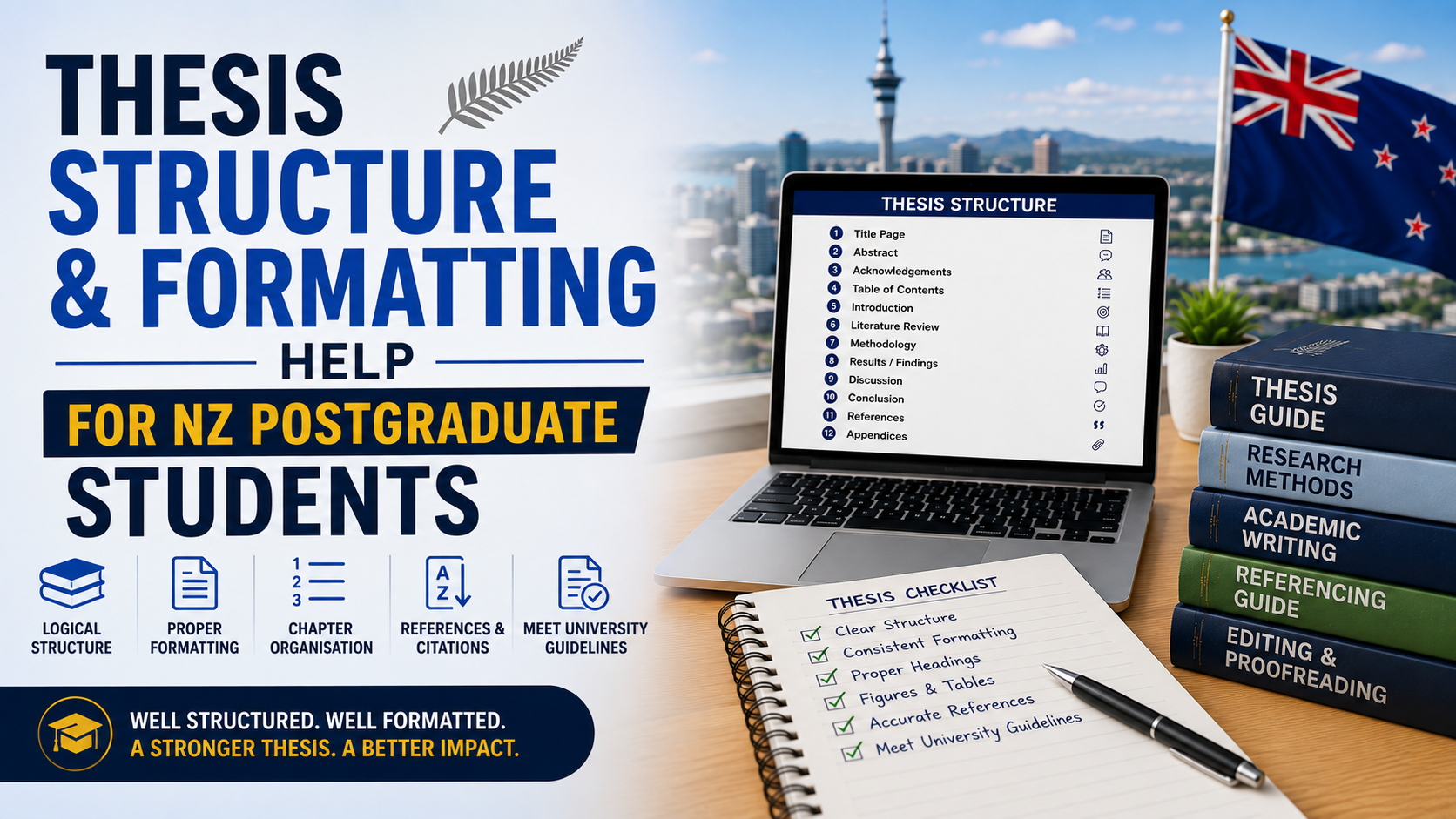
Thesis structure and formatting help for New Zealand postgraduate students can assist with organising an existing thesis, improving consistency, checking formatting and preparing a document for final review while keeping the student's research and academic contribution intact.
Importantly, there is no single formatting template that applies to every postgraduate thesis in New Zealand. The University of Auckland states that much of the formatting for sub-doctoral research components is department-specific, while its doctoral thesis procedures set particular requirements for doctoral submissions.
What Is a Postgraduate Thesis?
A postgraduate thesis is a substantial research document produced as part of a Master's or doctoral qualification.
Depending on the programme, it may be called a:
Master's thesis
Doctoral thesis
PhD thesis
Dissertation
Research project
Research portfolio
Research component
The terminology and requirements differ between institutions and programmes.
For example, the University of Auckland describes a thesis, research essay, research project, research portfolio or dissertation as a written report of a research study undertaken as part of a postgraduate qualification, while noting that the detailed requirements depend on the qualification and programme.
Why Is Thesis Structure Important?
A thesis is a long academic document.
Without a clear structure, readers can struggle to understand:
What problem is being investigated
Why the research matters
What previous research says
How the study was conducted
What the results mean
What contribution the research makes
A logical structure creates a clear progression from the research problem to the final conclusions.
Victoria University of Wellington recommends breaking a thesis into sections and identifies a common structure involving the abstract, introduction, research question or thesis, literature review, methodology, results/findings, discussion and conclusion. It also emphasises that different theses can require different structures.
Typical Thesis Structure for NZ Postgraduate Students
A conventional research thesis may contain the following sections:
Title page
Abstract
Acknowledgements
Table of contents
List of figures
List of tables
Glossary or abbreviations
Introduction
Literature review
Methodology
Results or findings
Discussion
Conclusion
References or bibliography
Appendices
Not every thesis will contain every section.
A creative-practice thesis, publication-based thesis or discipline-specific research project may use a different arrangement.
The University of Auckland's doctoral thesis procedures require the main text to follow a logical and consistent chapter or section structure and specify an order for thesis material.
1. Thesis Title Page
The title page provides essential identification information about the thesis.
It may include:
Thesis title
Student's full name
Qualification
Subject or discipline
University
Submission year
Required submission statement
Specific wording can vary between institutions.
For example, the University of Auckland's doctoral thesis procedures specify where the candidate's name and submission statement should appear on the title page.
Students should therefore use their university's current title-page requirements rather than copying a template from another institution.
2. Dissertation or Thesis Abstract
The abstract provides a concise summary of the research.
It normally identifies:
Research problem
Research aim
Methodology
Key findings
Conclusions
The University of Auckland currently specifies a maximum of 350 words for doctoral thesis abstracts and requires the abstract to summarise the aim, methods, findings and conclusions. Its sub-doctoral guidance also specifies a maximum of 350 words for thesis abstracts.
However, students should check their own programme requirements because abstract requirements can vary.
3. Acknowledgements
Acknowledgements are usually used to recognise people or organisations that contributed to the research or thesis process.
Depending on the university, this may include:
Supervisors
Research participants
Funding organisations
Laboratory or technical staff
Research collaborators
Academic support services
The University of Auckland notes that students should acknowledge third-party editors when such editing is undertaken in accordance with its applicable guidelines.
Students should also check whether their institution requires disclosure of external editing assistance.
4. Table of Contents
A table of contents helps readers navigate a long thesis.
It should normally show:
Chapter titles
Major headings
Subheadings
Page numbers
The University of Auckland recommends limiting the table of contents to a manageable hierarchy and states that no more than four levels of subheadings are recommended in its sub-doctoral guidance.
A common problem is allowing too many heading levels into the table of contents.
For most theses, a clear hierarchy is easier to read than a complicated numbering system.
5. List of Tables
A list of tables is useful when a thesis contains numerous tables.
Each entry can identify:
Table number
Table title
Page number
For example:
Table 1. Participant demographics — 42
Table 2. Survey response rates — 47
Table 3. Regression results — 63
The table numbering should remain consistent throughout the thesis.
6. List of Figures
A list of figures may be required when the thesis contains multiple:
Charts
Graphs
Diagrams
Maps
Photographs
Conceptual models
Check that the figure title shown in the list corresponds exactly to the figure title used in the thesis.
7. Glossary and Abbreviations
A glossary can help explain specialised terminology.
It may be particularly useful in:
Engineering
Medicine
Nursing
Computer science
Environmental science
Law
Business
Interdisciplinary research
A separate abbreviation list can be useful when the thesis repeatedly uses technical terms.
The University of Auckland's doctoral procedures provide for a glossary where specialised terms, symbols or abbreviations need explanation.
8. Introduction Chapter
The introduction establishes the research context.
It may include:
Background
Research problem
Research gap
Research aim
Research questions
Objectives
Scope
Significance
Thesis structure
A strong introduction should help the reader understand what the thesis is investigating and why.
Avoid turning the introduction into an excessively long literature review.
9. Literature Review
The literature review establishes the academic context of the research.
It should normally do more than summarise individual sources.
A strong literature review can:
Identify major theories
Compare previous studies
Evaluate competing perspectives
Identify research gaps
Establish the conceptual framework
Explain how the current study fits into existing knowledge
The literature review should connect directly to the research questions.
10. Methodology Chapter
The methodology chapter explains how the research was conducted.
Depending on the research design, this may cover:
Research philosophy
Research approach
Research design
Participants
Sampling
Data collection
Data analysis
Ethical considerations
Reliability or validity
Research limitations
The level of detail depends on the discipline.
A quantitative thesis may require statistical procedures, while a qualitative thesis may focus on interviews, coding and thematic analysis.
The University of Auckland's postgraduate guidance notes that students should discuss methodology and identify ethics approval where appropriate.
11. Results or Findings Chapter
The results or findings chapter presents what the research discovered.
Depending on the discipline, it may include:
Statistical results
Tables
Figures
Themes
Experimental findings
Interview findings
Case-study evidence
The chapter should clearly distinguish between reporting results and interpreting their broader implications.
In some thesis structures, results and discussion are combined.
12. Discussion Chapter
The discussion interprets the findings.
It can explain:
What the findings mean
How they compare with previous research
Whether the research questions were answered
Whether findings support or challenge existing theories
Practical implications
Theoretical implications
Unexpected findings
A common structural problem is repeating the results instead of interpreting them.
The discussion should move beyond:
“The study found X.”
towards:
“The finding suggests X because…”
13. Conclusion Chapter
The conclusion brings the research together.
It may include:
Summary of the research
Main findings
Contribution
Implications
Limitations
Recommendations
Future research
Avoid introducing major new arguments in the conclusion.
The conclusion should demonstrate how the thesis has answered its research questions.
14. Reference List or Bibliography
The reference section documents the sources used in the research.
Depending on the discipline and referencing system, students may need:
APA
Chicago
MLA
Harvard
Vancouver
IEEE
NZLSG
Another discipline-specific style
The University of Auckland states that the chosen referencing system should follow disciplinary norms and be applied consistently.
The reference list should also be checked for consistency between:
In-text citations ↔ Reference entries
15. Appendices
Appendices contain supplementary information that would interrupt the main argument if included in the body of the thesis.
Examples include:
Survey questionnaires
Interview schedules
Detailed statistical output
Additional tables
Consent documentation
Supplementary figures
Technical information
Appendices should support the thesis rather than become a place to store unrelated material.
The University of Auckland's doctoral procedures specify that appendices should be labelled sequentially.
Thesis Formatting Requirements in New Zealand
Formatting requirements vary significantly between universities and departments.
This is one of the most important points students should understand before formatting an entire thesis.
Do not automatically use formatting rules found in an online template.
Check the current:
University regulations
Faculty guidelines
Department requirements
Thesis handbook
Supervisor instructions
Submission instructions
Page Size
A4 is commonly used for New Zealand postgraduate theses.
The University of Auckland's sub-doctoral guidance generally accepts A4 for research components, while its doctoral procedures establish specific presentation requirements.
However, students should verify the requirements for their own programme.
Font and Typography
Readable fonts are important for examination and final submission.
For example, the University of Auckland's doctoral thesis procedures specify black main text equivalent to 12-point Times New Roman or 10-point Arial, with smaller footnote or endnote text permitted if it remains readable.
The University of Otago's current PhD thesis formatting guidance recommends a 12-point serif font such as Palatino, Times or Cambria for main text and a sans-serif font such as Arial or Calibri for headings.
These examples demonstrate why students should not assume that one font specification applies across every New Zealand university.
Line Spacing
Line spacing affects readability and examiner annotation.
The University of Auckland's current doctoral procedures require line spacing of no less than 1.5 and no more than double spacing, with exceptions for certain material such as longer quotations, footnotes/endnotes and tables or figures.
Its sub-doctoral guidance similarly states that line spacing should generally be at least 1.5 and no more than double spacing.
Margins
Margins need to accommodate:
Binding
Page numbers
Headers
Footers
Tables
Figures
The precise margin requirements can differ.
Students preparing a printed or bound thesis should pay particular attention to binding margins.
Page Numbering
Long theses usually require a structured page-numbering system.
A common arrangement is:
Preliminary pages
Use Roman numerals:
i, ii, iii, iv
Main thesis
Use Arabic numerals:
1, 2, 3, 4
The University of Otago's thesis-format guidance specifies Roman numerals for preliminary pages and Arabic numerals for the main text.
The University of Auckland requires page numbers to appear consistently throughout doctoral theses.
Heading Hierarchy
A thesis can contain several levels of headings.
For example:
Chapter 1 — Introduction
1.1 Background
1.1.1 Research Context
1.1.2 Research Problem
1.2 Research Aim
1.3 Research Questions
The important principle is consistency.
The same heading level should use the same:
Font
Size
Weight
Spacing
Numbering system
Alignment
The University of Auckland advises that chapters and sections should follow a logical scheme consistently throughout the thesis.
Thesis Formatting in Microsoft Word
Microsoft Word can be used to create a professional thesis, but long documents require careful setup.
Useful features include:
Heading Styles
Navigation Pane
Automatic Table of Contents
Section Breaks
Page Breaks
Cross-References
Caption tools
Automatic numbering
Different first-page headers
Roman and Arabic page numbering
Track Changes
Avoid manually formatting every heading.
Using Word's built-in heading styles makes it much easier to update the table of contents and maintain consistency.
Thesis Formatting in LaTeX
LaTeX is particularly popular in disciplines that involve:
Mathematics
Computer science
Physics
Engineering
Statistics
Technical research
The University of Otago's Computer Science department encourages postgraduate students to use LaTeX and provides a thesis template aligned with university requirements.
The University of Auckland also provides LaTeX thesis templates in some departments, demonstrating that discipline-specific workflows can differ.
LaTeX can be particularly useful for:
Mathematical equations
Large bibliographies
Cross-referencing
Figures
Tables
Automated numbering
Complex technical documents
However, students should still check whether their department provides an official template.
Thesis Formatting for Tables and Figures
Tables and figures should be presented consistently.
Check:
Numbering
Captions
Font size
Placement
Source information
Cross-references
Page breaks
Accessibility where applicable
For example:
Figure 4.2 Research framework
The text should refer to the figure appropriately.
Avoid writing:
“The diagram below shows…”
because page layout can change during editing.
A stronger approach is:
“Figure 4.2 illustrates the proposed research framework.”
Thesis Formatting for Equations
Technical theses may contain numerous equations.
Use consistent:
Equation numbering
Alignment
Symbols
Variable definitions
Spacing
If equations are referenced elsewhere, use automatic cross-references where possible.
This reduces errors when chapters are reorganised.
Thesis Formatting for Footnotes
Some disciplines use extensive footnotes, particularly:
Law
History
Humanities
Theology
Some social sciences
The formatting of footnotes should follow the selected referencing system and university requirements.
Do not mix multiple citation systems without a specific academic reason.
Thesis Structure for Master's Students
Master's theses can vary considerably in length and structure.
A common structure is:
Title page
Abstract
Acknowledgements
Contents
Introduction
Literature review
Methodology
Results
Discussion
Conclusion
References
Appendices
However, some Master's programmes may combine chapters.
For example:
Literature Review + Theoretical Framework
or:
Results + Discussion
The appropriate structure depends on the discipline and research design.
Thesis Structure for PhD Students
A doctoral thesis can be more complex.
It may include:
Multiple research studies
Several experiments
Multiple methodology chapters
Published papers
Co-authored research
Creative-practice components
Extensive appendices
The University of Otago recognises hybrid thesis formats in which published material can be incorporated into chapters or sections, while also providing for published material to be appended in certain circumstances.
The University of Auckland's doctoral procedures also address theses containing co-authored work and require appropriate co-authorship documentation.
Therefore, doctoral students should discuss the proposed thesis structure with their supervisors well before final formatting.
Thesis Structure for International Students in New Zealand
International postgraduate students may encounter additional formatting challenges when moving between university systems.
Potential difficulties include:
Different referencing styles
Different thesis templates
Different spelling conventions
Different academic terminology
Different chapter structures
Different submission systems
Different expectations for headings and formatting
New Zealand English should generally be used where required by the programme.
Students should also avoid assuming that formatting rules from a previous institution automatically apply to their New Zealand university.
Thesis Formatting for Publication-Based Research
Some postgraduate theses incorporate published or publishable research.
This can create structural challenges because journal articles may have their own:
Formatting
Headings
Referencing
Abstracts
Tables
Figures
Terminology
The thesis still needs to function as a coherent research document.
The University of Otago advises candidates who plan to include published material to discuss the appropriate format with their supervisors.
The University of Auckland's doctoral procedures similarly establish specific requirements around thesis chapters, sections and co-authored material.
Common Thesis Formatting Problems
1. Inconsistent Heading Styles
Chapter 1 may use one heading format while Chapter 5 uses another.
Solution: Use Word Styles or a consistent LaTeX structure.
2. Incorrect Page Numbering
A thesis may accidentally continue Arabic numbering through the preliminary pages.
Solution: Use section breaks and separate numbering systems.
3. Broken Table of Contents
Manual editing can result in incorrect page numbers.
Solution: Generate the table of contents automatically.
4. Figures Without Captions
Every important figure should follow the required caption convention.
5. Tables Split Incorrectly
Large tables can create awkward page breaks.
Review tables during the final formatting stage.
6. Different Fonts Between Chapters
Copying material from different documents can introduce inconsistent fonts.
This is particularly common in publication-based theses.
7. Inconsistent Referencing
A thesis may accidentally mix APA and Harvard formatting.
Use one approved system consistently unless the programme explicitly permits another approach.
8. Incorrect Appendices
Appendices may be incorrectly numbered or missing from the table of contents.
Check all appendix labels and cross-references.
9. Excessive Heading Levels
Too many subheadings can make a thesis difficult to navigate.
The University of Auckland recommends no more than four levels of headings in its sub-doctoral table-of-contents guidance.
10. Formatting Changes After Conversion to PDF
A Word document may look correct but change when converted to PDF.
Always inspect the final PDF page by page.
Thesis Formatting Checklist
Before submission, review the complete thesis.
Structure
Title page is correct
Abstract is included
Acknowledgements are included where appropriate
Table of contents is updated
Lists of tables and figures are updated
Chapters appear in the correct order
Conclusion follows the discussion
References are included
Appendices are correctly labelled
Formatting
Correct page size
Correct font
Correct line spacing
Correct margins
Consistent headings
Consistent paragraph formatting
Consistent page numbers
Tables are formatted consistently
Figures are numbered correctly
Captions are consistent
Footnotes follow the required style
References
Referencing style is correct
In-text citations match references
DOI/URL information is checked
Reference list formatting is consistent
Final PDF
No blank pages
No missing figures
No broken tables
No orphaned headings
No incorrect page numbers
Table of contents links work where applicable
All appendices are included
Final PDF has been reviewed visually
Thesis Structure and Formatting Help
Professional thesis formatting support can be useful when a postgraduate student already has the research and writing completed but needs help making the document consistent.
Depending on the applicable university rules, formatting or proofreading support may involve:
Structure Review
Checking whether chapters and sections follow a logical order.
Formatting Review
Checking:
Fonts
Headings
Margins
Spacing
Page numbering
Tables
Figures
Reference Formatting
Checking the consistency of the reference list and citation style.
Final Proofreading
Identifying minor:
Typographical errors
Formatting inconsistencies
Spelling errors
Punctuation problems
The University of Otago distinguishes editing, copy-editing and proofreading. Its guidelines define proofreading as correcting minor text and formatting errors on a final or near-final draft, while copy-editing can involve grammar, spelling, punctuation, clarity, transitions and wordiness.
Students should check their institution's rules before engaging third-party assistance.
Academic Integrity and Thesis Formatting Help
Formatting assistance should never involve changing the underlying research.
A responsible service should not:
Fabricate research
Invent findings
Create false references
Change statistical results
Alter evidence
Invent citations
Misrepresent authorship
Rewrite research conclusions without the student's involvement
The University of Otago states that research students remain responsible for the originality and presentation of their work.
The University of Auckland likewise states that responsibility for research, writing and submission remains with the student.
Where third-party editing is permitted, students should also follow any required acknowledgement or disclosure procedures.
Final Thoughts
A postgraduate thesis needs two things to work together: strong research and clear presentation.
A well-organised structure helps examiners follow the research argument, while consistent formatting makes the document easier to navigate and evaluate.
For NZ postgraduate students, the most important lesson is that there is no universal thesis formatting template for every university or discipline. The University of Auckland states that many formatting requirements are department-specific, while institutions such as the University of Otago provide their own thesis-format guidance.
Before finalising your thesis, check:
University requirements → Faculty guidelines → Department requirements → Supervisor advice → Final formatting → PDF review
If you use Microsoft Word or LaTeX, set up the document structure early rather than attempting to fix hundreds of formatting problems immediately before submission.
For students who already have a completed or near-completed thesis, professional formatting, copy-editing or proofreading support may help identify inconsistencies in structure and presentation. However, the student's research, evidence, findings and intellectual contribution should remain their own.
A well-structured thesis makes the research easier to understand. Consistent formatting makes the finished research easier to evaluate.
Frequently Asked Questions
Everything you need to know about our services


