Dissertation Due in One Week? Your Canadian Student Survival Plan
Introduction
A dissertation deadline that is only one week away can feel overwhelming. You may still have chapters to finish, supervisor feedback to address, references to check, tables to format and hundreds of small corrections to make.
The good news is that one week is still enough time to create a realistic plan if you stop trying to fix everything simultaneously.
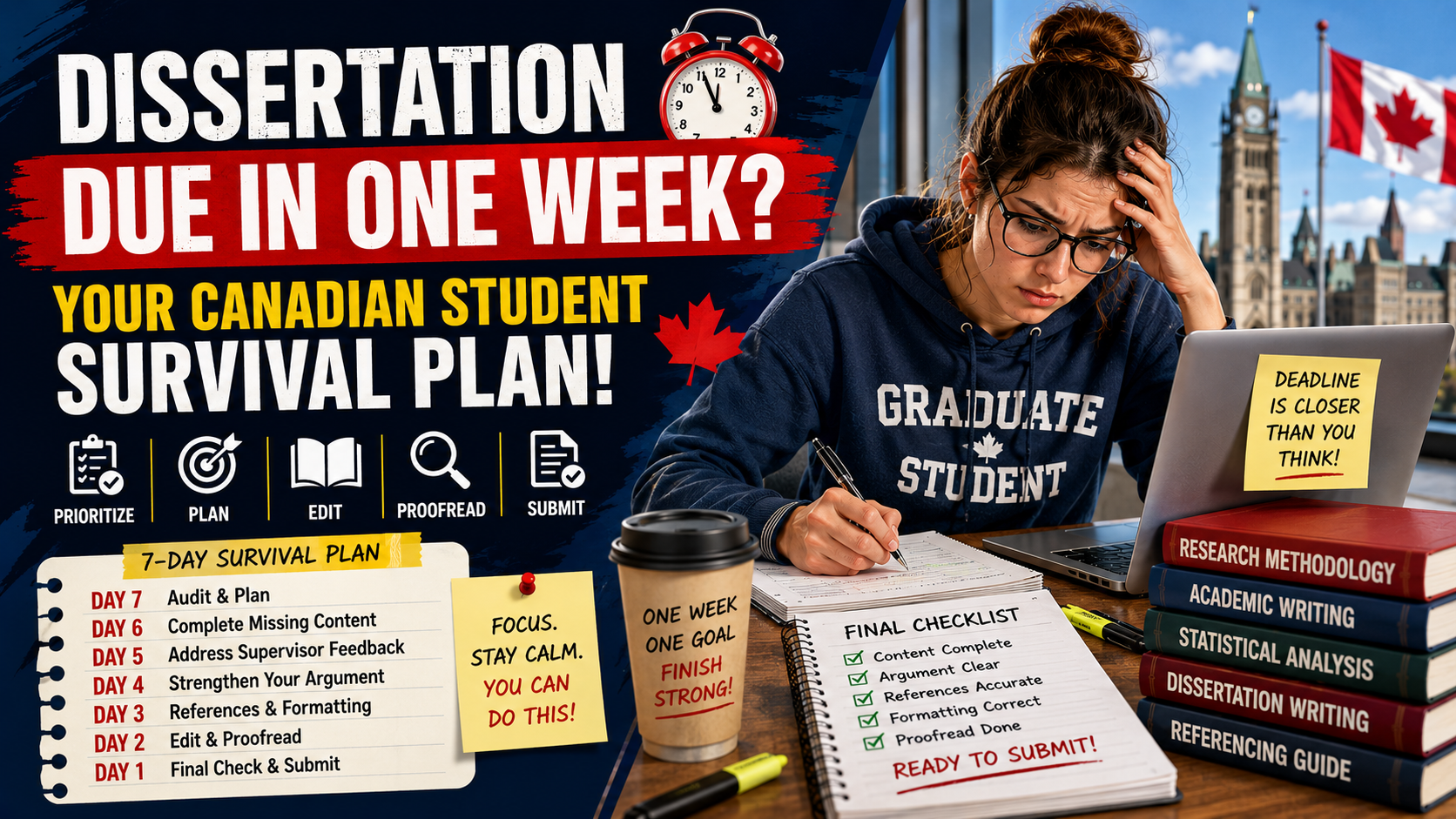
For Canadian university students, the final week should be about prioritisation, focused revision and submission preparation. The objective is not to create a completely different dissertation in seven days. It is to turn your existing research into the strongest, most complete and professionally presented submission possible.
This survival plan breaks the final week into manageable stages.
What Should You Do When Your Dissertation Is Due in One Week?
When you have seven days remaining, avoid starting with grammar corrections.
First determine what is actually incomplete.
Create three lists:
Critical
These issues could prevent you from submitting a complete dissertation.
Examples include:
Missing chapters
Incomplete methodology
Missing results
Unfinished analysis
Missing conclusion
Major supervisor revisions
Missing essential references
Important
These issues affect quality but do not necessarily prevent submission.
Examples include:
Weak transitions
Repetitive paragraphs
Unclear explanations
Inconsistent terminology
Poor paragraph structure
Cosmetic
These can be addressed after the major work is complete.
Examples include:
Minor punctuation
Small wording preferences
Minor formatting adjustments
Sentence-level polishing
Critical issues should always come first.
Your 7-Day Dissertation Survival Plan
The following schedule can help you structure the final week.
Day 7: Complete a Full Dissertation Audit
Do not begin rewriting immediately.
Read through your dissertation and identify what remains incomplete.
Check:
Research question
Research objectives
Abstract
Introduction
Literature review
Methodology
Results
Discussion
Conclusion
References
Appendices
Tables
Figures
Create a simple progress tracker.
Section | Status | Priority |
|---|---|---|
Introduction | Complete | Medium |
Literature Review | Needs revision | High |
Methodology | Complete | Medium |
Results | Incomplete | Critical |
Discussion | Needs revision | High |
Conclusion | Incomplete | Critical |
References | Needs checking | High |
Formatting | Incomplete | Medium |
The purpose is to understand exactly where your time needs to go.
Day 6: Finish Missing Essential Content
Day 6 should focus on completing anything that is genuinely missing.
Do not spend several hours polishing sentences while an important section remains unfinished.
Prioritise:
Missing chapters
Missing research findings
Incomplete analysis
Missing discussion
Missing conclusion
Essential references
If you discover that substantial research or analysis is still missing, contact your supervisor or graduate program rather than trying to conceal the problem.
Day 5: Address Supervisor Feedback
Supervisor feedback should receive serious attention during the final week.
Go through previous comments and classify them as:
Completed
Partially completed
Not addressed
No longer applicable
Pay particular attention to feedback concerning:
Research questions
Methodology
Literature review
Analysis
Discussion
Structure
Academic argument
Referencing
Do not make random changes simply because the deadline is approaching.
Every major revision should have a clear purpose.
Day 4: Review Your Research Argument
Once the dissertation is complete, step back and look at the argument as a whole.
Ask:
Does the introduction establish the research problem?
Does the literature review establish the research gap?
Does the methodology explain how the research addressed the problem?
Do the results answer the research questions?
Does the discussion explain the significance of the findings?
Does the conclusion bring the argument together?
A dissertation should feel like one connected research project rather than a collection of independent chapters.
Day 3: Check References, Citations and Formatting
By Day 3, move into detailed quality control.
Check Your References
Look for:
Missing citations
References that do not appear in the text
Citations without reference-list entries
Inconsistent author names
Incorrect publication dates
Duplicate references
Inconsistent formatting
Make sure you are using the referencing style required by your university or department.
Check Dissertation Formatting
Review:
Title page
Headings
Subheadings
Page numbers
Table of contents
Tables
Figures
Captions
Appendices
Margins
Line spacing
Reference formatting
Canadian universities and graduate programs can have different thesis and dissertation requirements, so use your official institutional guidelines as the final authority.
Day 2: Edit and Proofread
Now focus on the writing itself.
Editing and proofreading are not exactly the same.
Editing
Editing focuses on:
Clarity
Coherence
Academic language
Sentence structure
Paragraph organisation
Transitions
Repetition
Terminology
Proofreading
Proofreading focuses on:
Grammar
Spelling
Punctuation
Typographical errors
Formatting inconsistencies
Do not attempt to completely rewrite your dissertation on Day 2.
The objective is to make the existing research clearer and more consistent.
Day 1: Final Submission Check
The final day should not be treated as another writing day.
Ideally, your dissertation should already be complete.
Use Day 1 for quality control.
Check:
Correct dissertation version
Correct file format
Word count
Page numbering
Table of contents
References
Appendices
Tables
Figures
Required declarations
Formatting requirements
Submission instructions
File naming
Submission portal requirements
Then save a final copy.
If possible, keep a backup in a secure location.
What If Your Dissertation Is Still Incomplete?
This is where prioritisation becomes extremely important.
Suppose you have seven days remaining but:
Your literature review is unfinished.
Your discussion is incomplete.
Your references are inconsistent.
Your formatting needs work.
Do not begin by formatting the title page.
A better sequence would be:
Literature Review → Discussion → References → Formatting → Editing → Proofreading
The same principle applies to other dissertation problems.
Always fix the issue that has the greatest impact on completeness and academic quality first.
What If You Have Only Three Days Left?
A three-day deadline requires an even more aggressive approach.
Day 3
Complete:
Missing content
Major revisions
Results
Discussion
Conclusion
Day 2
Complete:
References
Citations
Formatting
Tables
Figures
Academic editing
Day 1
Complete:
Proofreading
Final formatting
Submission checklist
File preparation
Submission
Avoid spending hours on minor stylistic changes while essential sections remain unfinished.
What If Your Dissertation Is Due Tomorrow?
If your dissertation is due tomorrow, the goal changes from improvement to submission readiness.
Focus on:
1. Complete Essential Sections
Make sure the dissertation has all required chapters.
2. Check Your Research Questions
Confirm that your results and conclusion address the questions established in the introduction.
3. Check References
Fix obvious citation and reference-list problems.
4. Check Formatting
Correct major formatting issues that could affect submission.
5. Proofread
Focus on obvious errors rather than attempting a complete stylistic rewrite.
6. Submit Before the Last Possible Minute
Do not assume the submission portal will remain available indefinitely.
Technical problems, internet issues and file-upload errors can happen.
Should You Ask for Urgent Dissertation Editing Help?
If your dissertation is already substantially written but you are struggling to review everything before the deadline, permitted academic editing or proofreading support may be useful.
Potential areas of support include:
Grammar
Academic language
Clarity
Coherence
Proofreading
Referencing checks
Formatting checks
Tables and figures
Final document review
However, students should first check whether their university permits the specific type of external assistance they are considering.
The student's research, analysis, authorship and intellectual contribution should remain their own.
When Is Dissertation Editing More Useful Than Dissertation Writing?
If you already have:
Completed research
Existing chapters
Your own analysis
Your own findings
Your own references
but the document needs improvement before submission, editing may be more appropriate than attempting to outsource the entire dissertation.
Editing can focus on improving the presentation of work you have already produced.
It may address:
Sentence clarity
Academic tone
Grammar
Coherence
Repetition
Structure
Referencing consistency
Formatting
Canadian Students: Check Your University Requirements
One of the biggest mistakes students can make during the final week is relying entirely on generic dissertation advice.
Your university may have specific requirements for:
Dissertation structure
Formatting
Referencing
Page margins
Title pages
Abstract length
Appendices
Submission format
File type
Submission procedure
Academic-integrity declarations
Always check your university's official graduate-school or faculty documentation.
If your supervisor has provided additional requirements, those should also be considered.
International Students in Canada
International students may face additional challenges during the final week.
These can include:
Academic English
Canadian academic conventions
Supervisor communication
Referencing
Research terminology
Formatting requirements
Understanding institutional procedures
If language is the main problem, proofreading and academic-language editing may help improve the presentation of existing work where such support is allowed.
However, language support should not change the student's underlying research or intellectual contribution.
How to Handle Dissertation Stress During the Final Week
A deadline can make students feel that every problem needs to be fixed immediately.
That is rarely productive.
Instead, work in focused blocks.
For example:
90 minutes focused work → 15-minute break
During each work block, choose one specific objective.
Instead of:
"Work on dissertation."
Use:
"Complete the discussion section for Research Question 2."
Specific goals are easier to measure and complete.
Don't Forget Sleep
Working continuously for several days may seem productive, but severe exhaustion can increase mistakes.
Sleep deprivation can affect:
Concentration
Memory
Decision-making
Proofreading accuracy
Attention to detail
A final dissertation check performed while exhausted may actually create additional errors.
Where possible, maintain reasonable sleep and take short breaks.
Your One-Week Dissertation Survival Checklist
Use this checklist during the final week.
Research
Research question is clear
Research objectives are addressed
Literature review is complete
Research gap is established
Methodology is explained
Results are presented
Discussion addresses findings
Conclusion answers the research question
Academic Quality
Supervisor feedback has been reviewed
Major revisions have been addressed
Arguments are logically connected
Terminology is consistent
Claims are appropriately supported
References
In-text citations checked
Reference list checked
Citation-reference matching checked
Referencing style followed
Missing references identified
Formatting
Title page checked
Headings checked
Page numbers checked
Contents page updated
Tables numbered
Figures labelled
Appendices included
Formatting follows university requirements
Final Review
Grammar checked
Spelling checked
Punctuation checked
Formatting checked
Word count checked
File name checked
Correct document version saved
Submission requirements checked
Submission portal checked
What Not to Do During the Final Week
Avoid these common mistakes.
Don't Rewrite Everything
A complete rewrite seven days before submission can create more problems than it solves.
Don't Ignore Supervisor Feedback
If there is important feedback that can realistically be addressed, prioritise it.
Don't Leave References Until the Final Hour
Reference problems can take longer to resolve than expected.
Don't Make Unverified Research Changes
Do not change findings simply because you think a different result would look better.
Don't Fabricate Data
Never invent participants, results, statistics, sources or research findings to meet a deadline.
Don't Ignore Academic-Integrity Rules
Urgency does not remove university requirements.
Don't Wait Until the Last Minute to Upload
Technical problems can happen at exactly the wrong time.
Can AI Help With a Dissertation Due in One Week?
Potentially, but students need to check their university's AI policy first.
Institutional rules may differ regarding:
AI-assisted editing
AI-generated writing
Research assistance
Data analysis
Referencing
Disclosure requirements
AI tools can also introduce inaccurate information or alter the meaning of academic writing.
If AI use is permitted, verify all substantive changes and ensure that the final dissertation remains an accurate representation of your own work.
A Simple Emergency Dissertation Workflow
If everything feels overwhelming, remember this sequence:
1. Audit
What is actually incomplete?
↓
2. Prioritise
Which problems are critical?
↓
3. Complete
Finish essential sections.
↓
4. Revise
Address major supervisor feedback.
↓
5. Validate
Check research questions, methodology, results and discussion.
↓
6. Reference
Check citations and references.
↓
7. Format
Follow official university requirements.
↓
8. Edit
Improve clarity and academic presentation.
↓
9. Proofread
Correct final errors.
↓
10. Submit
Complete the official submission process.
Final Takeaway
Having a dissertation due in one week does not mean you should panic or attempt to fix every sentence at once.
The smartest approach is to prioritise completeness first, academic quality second and presentation third.
Your final week should look something like this:
Day 7: Audit the dissertation
Day 6: Complete missing content
Day 5: Address supervisor feedback
Day 4: Review the research argument
Day 3: Check references and formatting
Day 2: Edit and proofread
Day 1: Complete final checks and submit
If you are a Canadian university student approaching a dissertation deadline, use your university's official requirements as your final authority. If you need external editing or proofreading support, verify that the specific assistance is permitted.
Most importantly, do not sacrifice academic integrity for speed. Your research, findings, analysis and intellectual contribution should remain your own.
A successful final week is not about making the dissertation perfect. It is about making it complete, accurate, coherent, compliant and ready for submission.
Frequently Asked Questions
Everything you need to know about our services
Related Posts

Dissertation Abstract Writing Help for New Zealand Students

Dissertation Discussion Chapter Editing Help in New Zealand
