Dissertation Abstract Writing Help for New Zealand Students
Introduction
A dissertation abstract is one of the shortest parts of a thesis, but it is also one of the most important. In just a few paragraphs, the abstract needs to give the reader a clear understanding of the research problem, purpose, methodology, key findings and overall conclusion.
For Master's and PhD students in New Zealand, writing an effective dissertation abstract can be challenging because the student must condense months or years of research into a concise, self-contained summary.
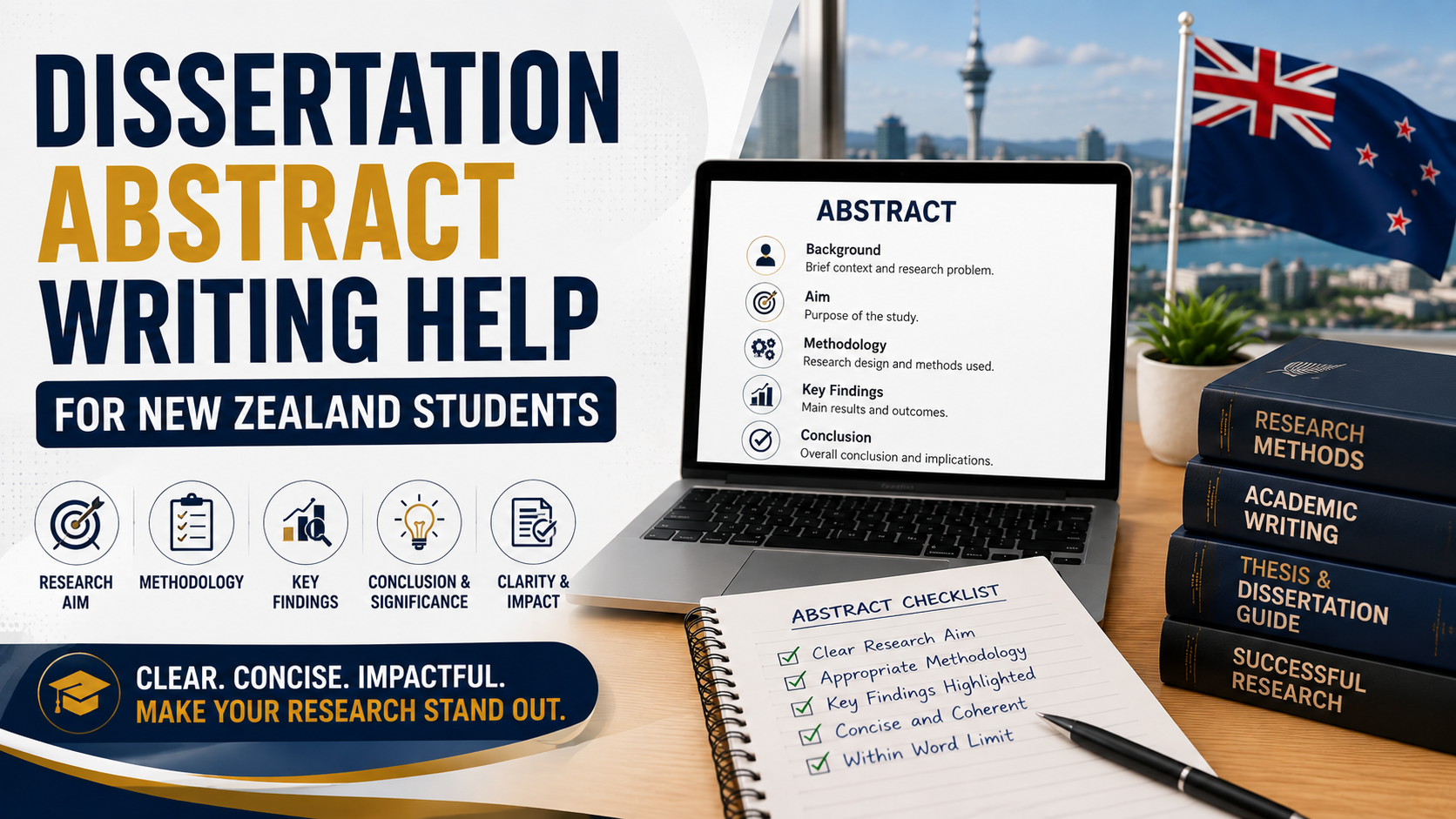
Dissertation abstract writing help for New Zealand students can provide support with structure, clarity, academic language, concision and consistency while ensuring that the student's actual research, findings and conclusions remain their own.
Victoria University of Wellington explains that abstracts give readers an overall idea of the research and should be clear, succinct and able to stand alone without requiring the reader to read the entire thesis.
What Is a Dissertation Abstract?
A dissertation abstract is a concise summary of a research project.
It usually gives readers information about:
The research problem
The purpose or aim of the study
The research methodology
The main findings
The conclusion or significance of the research
The abstract appears near the beginning of a dissertation or thesis, but it is often easiest to write or finalise it after the main research has been completed.
Victoria University of Wellington describes the abstract as one of the standard parts of a thesis, while also noting that thesis structures can differ depending on the discipline and research project.
Why Is the Dissertation Abstract Important?
The abstract may be the first substantial section a reader encounters.
A well-written abstract allows readers to quickly understand:
What was studied → Why it was studied → How it was studied → What was found → What it means
A weak abstract can make a strong dissertation appear less focused.
Common problems include:
Trying to include too much background
Omitting the research purpose
Describing the methodology vaguely
Failing to mention the main findings
Making claims that are not supported by the dissertation
Repeating the introduction
Using unnecessarily complicated language
Exceeding the required word count
For postgraduate students, improving the abstract can therefore be an important final stage of dissertation preparation.
What Should a Dissertation Abstract Include?
There is no single universal abstract structure for every discipline.
However, a typical research abstract includes five core components.
1. Research Context or Problem
Briefly introduce the issue being investigated.
For example:
The increasing use of artificial intelligence in higher education has created new challenges for universities seeking to balance technological innovation with academic integrity.
The background should be concise.
An abstract does not have space for a complete literature review.
2. Research Aim
Explain what the study intended to investigate.
For example:
This study examines how university students perceive the use of generative artificial intelligence in academic writing.
The aim should be specific enough for the reader to understand the scope of the research.
3. Methodology
Briefly explain how the research was conducted.
Depending on the study, this could include:
Quantitative surveys
Qualitative interviews
Case studies
Experiments
Secondary data analysis
Systematic reviews
Mixed-methods research
Ethnographic research
For example:
A mixed-methods approach was used, combining an online survey of 240 students with semi-structured interviews involving 15 participants.
The methodology section should provide enough information to establish how the findings were produced without reproducing the complete methodology chapter.
4. Key Findings
The findings are one of the most important parts of the abstract.
Students sometimes make the mistake of saying:
The results are discussed in this dissertation.
That does not actually tell the reader what was discovered.
Instead, identify the major finding.
For example:
The findings indicate that students generally viewed AI tools as useful for brainstorming and language support but expressed concerns about reliability, assessment fairness and inappropriate use.
The abstract should accurately represent the actual findings.
5. Conclusion or Significance
End by explaining the main conclusion or significance of the research.
For example:
The findings suggest that universities may need clearer guidance distinguishing acceptable AI-assisted learning from practices that compromise academic integrity.
The conclusion should follow logically from the research findings.
A Simple Dissertation Abstract Formula
Students can use the following framework as a starting point:
Problem → Aim → Method → Findings → Conclusion
For example:
Problem: Online learning has changed how university students engage with academic resources.
Aim: This study investigates the factors associated with student engagement in online learning.
Method: A mixed-methods design was used, combining survey data with semi-structured interviews.
Findings: The findings indicate that flexibility, instructor communication and access to learning resources were important influences on engagement.
Conclusion: The study suggests that institutions can improve online engagement by combining flexible learning arrangements with effective academic support.
This is a framework rather than a template that should be copied directly.
The actual abstract must reflect the student's own research.
How Long Should a Dissertation Abstract Be?
The required length depends on the university, qualification, faculty and programme.
For example, the University of Auckland's current guidance for sub-doctoral research components states that a thesis abstract should be no more than 350 words, while also advising students to check department-specific requirements.
The University of Auckland's doctoral thesis policy likewise specifies an abstract of no more than 350 words, summarising the aim, methods, findings and conclusions of the doctoral research.
However, students should not assume that 350 words is a universal New Zealand requirement.
Programme-specific requirements can differ.
For example, the University of Auckland's Law Faculty guidance for certain dissertations specifies an abstract range of 250–350 words.
Therefore, before finalising an abstract, check:
University requirements
Faculty requirements
Department guidelines
Programme handbook
Dissertation instructions
Supervisor guidance
Dissertation Abstract Writing for Master's Students
Master's dissertations usually have a more focused research scope than doctoral theses, but the abstract still needs to communicate the complete research project.
A Master's abstract should generally allow the reader to identify:
The research problem
Research aim
Methodology
Main findings
Main conclusion
Avoid trying to summarise every chapter.
A concise abstract is usually more effective than one containing unnecessary background information.
Dissertation Abstract Writing for PhD Students
PhD abstracts can be particularly challenging because doctoral research may involve:
Multiple research questions
Complex methodologies
Several datasets
Multiple experiments
Interdisciplinary research
Published research papers
Significant theoretical contributions
The challenge is deciding which findings and contributions are most important.
The University of Auckland permits certain doctoral theses to incorporate published or unpublished research papers as chapters, with appropriate introductory and concluding material. This means that some doctoral thesis structures can differ substantially from a conventional chapter-by-chapter dissertation.
The abstract should therefore summarise the overall doctoral research project, rather than simply describing one chapter or publication.
Dissertation Abstract Help for International Students in New Zealand
International students may face additional challenges when writing an abstract in academic English.
The research itself may be strong, but the abstract can become difficult to read because of:
Long sentences
Unnecessary repetition
Literal translation
Overly complex vocabulary
Weak transitions
Unclear research aims
Inconsistent terminology
Unclear descriptions of methodology
Professional language editing can help improve these issues while preserving the student's intended meaning.
The University of Auckland notes that students remain responsible for their research, writing and submission, while supervisors provide academic guidance and feedback.
Common Dissertation Abstract Mistakes
1. Writing a Mini Literature Review
An abstract does not need a long discussion of previous studies.
The reader needs enough context to understand the research problem, not a detailed review of the literature.
2. Including Too Much Background
Students sometimes spend half the abstract explaining why a topic is important.
This leaves insufficient space for methodology and findings.
Keep background focused.
3. Omitting the Findings
One of the most serious abstract problems is describing the research without saying what it found.
For example:
This study investigates the experiences of international students.
The reader still does not know what the study discovered.
4. Using Vague Statements
Statements such as:
Interesting results were found.
are not informative.
Instead, briefly state the important result.
5. Introducing Information Not Found in the Dissertation
The abstract should accurately represent the research.
Do not introduce:
New findings
New arguments
New data
New conclusions
Unsupported claims
6. Using Excessive Technical Language
The abstract should be appropriate for the intended academic audience but should remain understandable.
Where technical terminology is necessary, use it accurately and consistently.
7. Exceeding the Word Limit
An abstract that exceeds the required length may create unnecessary problems at submission.
University and programme-specific requirements should always take priority.
Should You Include References in a Dissertation Abstract?
Generally, abstracts are designed to summarise the research itself rather than provide a detailed literature discussion.
Victoria University of Wellington advises that abstracts usually do not need references cited within the text, although it notes that exceptions can exist.
Therefore, students should follow their discipline and programme requirements rather than assuming that every abstract must or must not contain citations.
Should an Abstract Include Tables or Figures?
For a conventional dissertation abstract, tables and figures are generally unnecessary.
The purpose of an abstract is to provide a concise textual summary.
Specific formats may have different requirements, particularly for conference abstracts or discipline-specific research outputs.
Students should therefore distinguish between:
Dissertation thesis abstracts
Journal article abstracts
Conference abstracts
Research proposal abstracts
These can have different formatting rules.
Dissertation Abstract vs Executive Summary
These terms are sometimes confused.
Abstract
A concise summary of the research project, typically including the aim, methods, findings and conclusion.
Executive Summary
A broader summary often used in professional, business or policy documents. It may contain recommendations, implications and key information for decision-makers.
A dissertation normally requires an abstract rather than an executive summary unless the programme specifically asks for one.
How Professional Abstract Editing Can Help
A professional editing service can review an existing abstract for:
Structure
Clear research purpose
Logical progression
Appropriate balance between sections
Language
Grammar
Spelling
Sentence structure
Academic tone
Concision
Content Alignment
Abstract matches the dissertation
Findings accurately reflect the results
Conclusion follows from findings
Research aim is represented accurately
Consistency
Terminology matches the dissertation
Methodology description is accurate
Research questions are represented consistently
Word Count
Unnecessary wording removed
Repetition reduced
Abstract kept within the applicable requirement
The purpose is to improve the student's existing work rather than create research that the student has not conducted.
Dissertation Abstract Writing vs Proofreading
These services can involve different levels of support.
Abstract Writing Support
May involve reviewing:
Structure
Organisation
Concision
Research aim
Methodology description
Findings summary
Conclusion
Copy-Editing
Focuses more closely on:
Grammar
Spelling
Punctuation
Sentence construction
Style
Wordiness
Proofreading
Usually focuses on final minor:
Typographical errors
Grammar issues
Formatting inconsistencies
Spelling mistakes
The University of Otago distinguishes editing, copy-editing and proofreading in its thesis and dissertation guidelines. It defines copy-editing as improving style, grammar, spelling and punctuation, while proofreading focuses on minor text and formatting errors in a final or near-final draft.
Academic Integrity and Dissertation Abstract Help
Academic integrity is particularly important when seeking external writing or editing assistance.
A legitimate editing service should not:
Fabricate research findings
Invent methodology
Create false data
Invent citations
Change statistical results
Create unsupported conclusions
Misrepresent the student's research
The University of Otago states that research students are responsible for the originality and presentation of their work. Its guidelines distinguish between permissible copy-editing/proofreading and assistance that could compromise academic integrity.
The University of Auckland similarly states that responsibility for research, writing and submission remains with the student.
Students should therefore check their university's current policies before using external writing, editing or proofreading services.
How to Prepare Your Dissertation Abstract for Editing
Before requesting professional editing, prepare:
1. Final or Near-Final Dissertation
The abstract should reflect the completed research as closely as possible.
2. Research Aim
Clearly identify the central purpose of the research.
3. Research Questions
These help ensure that the abstract accurately represents the project.
4. Methodology
Provide the correct research design and methods.
5. Main Findings
Identify the most important findings rather than listing every result.
6. Final Conclusion
Make sure the conclusion reflects the actual research.
7. University Guidelines
Provide the applicable abstract word limit and formatting instructions.
8. Supervisor Feedback
Include any feedback concerning the abstract or overall dissertation.
Dissertation Abstract Checklist
Before submitting your thesis, ask:
Content
Does the abstract clearly identify the research problem?
Is the research aim stated?
Is the methodology briefly explained?
Are the most important findings included?
Is the conclusion clear?
Accuracy
Does the abstract match the dissertation?
Are findings reported accurately?
Are claims supported by the research?
Have no new findings been introduced?
Writing
Is the language concise?
Are unnecessary words removed?
Are sentences easy to follow?
Is terminology consistent?
Formatting
Is the abstract within the required word limit?
Does it follow university formatting requirements?
Are keywords included if required?
Final Review
Has the abstract been checked against the final dissertation?
Has supervisor feedback been addressed?
Has the applicable university policy been checked?
Final Thoughts
A dissertation abstract may be only a few hundred words, but it needs to represent an entire research project.
The strongest abstracts answer five essential questions:
What problem was investigated?
What was the research trying to discover?
How was the research conducted?
What were the main findings?
What is the main conclusion?
For New Zealand Master's and PhD students, dissertation abstract writing help can be particularly useful when an otherwise strong thesis has an abstract that is too long, unclear, repetitive or poorly aligned with the final research.
Professional editing can help make an existing abstract more concise, coherent and academically polished.
However, the abstract should always remain an accurate representation of the student's own research.
Before submitting, students should check their university and programme requirements, particularly the applicable word limit and rules concerning third-party editing.
A strong abstract does not attempt to tell the reader everything. It gives the reader just enough accurate information to understand the research, its findings and its significance.
Frequently Asked Questions
Everything you need to know about our services
Related Posts

Dissertation Chapter 1 Writing Help in New Zealand

Dissertation Proofreading for Massey University Postgraduate Students
