Dissertation Results Chapter Editing for New Zealand Universities
Introduction
Writing the results chapter is one of the most important stages of completing a dissertation or thesis. After months of research, data collection and analysis, students need to present their findings in a clear, organised and academically appropriate way.
For postgraduate students in New Zealand, the results chapter may include statistical findings, tables, graphs, interview themes, observations, experiments or other forms of analysed evidence. The exact format depends on the discipline, research methodology and university requirements.
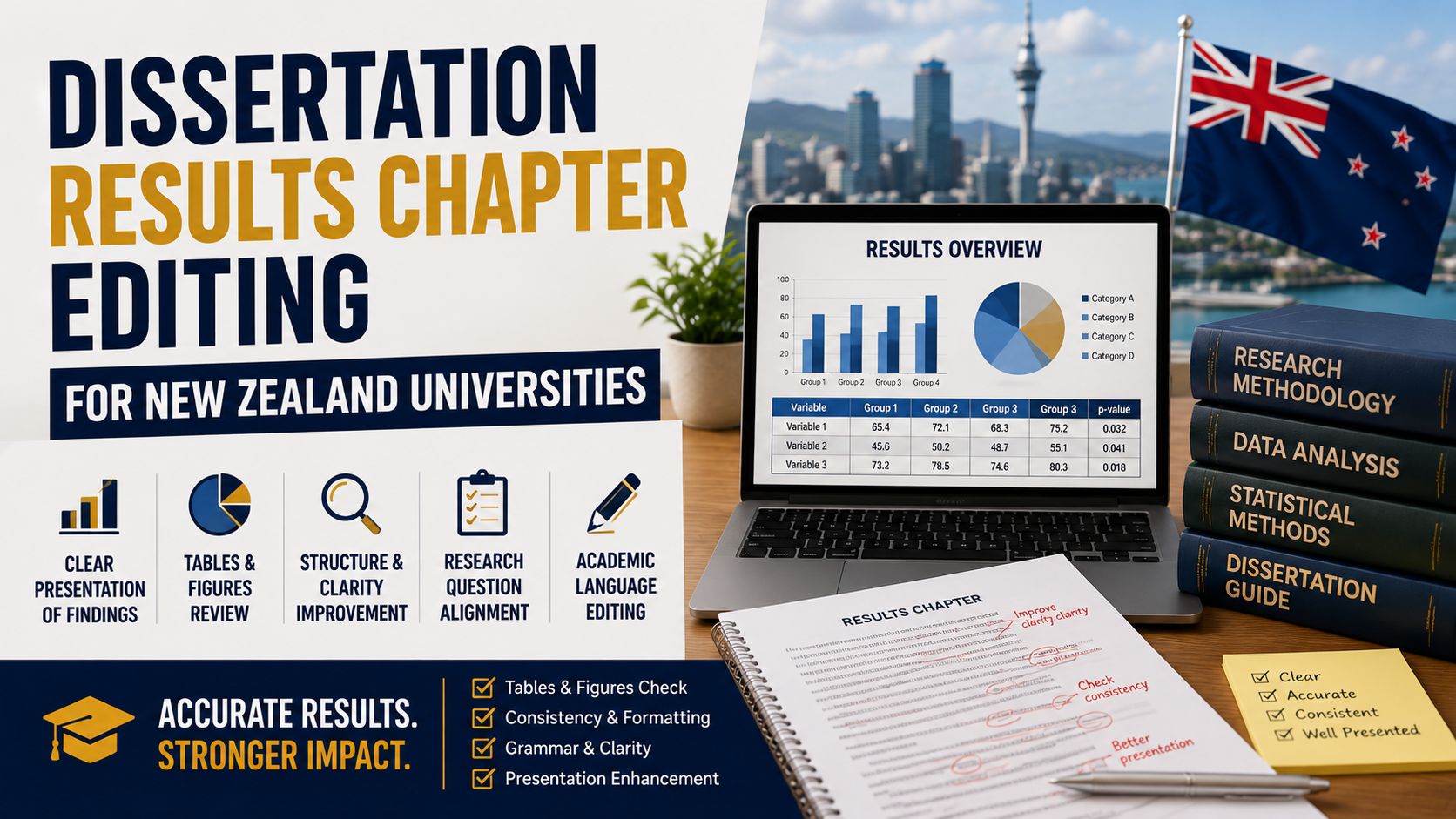
A dissertation results chapter editing service for New Zealand universities can help students improve the clarity, structure, academic language and presentation of an existing results chapter while keeping the student's original research and findings intact.
Professional editing should not change, invent or manipulate research results. Instead, the purpose is to help ensure that the student's findings are communicated accurately and consistently.
What Is a Dissertation Results Chapter?
The results chapter presents the outcomes of the research.
Victoria University of Wellington describes the results section as the part of a thesis where researchers describe the data gathered and the outcomes of their analysis. It may include graphs, tables, charts, measurements, observations or qualitative material such as interview excerpts.
The results chapter generally answers:
What did the research find?
What patterns appeared in the data?
What statistical results were obtained?
What themes emerged from qualitative data?
How do the findings relate to the research questions?
Which results are most important for the reader?
The chapter should present the evidence clearly without turning every result into an extended interpretation.
Why Does Results Chapter Editing Matter?
A results chapter can become difficult to manage because it often contains large amounts of information.
Students may have:
Hundreds of survey responses
Statistical output
Interview transcripts
Coding tables
Experimental measurements
Graphs and figures
Multiple datasets
Qualitative themes
Numerous research questions
The challenge is deciding what the reader actually needs to see.
Editing can help identify problems such as:
Repetitive explanations
Unclear headings
Poor transitions
Inconsistent terminology
Confusing figure references
Weak descriptions of tables
Grammar problems
Inconsistent tense
Formatting inconsistencies
Findings that are difficult to connect to research questions
The objective is to make the student's existing findings easier to understand.
What Does Results Chapter Editing Include?
A professional editing service may review several aspects of the chapter.
1. Chapter Structure
The results chapter should have a logical progression.
A possible structure could be:
Introduction
Participant or sample overview
Data preparation
Results for Research Question 1
Results for Research Question 2
Results for Research Question 3
Key findings summary
However, this is not a universal structure.
Victoria University of Wellington notes that thesis structures can differ and recommends discussing alternative structures with a supervisor where appropriate.
The appropriate organisation depends on the research design and discipline.
2. Academic Language Editing
Results chapters need precise language.
Editing may address:
Grammar
Spelling
Punctuation
Sentence structure
Academic tone
Wordiness
Repetition
Unclear terminology
Inconsistent tense
Awkward phrasing
For example:
Before
The results that were obtained from the survey showed that there was a very significant difference between the two groups in terms of their responses.
After
The survey results showed a significant difference between the two groups.
The second version communicates the same idea more directly.
3. Table and Figure Presentation
Tables and figures can make complicated results easier to understand.
However, they need to be presented carefully.
An editor can check whether:
Tables are numbered consistently
Figures have appropriate titles
Tables and figures are referenced in the text
Terminology is consistent
Captions are clear
Results are not unnecessarily repeated
Formatting follows the required style
Students should still verify the technical accuracy of their statistical tables and figures.
An editor should not alter numerical findings simply to make them appear more favourable.
4. Connecting Findings to Research Questions
A strong results chapter should make it easy for readers to identify which findings address which research questions.
For example:
Research Question 1
What factors influence student engagement with online learning?
Results
The survey identified three major factors:
Course flexibility
Instructor communication
Access to learning resources
This structure helps the reader follow the relationship between the research question and the evidence.
An editor can identify areas where that relationship is unclear.
5. Improving Results Descriptions
A table should generally be introduced and explained in the surrounding text.
Instead of simply inserting:
Table 4.2: Survey Results
the text can guide the reader:
Table 4.2 presents the distribution of responses across the three study groups. The highest proportion of respondents selected...
The purpose is to help readers understand why the table matters.
6. Improving Statistical Reporting
Quantitative dissertations often contain statistical terminology and numerical results.
Depending on the discipline and methodology, the chapter may include:
Descriptive statistics
Means
Medians
Standard deviations
Frequencies
Percentages
Correlations
Regression results
t-tests
ANOVA
Confidence intervals
Effect sizes
p-values
Editing can improve how these findings are described in prose.
However, statistical interpretation should remain grounded in the student's actual analysis.
An editor should never fabricate statistical results or change findings to create a desired conclusion.
7. Editing Qualitative Results
Qualitative dissertations may present findings differently.
A results or findings chapter may include:
Interview themes
Participant quotations
Coding categories
Observational findings
Narrative evidence
Case-study findings
Thematic analysis
Editing can help ensure that themes are clearly labelled and that quotations are introduced appropriately.
For example:
Theme: Academic Workload
Participants frequently described workload as a significant challenge. One participant explained that managing multiple assessment deadlines created difficulties with maintaining consistent study routines.
The quotation or evidence should support the theme rather than simply appear without context.
Results Chapter vs Discussion Chapter
One of the most important distinctions students need to understand is the difference between reporting results and interpreting results.
Results Chapter
The results chapter primarily presents what the research found.
It may explain:
What the data showed
Which patterns appeared
Which themes emerged
Which statistical outcomes were obtained
Discussion Chapter
The discussion interprets what those findings mean.
Victoria University of Wellington explains that the discussion chapter interprets results, compares them with previous studies, evaluates their importance and considers limitations and future research.
A simple way to remember the difference is:
Results = What did you find?
Discussion = What do those findings mean?
The distinction can vary between disciplines, however. Some thesis structures integrate results and discussion rather than treating them as completely separate chapters.
Common Results Chapter Problems
Problem 1: Reporting Everything
Researchers often have more data than they can reasonably include.
A dissertation does not necessarily need to present every piece of collected data in the main chapter.
The results chapter should prioritise evidence relevant to the research questions and objectives.
Victoria University of Wellington specifically advises students to make decisions about what data to present by considering their research questions or aims.
Problem 2: Repeating Tables
A student may present a table and then repeat every number from that table in a paragraph.
This can make the chapter unnecessarily long.
Instead, the accompanying text can highlight the most important patterns.
Problem 3: Overinterpreting Findings
A results chapter may become confusing when students immediately explain why a result occurred or compare it extensively with previous studies.
Those discussions may belong in the discussion chapter, depending on the discipline and thesis structure.
Problem 4: Weak Section Headings
Generic headings such as:
Results
Analysis
Findings
may not always provide enough information.
More specific headings can help readers understand the organisation of the chapter.
For example:
Participant Characteristics
Online Learning Engagement
Factors Influencing Student Participation
Results for Research Question 2
Results Chapter Editing for NZ University Students
New Zealand universities do not necessarily require identical dissertation structures.
The University of Auckland states that research-component requirements should be read alongside the relevant programme regulations and that the applicable regulations take precedence over general guidance.
Victoria University of Wellington similarly explains that thesis structures can differ and that students should discuss alternative structures with their supervisors when appropriate.
This means students should not rely on a generic online results-chapter template as though it were a universal New Zealand requirement.
Instead, check:
University regulations
Faculty guidelines
Programme requirements
Dissertation handbook
Supervisor instructions
Referencing requirements
Methodology conventions
Results Chapter Editing for Master's Students
Master's dissertations often have a more focused research scope than doctoral theses, but expectations still vary by programme.
Editing can be useful when students need to improve:
Chapter organisation
Academic language
Results presentation
Table and figure references
Statistical descriptions
Qualitative theme presentation
Consistency with research questions
Overall readability
The editor should work with the student's existing research rather than replacing the student's analysis.
Results Chapter Editing for PhD Students
PhD results chapters can be particularly complex because doctoral research may involve:
Multiple research questions
Several datasets
Multiple experiments
Longitudinal studies
Mixed-methods research
Multiple analytical techniques
Publications incorporated into the thesis
The University of Auckland allows certain doctoral theses to incorporate published or unpublished research papers as chapters under applicable rules, demonstrating why thesis structures can vary substantially between doctoral projects.
For doctoral students, editing therefore needs to account for the specific thesis structure rather than applying a generic chapter template.
Results Chapter Editing for International Students
International students studying at New Zealand universities may face additional challenges with academic English and research presentation.
Common difficulties include:
Describing statistical findings in English
Explaining qualitative themes
Using discipline-specific terminology
Writing concise academic sentences
Maintaining consistent tense
Describing tables and figures
Understanding the distinction between findings and interpretation
Language editing can improve readability while preserving the student's research voice.
What a Professional Results Chapter Editor Should Check
A comprehensive editing review can examine the chapter at several levels.
Language
Grammar
Spelling
Punctuation
Sentence clarity
Academic expression
Structure
Section order
Headings
Transitions
Logical progression
Data Presentation
Table references
Figure references
Captions
Consistency
Explanatory text
Research Alignment
Research questions
Research objectives
Methodology
Findings
Chapter conclusions
Consistency
Terminology
Statistical notation
Tenses
Abbreviations
Formatting
Dissertation Results Chapter Editing vs Proofreading
These terms are sometimes used interchangeably, but they can describe different levels of support.
Editing
Editing may involve reviewing:
Structure
Clarity
Coherence
Academic expression
Organisation
Transitions
Presentation
Copy-Editing
Copy-editing focuses more closely on:
Grammar
Spelling
Punctuation
Style
Wordiness
Repetition
Sentence construction
Proofreading
Proofreading is generally the final review for minor language and formatting errors.
The University of Otago explicitly distinguishes editing, copy-editing and proofreading in its guidelines for theses and dissertations.
Academic Integrity and Results Chapter Editing
Academic integrity is particularly important when working with research findings.
A legitimate editing service should never:
Invent data
Change numerical results
Fabricate statistical tests
Create fake participants
Alter interview quotations
Manipulate findings
Invent citations
Create evidence that does not exist
The student's research and intellectual contribution must remain their own.
The University of Otago states that research students are responsible for the originality and presentation of their work. It permits third-party copy-editing and proofreading subject to its guidelines and recommends that students discuss the use of such services with their primary supervisor.
The University of Auckland likewise provides specific guidance on third-party editing and proofreading and emphasises candidates' responsibility for maintaining the originality and academic integrity of their work.
Students should therefore check their university's current rules before engaging an external editor.
How to Prepare Your Results Chapter for Editing
Before submitting a chapter for editing, prepare:
1. Current Results Draft
Provide the most complete version available.
2. Research Questions
These help the editor understand the purpose of each section.
3. Research Objectives
Objectives provide additional context for evaluating chapter organisation.
4. Methodology
The editor should understand how the data were collected and analysed.
5. Supervisor Feedback
Include relevant comments or revision requests.
6. University Guidelines
Provide the applicable formatting and thesis requirements.
7. Referencing Style
Specify whether the dissertation uses APA, Harvard, Chicago, Vancouver or another required style.
8. Submission Deadline
A clear deadline helps establish an appropriate editing schedule.
Results Chapter Editing Checklist
Before submitting your dissertation, ask:
Research Alignment
Does each major section relate to a research question?
Are the research objectives addressed?
Are important findings clearly presented?
Data Presentation
Are tables numbered correctly?
Are figures numbered correctly?
Are tables and figures referenced in the text?
Are captions consistent?
Are units and terminology consistent?
Writing
Are sentences concise?
Is the terminology consistent?
Is unnecessary repetition removed?
Are tense and grammatical structures consistent?
Results vs Discussion
Are findings clearly distinguished from interpretation?
Have excessive explanations been moved to the appropriate section?
Does the chapter follow the conventions of the discipline?
Formatting
Does the chapter follow university requirements?
Are headings consistent?
Are tables and figures formatted correctly?
Are appendices referenced appropriately?
Final Accuracy
Have all numerical values been checked?
Do tables match the text?
Do figures match the reported findings?
Are statistical values accurate?
Have quotations been checked against the original data?
Final Thoughts
The results chapter is where months of research are transformed into a clear presentation of evidence.
A strong chapter should allow the reader to understand:
What was investigated → What data were analysed → What was found → Which findings answer the research questions
For New Zealand university students, professional results chapter editing can provide an additional review of academic language, organisation, coherence, tables, figures and consistency.
The most important principle is that editing should clarify the student's research rather than change the research itself.
Before using an external service, students should check their university's current academic-integrity and third-party editing requirements and, where appropriate, discuss the service with their supervisor.
A well-edited results chapter does not make the research stronger by changing the findings. It makes the student's existing research clearer, more precise and easier for examiners and readers to follow.
Frequently Asked Questions
Everything you need to know about our services
Related Posts

Dissertation Formatting Help for Irish Universities

Dissertation Proofreading Checklist Before Submission
