Dissertation Discussion Chapter Editing Help in New Zealand
Introduction
The discussion chapter is where a dissertation moves beyond simply presenting research findings and explains what those findings mean.
For many Master's and PhD students in New Zealand, writing the discussion chapter can be one of the most challenging parts of the dissertation. Students need to connect their findings with previous research, address their research questions, explain the significance of the results, acknowledge limitations and demonstrate the contribution of their study.
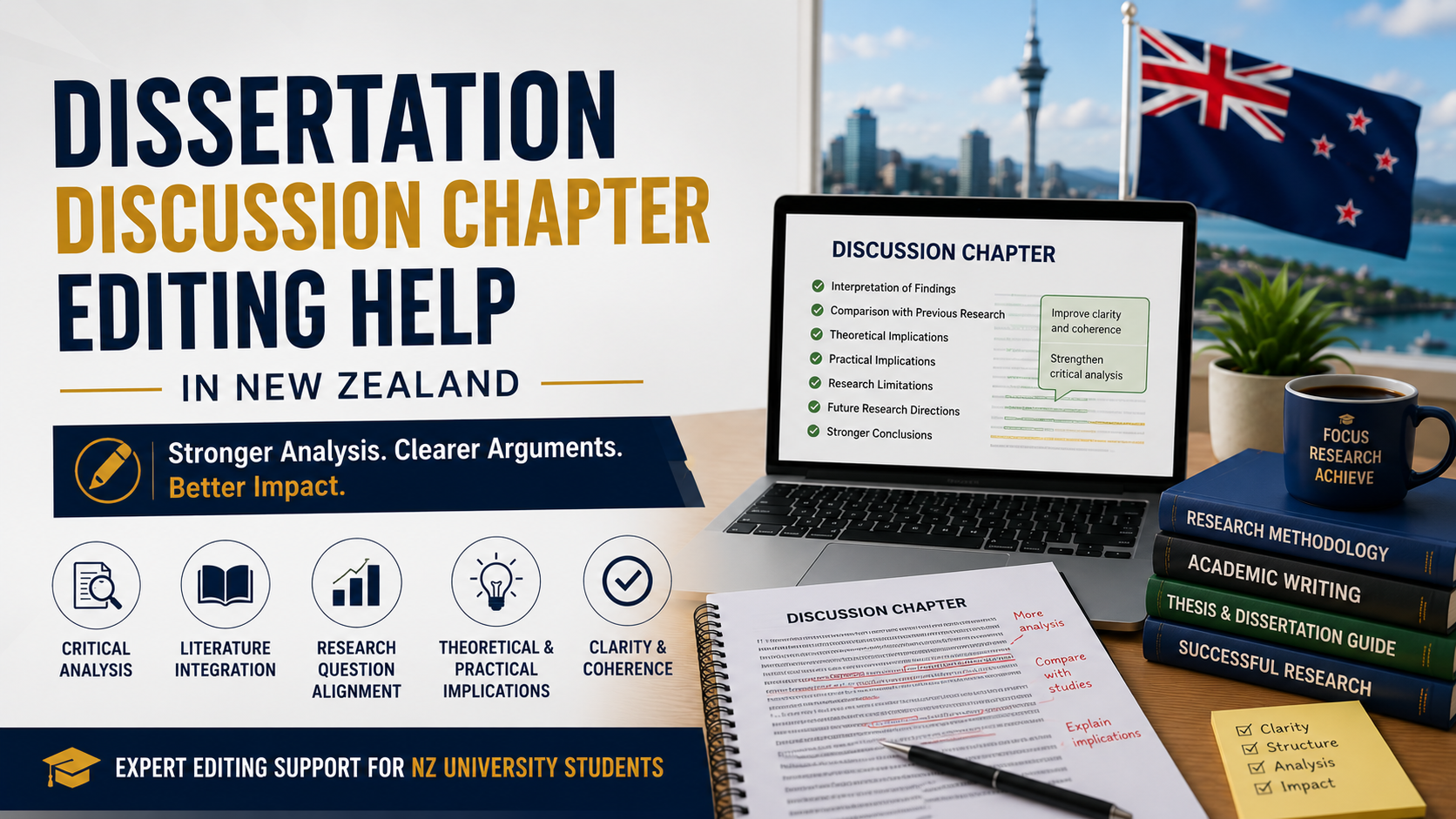
A dissertation discussion chapter editing service in New Zealand can help students improve the organisation, academic language, clarity, coherence and presentation of an existing discussion chapter while preserving the student's original interpretation and research contribution.
The University of Auckland and Victoria University of Wellington both emphasise that postgraduate research components can vary by programme and discipline. Students should therefore follow their own university, faculty and supervisor requirements rather than relying on a generic discussion-chapter template.
What Is a Dissertation Discussion Chapter?
The discussion chapter interprets the findings presented earlier in the dissertation.
Victoria University of Wellington explains that a standard discussion chapter typically:
Interprets what the results mean
Compares results with previous studies
Evaluates the importance of the research
Highlights research limitations
Identifies possible directions for future research
The university also notes that some disciplines integrate discussion with results or findings rather than using a completely separate discussion chapter.
In simple terms:
Results chapter = What did you find?
Discussion chapter = What do those findings mean?
The exact distinction can vary according to discipline and research design.
Why Is the Discussion Chapter Important?
A dissertation is not simply a collection of research findings.
The discussion demonstrates how those findings contribute to the broader academic conversation.
A strong discussion chapter can help the reader understand:
Why the findings matter
Whether they support previous research
Where they differ from earlier studies
What the findings contribute
What limitations affect interpretation
What the findings could mean for theory or practice
What future research could investigate
This makes the discussion an important part of demonstrating the significance of the research.
What Does Dissertation Discussion Chapter Editing Include?
Professional editing can focus on how effectively an existing discussion chapter communicates the student's own research.
Depending on the agreed scope, editing may address the following areas.
1. Discussion Chapter Structure
A discussion chapter can become difficult to follow when ideas appear in an inconsistent order.
A possible structure is:
Introduction to the discussion
Summary of major findings
Interpretation of findings
Comparison with previous research
Theoretical implications
Practical implications
Research limitations
Recommendations for future research
Chapter conclusion
This is only a general framework.
Victoria University of Wellington explicitly notes that thesis structures can differ and recommends discussing alternative structures with supervisors when a student's research does not fit a standard structure.
An editor should therefore work with the student's required structure rather than forcing every dissertation into the same template.
2. Improving Interpretation of Findings
One of the biggest weaknesses in discussion chapters is simply repeating the results.
For example:
The results showed that 72% of participants preferred online learning.
That statement reports a finding.
The discussion needs to move towards interpretation:
The preference for online learning may indicate that flexibility is an important consideration for students managing study alongside employment or other commitments.
The interpretation should be supported by the student's evidence and relevant literature.
An editor can help identify places where the chapter merely repeats results and where the relationship between findings and interpretation could be made clearer.
3. Connecting Findings With Previous Research
The discussion chapter should generally connect the student's findings with the existing literature.
For example:
The present study's finding that flexible learning arrangements were associated with higher student engagement is consistent with previous research identifying flexibility as an important factor in online learning participation.
The discussion can then explore:
Where findings agree with previous research
Where findings differ
Why differences might exist
Whether the findings extend previous research
Whether the findings challenge existing assumptions
This is often more valuable than simply listing studies.
4. Strengthening Critical Analysis
A discussion chapter should not simply say:
Smith (2023) found X. Jones (2024) found Y. Brown (2025) found Z.
That approach can become descriptive.
A more analytical discussion asks:
Why did the studies produce different findings?
Are the methodologies comparable?
Do the findings apply to different populations?
Are there theoretical differences?
Could contextual factors explain the results?
How does the current research contribute something different?
Editing can help identify sections where the writing is descriptive and suggest places where the student's own analysis could be expressed more clearly.
The actual interpretation and intellectual contribution must remain the student's own.
5. Linking the Discussion to Research Questions
A strong discussion should return to the research questions.
For example:
Research Question
How does remote working influence employee wellbeing?
Discussion
The findings suggest that remote working can improve perceived flexibility but may also contribute to social isolation. These results address the first research question by demonstrating that the relationship between remote working and wellbeing is multidimensional rather than uniformly positive.
This approach makes the connection between:
Research Question → Finding → Interpretation → Literature → Contribution
clear to the reader.
6. Discussing Unexpected Findings
Research does not always produce the expected outcome.
Unexpected findings can actually provide valuable opportunities for discussion.
Students may need to explain:
Why the result was unexpected
Whether previous research reported similar outcomes
Whether methodological factors could have influenced it
Whether the sample or research context was different
Whether another theoretical explanation is possible
The discussion should not attempt to make unexpected results appear more favourable.
Instead, the student should provide a reasonable evidence-based interpretation.
7. Editing the Limitations Section
Most research has limitations.
These may involve:
Sample size
Sampling method
Research setting
Data collection period
Measurement instruments
Access to participants
Methodological constraints
Potential sources of bias
Generalisability
A useful limitations section should be specific rather than simply stating:
This study had several limitations.
The student should explain what the limitation was and why it matters.
For example:
The study relied on a convenience sample from a single institution, which may limit the extent to which the findings can be generalised to students at other universities.
An editor can help improve clarity and avoid repetitive language while preserving the student's actual assessment of the research limitations.
8. Improving Implications
Depending on the discipline, a discussion chapter may address theoretical, practical, professional or policy implications.
Theoretical implications
How do the findings contribute to existing theories or concepts?
Practical implications
How could organisations, professionals or practitioners use the findings?
Policy implications
Could the research inform institutional or public policy?
Research implications
What do the findings suggest for future researchers?
Not every dissertation requires all four categories.
The appropriate approach depends on the research field and programme requirements.
Results vs Discussion vs Conclusion
Students sometimes struggle to distinguish these three chapters.
Results
The results chapter presents the evidence produced by the research.
Victoria University of Wellington describes the results section as presenting the data gathered and the outcomes of analysis, including tables, graphs, measurements, observations or qualitative material where appropriate.
Discussion
The discussion interprets the findings and explains their significance.
Conclusion
The conclusion brings the research together and provides a final statement about what the study has established.
A simple framework is:
Results → What happened?
Discussion → What does it mean?
Conclusion → What should the reader take away?
Common Discussion Chapter Problems
Problem 1: Repeating the Results
A discussion chapter should not simply reproduce the results chapter.
Instead, students should explain what the findings mean and why they matter.
Problem 2: Too Much Literature Review
Another common problem is turning the discussion into a second literature review.
The literature should support the interpretation of the student's findings rather than replace the student's own analysis.
Problem 3: Unsupported Claims
Statements such as:
This finding proves that the intervention is effective.
may be too strong unless the research design genuinely supports that conclusion.
More cautious academic language may be appropriate:
These findings provide evidence suggesting that the intervention may improve...
The appropriate level of certainty depends on the methodology and evidence.
Problem 4: Weak Connections Between Findings and Literature
A discussion becomes stronger when the student explains why a finding is consistent or inconsistent with earlier research.
Simply citing another study does not automatically create critical discussion.
Problem 5: Excessive Discussion of Minor Findings
Not every result deserves the same amount of attention.
The discussion should prioritise findings that are directly relevant to the research questions, objectives and contribution of the study.
Problem 6: Generic Limitations
Statements such as:
The study had a small sample.
are incomplete without explaining the implications.
A stronger discussion explains how the sample size affects interpretation or transferability of the findings.
Discussion Chapter Editing for New Zealand University Students
New Zealand universities do not all use identical dissertation structures.
The University of Auckland's guidance states that research components should be read alongside the relevant programme regulations, and that those regulations take precedence where there is a conflict.
Victoria University of Wellington also explains that different theses can have different structures.
Therefore, discussion chapter editing should take account of:
University requirements
Faculty requirements
Programme regulations
Research methodology
Discipline conventions
Supervisor feedback
Thesis structure
Referencing style
Students should provide their editor with the relevant university or programme guidelines where appropriate.
Discussion Chapter Editing for Master's Students
Master's dissertations often have a more focused research question and smaller research scope than doctoral theses.
However, students still need to demonstrate that they can interpret their findings and position their research within existing scholarship.
Editing may focus on:
Clear interpretation
Research-question alignment
Critical comparison with literature
Appropriate academic language
Limitations
Implications
Future research
Overall chapter coherence
The editor should not create new research arguments that the student has not developed.
Discussion Chapter Editing for PhD Students
PhD discussion chapters can be more complex because doctoral research may involve:
Multiple research questions
Several studies
Mixed methodologies
Multiple datasets
Published research papers
Theoretical contributions
Substantial practical implications
For example, the University of Auckland allows certain doctoral theses to incorporate published or unpublished research papers as chapters, with an introductory chapter and concluding discussion required in the relevant format.
The University of Otago also provides guidance for theses incorporating publications and notes that candidates may need to synthesise and discuss findings from those publications.
This makes consistency and synthesis particularly important in some doctoral thesis structures.
Discussion Chapter Editing for International Students
International students may have strong research but struggle to express complex interpretations in academic English.
Common challenges include:
Explaining nuanced findings
Using cautious academic language
Comparing conflicting studies
Expressing cause and effect carefully
Discussing limitations
Connecting theory with findings
Avoiding repetition
Maintaining consistent terminology
Editing can improve the language without replacing the student's academic voice.
What Should a Professional Discussion Chapter Editor Check?
A detailed editing review can consider several layers.
Structure
Logical section order
Clear headings
Transitions
Chapter progression
Interpretation
Findings are interpreted clearly
Important findings receive appropriate attention
Results are not simply repeated
Literature Integration
Relevant studies are connected to findings
Agreements and differences are explained
Claims are appropriately supported
Critical Analysis
Alternative explanations are considered where appropriate
Claims are appropriately qualified
The contribution of the research is clearly expressed
Limitations
Important limitations are identified
Their implications are explained
Claims are not unnecessarily weakened
Implications
Theoretical implications are clear where relevant
Practical implications are realistic
Future research recommendations follow from the findings
Language
Grammar
Spelling
Academic tone
Sentence clarity
Concision
Terminology
Transitions
Dissertation Discussion Editing vs Proofreading
These services are not necessarily identical.
Editing
Editing can involve broader review of:
Structure
Clarity
Coherence
Academic expression
Organisation
Consistency
Copy-Editing
Copy-editing focuses more closely on:
Grammar
Spelling
Punctuation
Sentence construction
Style
Wordiness
Repetition
Proofreading
Proofreading is generally the final review for minor textual and formatting errors.
The University of Otago explicitly distinguishes editing, copy-editing and proofreading in its thesis and dissertation guidelines. It defines editing as guidance concerning substance and structure, while copy-editing and proofreading involve more limited language, style and final-error correction.
Academic Integrity and Discussion Chapter Editing
Academic integrity is particularly important when using external editing support.
A responsible editor should not:
Invent interpretations
Fabricate citations
Create research findings
Change statistical outcomes
Write an undisclosed argument on behalf of the student
Manipulate evidence
Misrepresent the student's contribution
The University of Otago states that research students remain responsible for the originality and presentation of their work. Its guidelines permit third-party copy-editing and proofreading under specified conditions, while stating that third parties cannot provide editing advice or make editorial revisions that could breach academic integrity. Students should discuss the use of copy-editors or proofreaders with their primary supervisor first.
The University of Auckland similarly states that postgraduate candidates remain responsible for maintaining the academic integrity and originality of their work when using third-party or GenAI assistance.
Students should therefore check their institution's current rules before using external support.
How to Prepare Your Discussion Chapter for Editing
Before sending your chapter for editing, prepare the following where relevant:
1. Latest Discussion Draft
Use the most complete version available.
2. Research Questions
These help establish whether the discussion addresses the central research problem.
3. Research Objectives
Objectives provide additional context for evaluating the chapter's organisation.
4. Results or Findings Chapter
Providing the preceding chapter helps the editor understand what is actually being interpreted.
5. Literature Review
This allows the editor to understand the major theoretical and research context.
6. Supervisor Feedback
Include comments that affect the discussion chapter.
7. University Guidelines
Provide the relevant thesis or dissertation requirements.
8. Referencing Style
Specify the required citation system.
Discussion Chapter Editing Checklist
Before submitting your dissertation, check:
Research Alignment
Does the discussion answer the research questions?
Are the research objectives addressed?
Are the major findings interpreted?
Critical Analysis
Are findings compared with previous research?
Are similarities and differences explained?
Are alternative interpretations considered where appropriate?
Academic Argument
Are claims supported by evidence?
Is the level of certainty appropriate?
Are unsupported generalisations avoided?
Limitations
Are significant limitations acknowledged?
Are their implications explained?
Implications
Are theoretical implications discussed where relevant?
Are practical implications realistic?
Do future research recommendations follow from the findings?
Structure
Does each section have a clear purpose?
Are transitions logical?
Is unnecessary repetition removed?
Language
Is academic language clear?
Are sentences concise?
Is terminology consistent?
Are grammar and punctuation accurate?
Final Thoughts
The discussion chapter is where a dissertation demonstrates why its findings matter.
A strong discussion connects:
Research Questions → Findings → Interpretation → Previous Research → Contribution → Implications
For New Zealand Master's and PhD students, professional discussion chapter editing can help improve the clarity, organisation, academic language and coherence of an existing chapter.
However, editing should never replace the student's intellectual contribution.
The University of Auckland states that responsibility for research, writing and submission remains with the student, while supervisors provide academic advice and feedback.
Similarly, the University of Otago makes clear that research students are responsible for the originality and presentation of their work.
The most useful editing therefore focuses on making the student's existing argument clearer—not creating the argument for them.
Before using any external editing service, students should check their university's current academic-integrity requirements and confirm what type of assistance is permitted.
A well-edited discussion chapter should ultimately help the examiner see the connection between the research findings, existing scholarship and the contribution of the student's study.
Frequently Asked Questions
Everything you need to know about our services
Related Posts

AI and Data Science Dissertation Help in Ireland

Why Students Choose Professional Dissertation Editing Services
