Dissertation vs Assignment: What's Different?
Introduction
Many university students use the terms assignment and dissertation interchangeably, but they are very different forms of academic assessment. While both evaluate your understanding of a subject, they differ significantly in purpose, length, research requirements, independence, and assessment criteria.
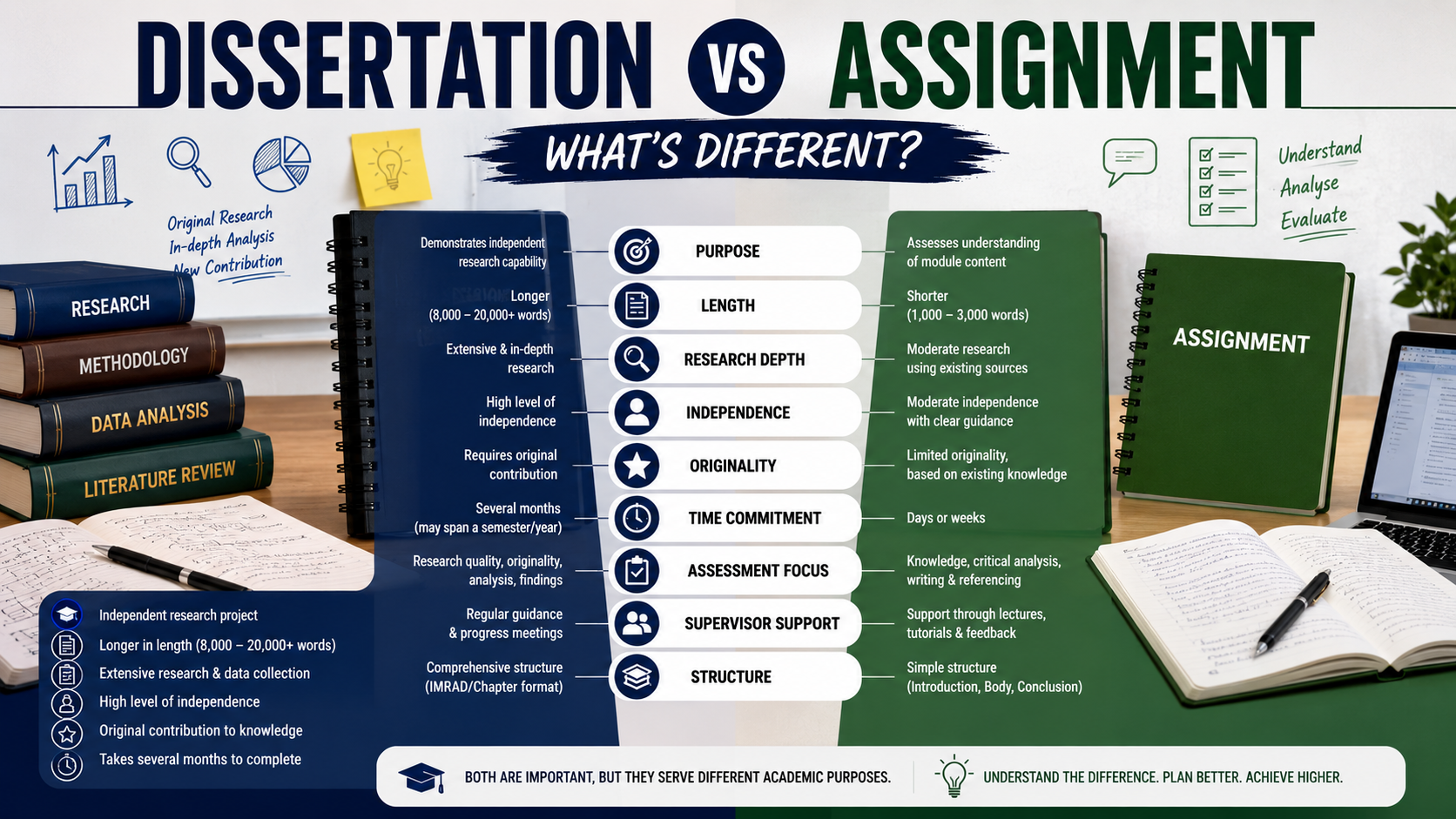
Understanding these differences is essential because the approach that works for a standard assignment is rarely sufficient for a dissertation. Students who know what lecturers expect from each type of assessment are better prepared to manage their workload and achieve higher grades.
In this guide, you'll learn:
What Is an Assignment?
An assignment is an academic task completed during a module or course.
Assignments may include:
Essays
Reports
Case studies
Reflective writing
Literature reviews
Business reports
Presentations
Assignments are designed to assess your understanding of specific learning outcomes within a module.
What Is a Dissertation?
A dissertation is a substantial independent research project completed near the end of an undergraduate or postgraduate programme.
Unlike standard assignments, a dissertation requires students to:
Select or investigate a research topic
Review academic literature
Conduct original research (where required)
Analyse findings
Draw evidence-based conclusions
A dissertation demonstrates a student's ability to conduct independent academic research.
Dissertation vs Assignment: Key Differences
The most important differences include:
Purpose
Length
Research depth
Independence
Assessment criteria
Time required
Let's examine each in detail.
Difference 1: Purpose
Assignment
Assignments assess your understanding of specific module content.
Students demonstrate:
Knowledge
Application
Critical thinking
Dissertation
Dissertations assess your ability to conduct independent research and contribute meaningful academic analysis to a chosen topic.
Difference 2: Length
Assignments are usually much shorter.
Typical assignment lengths include:
1,000 words
2,000 words
3,000 words
Dissertations commonly range from:
8,000 words
10,000 words
15,000 words
20,000 words or more
Requirements vary by university and programme.
Difference 3: Research Requirements
Assignments often require students to research an existing topic using recommended academic sources.
Dissertations require much more extensive research including:
Literature review
Research methodology
Data collection
Data analysis
Interpretation of findings
The research process is significantly more advanced.
Difference 4: Independence
Assignments usually involve guidance from lecturers through lectures, seminars, and module materials.
Dissertations require considerably greater independence.
Students are expected to:
Manage their own research
Organise timelines
Solve research problems
Make independent academic decisions
Supervisors provide guidance rather than direct instruction.
Difference 5: Originality
Assignments primarily assess your ability to engage with existing academic literature.
Dissertations require greater originality.
Originality may involve:
New research
New interpretations
Different perspectives
Application of theory to unexplored situations
Original contribution is a key postgraduate expectation.
Difference 6: Structure
Assignment Structure
A typical assignment includes:
Introduction
Main body
Conclusion
References
Dissertation Structure
Dissertations are more complex and often include:
Title page
Abstract
Table of contents
Introduction
Literature review
Methodology
Results
Discussion
Conclusion
References
Appendices
Each section serves a distinct academic purpose.
Difference 7: Assessment
Assignments commonly assess:
Knowledge
Critical analysis
Structure
Academic writing
Referencing
Dissertations additionally assess:
Research design
Methodology
Data analysis
Originality
Research quality
Independent learning
Assessment criteria are significantly broader.
Difference 8: Time Commitment
Assignments are generally completed over:
One week
Several weeks
Dissertations often require:
Several months
Entire academic semesters
Effective planning becomes essential.
Difference 9: Supervisor Support
Assignments are supported through lectures and tutorials.
Dissertations involve:
Supervisor meetings
Research feedback
Progress reviews
However, students remain responsible for the project.
Difference 10: Academic Skills Required
Assignments develop:
Academic writing
Research
Critical thinking
Dissertations additionally require:
Project management
Independent research
Data analysis
Problem-solving
Academic resilience
These skills prepare students for advanced academic or professional careers.
Comparison Table
Feature | Assignment | Dissertation |
|---|---|---|
Purpose | Assess module learning | Assess independent research |
Length | Usually 1,000–3,000 words | Often 8,000–20,000+ words |
Research | Moderate | Extensive |
Originality | Limited | High |
Supervision | Lecturer guidance | Supervisor support |
Duration | Days or weeks | Several months |
Structure | Simple | Complex |
Assessment | Module criteria | Comprehensive research criteria |
Which Is More Difficult?
Most students find dissertations more challenging because they involve:
Greater independence
Longer deadlines
Extensive research
Research methodology
Data collection
Larger writing projects
However, both require strong academic skills.
Tips for Assignment Success
To improve assignment grades:
Understand the assignment brief.
Conduct quality academic research.
Demonstrate critical analysis.
Structure your work logically.
Reference accurately.
Proofread carefully.
Tips for Dissertation Success
Successful dissertations require:
Early planning
Consistent research
Regular supervisor meetings
Time management
Detailed literature review
Strong methodology
Careful editing
Starting early is one of the biggest predictors of success.
Common Student Mistakes
Students often:
Treat dissertations like longer assignments.
Leave research until the last minute.
Ignore supervisor feedback.
Use insufficient academic sources.
Write without a clear research question.
Understanding the differences helps avoid these mistakes.
Dissertation vs Assignment: Which Is More Important?
Assignments contribute to module grades throughout your programme.
Dissertations often carry significant credit because they demonstrate the highest level of independent academic achievement within the degree.
Both are important, but dissertations typically have greater overall impact on final classifications.
Key Takeaways
Assignments assess module knowledge and academic writing.
Dissertations assess independent research and originality.
Dissertations require much deeper research.
Dissertation writing takes considerably longer.
Strong planning improves both assignment and dissertation quality.
Understanding assessment expectations increases academic success.
Conclusion
Although assignments and dissertations share many academic writing principles, they differ substantially in purpose, scale, and expectations. Assignments test your understanding of module content, whereas dissertations demonstrate your ability to conduct independent academic research and contribute meaningful analysis.
Recognising these differences allows students to adopt the right research strategies, manage their time effectively, and meet university expectations with greater confidence. Whether you're preparing your first assignment or beginning your dissertation, understanding the assessment requirements is the first step towards achieving higher grades.on, understanding the assessment requirements is the first step towards achieving higher grades.
Frequently Asked Questions
Everything you need to know about our services


