Common AI Mistakes That Cost Students Marks (2026 Guide)
Introduction
Artificial intelligence (AI) tools like ChatGPT, Gemini, Claude, Microsoft Copilot, and Grammarly have become popular study companions for university students. They can explain difficult concepts, generate ideas, improve grammar, and help organise assignments.
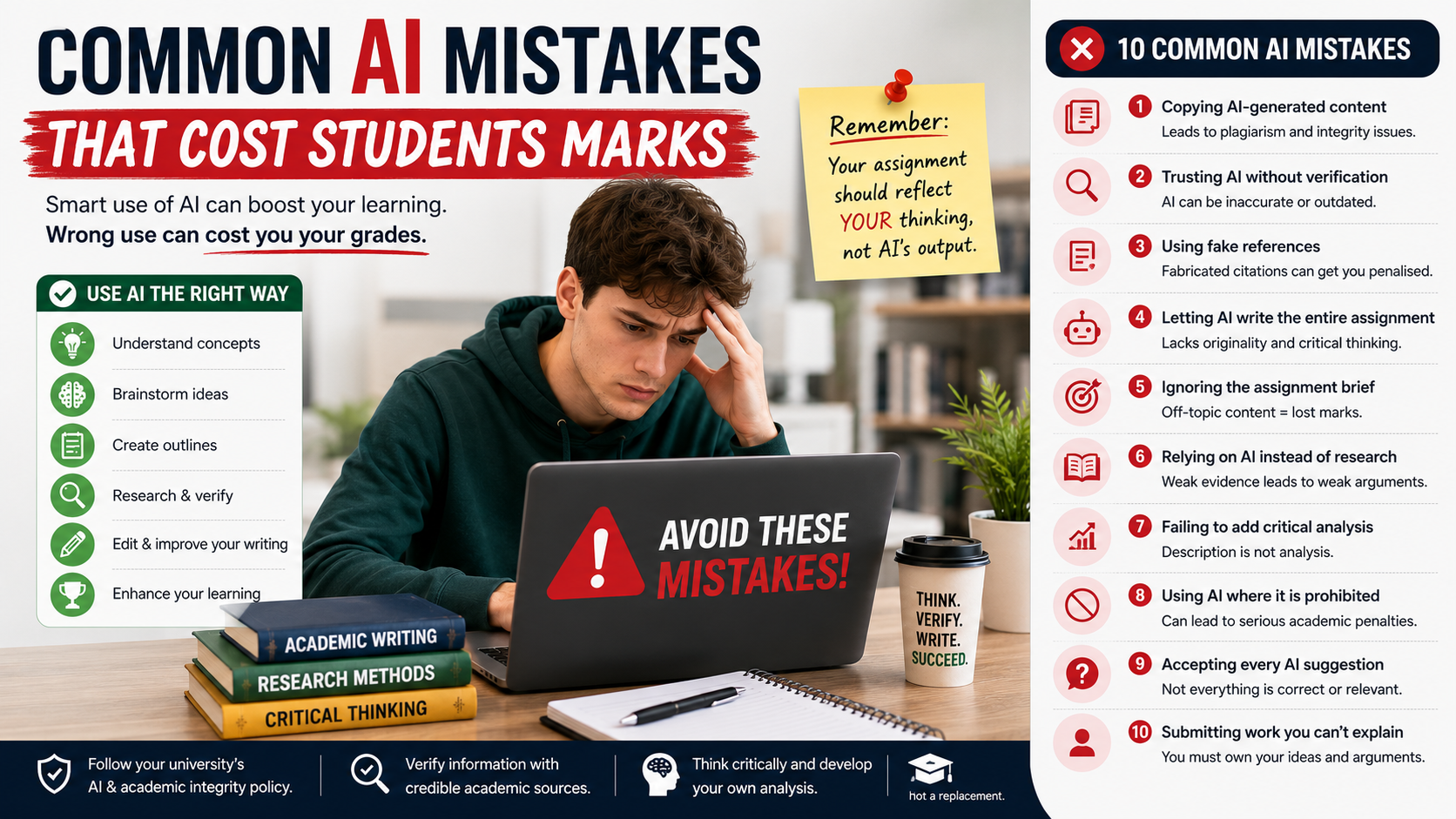
However, using AI incorrectly can lead to lower grades, academic integrity concerns, or even disciplinary action. The issue is often not that students use AI—but that they rely on it in ways that undermine independent learning and fail to meet assessment requirements.
This guide explores the most common AI mistakes students make and explains how to avoid them while using AI responsibly.
Why AI Misuse Can Affect Your Grades
University assignments assess much more than the final piece of writing.
Examiners evaluate your ability to:
Think critically
Conduct independent research
Analyse evidence
Develop original arguments
Apply subject knowledge
Communicate ideas effectively
If AI performs these tasks instead of you, your assignment may no longer demonstrate the learning outcomes required for the assessment.
Mistake 1: Copying AI-Generated Content
One of the biggest mistakes is copying AI-generated text directly into an assignment.
Problems include:
Lack of originality
Generic explanations
Reduced critical analysis
Possible academic integrity concerns
Instead, use AI to understand a topic, then write your own explanation based on your research.
Mistake 2: Trusting AI Without Verification
AI systems can occasionally provide:
Incorrect facts
Outdated information
Fabricated references
Misinterpreted concepts
Always verify:
Statistics
Dates
Quotations
References
Research findings
Use trusted academic sources before including information in your assignment.
Mistake 3: Using Fake References
Some AI tools generate citations that appear genuine but do not actually exist.
Never include a reference unless you have personally checked it using sources such as:
Google Scholar
JSTOR
ScienceDirect
PubMed
IEEE Xplore
SpringerLink
Your university library
Accurate referencing is an essential part of academic writing.
Mistake 4: Letting AI Write the Entire Assignment
AI can generate complete essays within seconds, but submitting them as your own work may breach university academic integrity policies.
Your assignment should demonstrate:
Independent thinking
Critical evaluation
Subject knowledge
Personal understanding
Use AI to support learning—not replace it.
Mistake 5: Ignoring the Assignment Brief
AI may generate content that looks impressive but fails to answer the specific question.
Before writing, make sure you understand:
The assessment task
Learning outcomes
Marking criteria
Required referencing style
Word count
Submission instructions
Always compare AI suggestions with the assignment requirements.
Mistake 6: Relying on AI Instead of Academic Research
AI should never replace:
Peer-reviewed journal articles
Academic books
Government publications
Professional guidelines
Primary research
Strong assignments are supported by credible academic evidence, not AI-generated summaries.
Mistake 7: Failing to Add Critical Analysis
AI often provides descriptive information rather than evaluation.
High-scoring assignments usually include:
Comparison of theories
Evaluation of evidence
Discussion of limitations
Alternative viewpoints
Justified conclusions
Develop your own analysis instead of relying solely on AI responses.
Mistake 8: Using AI Where It Is Prohibited
Some assessments explicitly ban AI tools.
If your lecturer or university states that AI is not permitted for a particular assignment, you should follow those instructions.
Always check:
Assignment brief
Module handbook
Faculty guidance
University AI policy
Mistake 9: Accepting Every AI Suggestion
AI recommendations are not always appropriate.
Before accepting changes:
Check accuracy
Ensure the wording reflects your meaning
Confirm the academic tone is suitable
Remove unnecessary repetition
Critical judgement remains your responsibility.
Mistake 10: Submitting Work You Cannot Explain
If you cannot explain the arguments, evidence, or conclusions in your assignment, you may struggle to answer questions about your work.
The final submission should reflect your own understanding of the topic.
How to Use AI Responsibly
AI can improve your learning when used appropriately.
Good uses include:
Explaining difficult concepts
Brainstorming research ideas
Creating assignment outlines
Generating revision questions
Improving grammar and clarity
Organising study notes
Explaining lecturer feedback
These activities support learning without replacing independent academic work.
Best Practices for Ethical AI Use
1. Write the First Draft Yourself
Use your own research and understanding before asking AI for feedback.
2. Verify Everything
Double-check facts, references, and statistics using credible academic sources.
3. Conduct Independent Research
Read peer-reviewed journal articles, academic books, and official publications rather than relying solely on AI.
4. Follow University Policies
Different universities have different expectations regarding AI use.
Always read:
Academic integrity policy
Assignment instructions
Faculty guidance
Lecturer recommendations
5. Keep Your Own Academic Voice
Use AI to improve clarity and organisation, but ensure the final assignment reflects your own ideas, analysis, and writing style.
Final Thoughts
AI can be an excellent learning tool when used responsibly, but it should never replace the core skills that universities assess. The most common mistakes—such as copying AI-generated text, trusting unverified information, using fabricated references, or relying on AI instead of independent research—can reduce the quality of your work and affect your marks.
The best approach is to treat AI as a study assistant rather than an author. Use it to clarify concepts, brainstorm ideas, improve writing, and organise information while conducting your own research and developing original arguments. By combining responsible AI use with critical thinking and credible academic evidence, you can produce assignments that demonstrate genuine learning and academic integrity.
Frequently Asked Questions
Everything you need to know about our services
Related Posts

Turnitin AI Detection Explained for UK Students (2026 Guide)

Can You Cite ChatGPT in UK Universities? (2026 Guide)
