Best Academic Writing Resources (2026): 30 Essential Tools, Websites & Guides for University Students
Introduction
Academic writing is a fundamental skill for success at university. Whether you're writing an essay, report, literature review, dissertation, or research paper, producing clear, well-structured, and properly referenced work is essential for achieving higher grades.
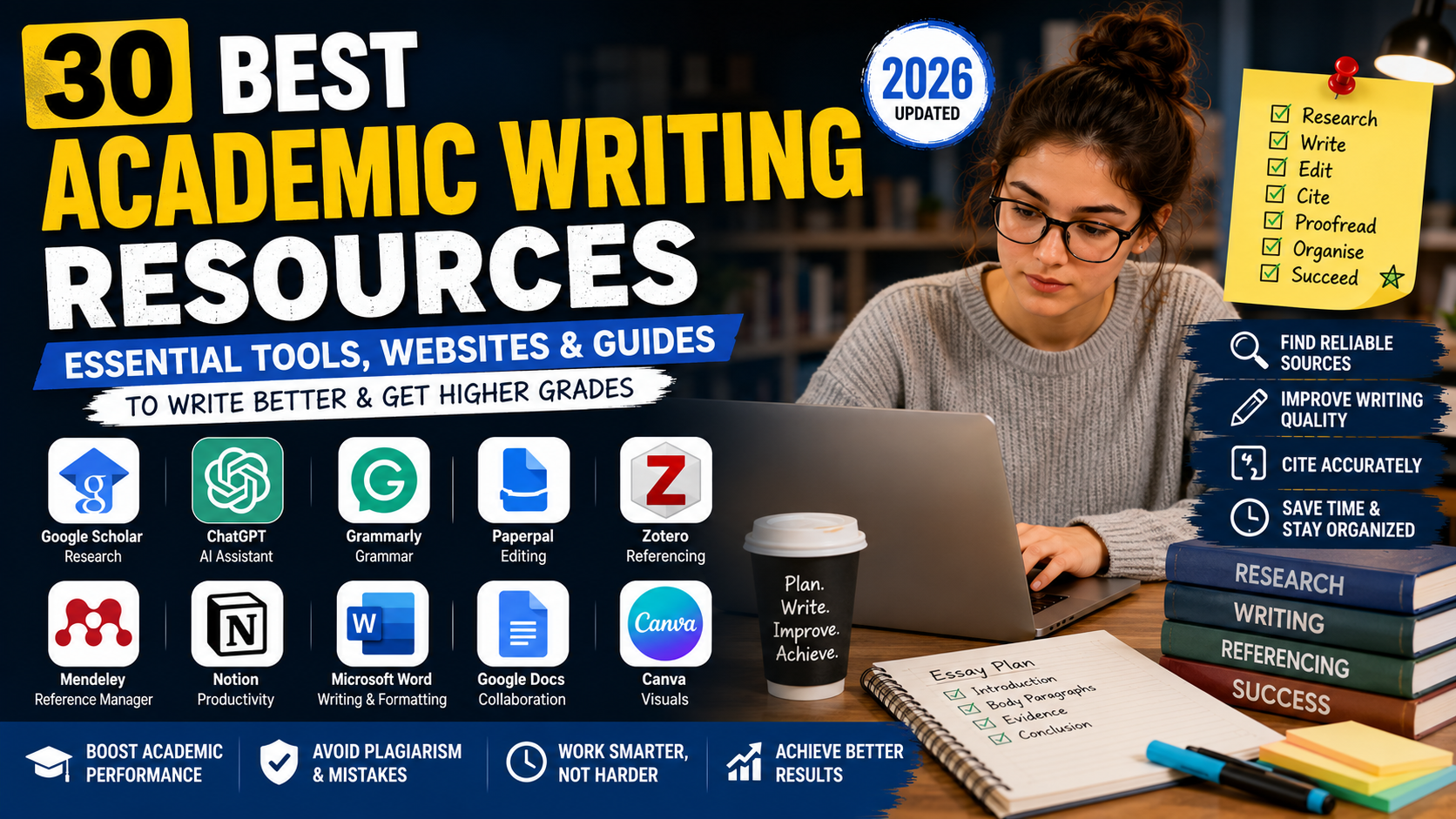
Fortunately, there are many high-quality academic writing resources that can help you improve your writing, strengthen your research skills, and avoid common mistakes.
This guide highlights the best academic writing resources available in 2026, covering writing guides, grammar checkers, referencing tools, research databases, AI assistants, note-taking apps, and productivity software.
Quick Comparison Table
Resource | Best For | Free Version | Best For |
|---|---|---|---|
Google Scholar | Academic research | ✅ | Finding scholarly articles |
ChatGPT | Brainstorming | ✅ | Explaining concepts |
Grammarly | Grammar checking | ✅ | Proofreading |
Paperpal | Academic editing | Limited | Research writing |
Zotero | Referencing | ✅ | Citation management |
Mendeley | Research library | ✅ | Organising papers |
Notion | Study planning | ✅ | Project management |
Microsoft Word | Writing | Paid | Formatting assignments |
Google Docs | Collaboration | ✅ | Group work |
Canva | Visual presentations | ✅ | Academic posters |
Why Academic Writing Resources Matter
The right resources can help you:
Improve academic writing skills
Develop stronger arguments
Find credible academic sources
Reference correctly
Avoid plagiarism
Save time during research
Improve grammar and clarity
Organise projects effectively
Best Research Resources
1. Google Scholar
Google Scholar is one of the best free academic search engines.
Best for:
Peer-reviewed articles
Conference papers
Books
Theses
Citations
2. Research Rabbit
Research Rabbit helps discover related academic papers through visual research maps.
3. Connected Papers
Ideal for literature reviews because it shows relationships between research articles.
4. JSTOR
A valuable source for journal articles, books, and primary academic materials across many disciplines.
5. PubMed
Essential for students studying medicine, nursing, healthcare, pharmacy, and life sciences.
Best Academic Writing Tools
6. Grammarly
Helps improve:
Grammar
Punctuation
Clarity
Tone
Readability
7. Paperpal
Designed specifically for academic writing and manuscript editing.
8. Microsoft Word
Still the most widely used software for university assignments because of its formatting, review, and citation features.
9. Google Docs
Excellent for collaborative writing and automatic cloud saving.
10. Hemingway Editor
Improves readability by identifying overly complex sentences and passive voice.
Best Referencing Resources
11. Zotero
Free reference manager supporting Harvard, APA, MLA, Chicago, and many other citation styles.
12. Mendeley
Combines citation management with PDF organisation and annotation.
13. Cite This For Me
Generates citations in multiple referencing styles. Always verify automatically generated references before submission.
14. Cite Them Right
A widely recognised referencing resource used by many UK universities to help students format citations correctly.
Best AI Resources
15. ChatGPT
Useful for:
Brainstorming ideas
Explaining theories
Creating outlines
Summarising concepts
Improving clarity
Always verify information and follow your university's AI policy.
16. Perplexity
Provides AI-assisted answers with linked sources for further reading.
17. Claude
Useful for analysing long documents, summarising research, and refining written content.
18. Gemini
Can assist with research planning, drafting ideas, and organising information.
Best Productivity Resources
19. Notion
Create study dashboards, assignment trackers, and dissertation timelines.
20. Todoist
Manage tasks, reminders, and coursework deadlines.
21. Trello
Organise projects using Kanban boards.
22. Forest
Encourages distraction-free study sessions using focus timers.
23. Clockify
Track time spent on research, writing, editing, and revision.
Best Note-Taking Resources
24. OneNote
Organise lecture notes, handwritten annotations, and research material.
25. Evernote
Store notes, PDFs, images, and web clippings in one searchable location.
26. Obsidian
Build interconnected research notes using linked knowledge graphs.
Best Visual Resources
27. Canva
Create:
Academic posters
Infographics
Presentation slides
Diagrams
28. Lucidchart
Design flowcharts, concept maps, and research diagrams.
Best Plagiarism & Originality Resources
29. Turnitin
Used by many universities to compare submitted work against extensive academic databases.
30. Copyscape
Useful for checking whether online content has been duplicated, particularly for web publishing.
How to Choose the Right Academic Writing Resources
Choose tools based on your needs:
Need | Recommended Resource |
|---|---|
Research | Google Scholar |
Grammar | Grammarly |
Academic Editing | Paperpal |
Referencing | Zotero |
Collaboration | Google Docs |
Productivity | Notion |
Focus | Forest |
Literature Reviews | Connected Papers |
AI Assistance | ChatGPT |
Time Tracking | Clockify |
Tips for Using Academic Resources Effectively
Use peer-reviewed sources whenever possible.
Verify AI-generated information with reliable academic references.
Check automatically generated citations carefully.
Organise research materials from the beginning of your project.
Follow your university's guidance on referencing and AI use.
Back up your work regularly using cloud storage.
Final Thoughts
The best academic writing resources combine reliable research databases, effective writing software, accurate referencing tools, and productivity apps. Rather than relying on a single tool, create a workflow that supports every stage of the writing process—from planning and research to drafting, editing, and proofreading.
Using trusted resources alongside your university's academic guidance will help you produce clearer, better-structured, and more credible assignments while developing valuable writing skills that extend beyond university.
Frequently Asked Questions
Everything you need to know about our services
Related Posts

Best Time Management Apps for Students (2026): 20 Apps to Study Smarter and Stay Organised

Best Apps for Dissertation Writing (2026): 25 Essential Tools Every Student Should Know
